



NXP Presents Easy-to-Use, High-Performance Crossover Solution
 Published2017.11.02 17:04
NXP Semiconductors has unveiled the i.MX RT series, a crossover solution that minimizes costs while simultaneously meeting superior performance and technology integration requirements.
The i.MX RT crossover processor maintains the superior performance and functionality of application processors while being easier to use than conventional microcontrollers and capable of performing deterministic operation in real time. Optimal application areas for i.MX RT include audio subsystems, consumer and healthcare, home and building automation, industrial computing, motor control, and power conversion.
The new crossover processor delivers a rich user experience (graphics, display, and audio) through high-level integration while simultaneously reducing system-level costs. With high-density SRAM and integrated DC-DC included, the i.MX RT delivers unprecedented price-to-performance value. Equipped with fast and secure external memory interfaces, there is no need to use embedded flash, thereby significantly reducing product costs and flash programming expenses.

EEMBC President Markus Levy stated, "Embedded designers are under pressure to balance performance and cost in their end products. i.MX RT represents remarkable progress in both performance and cost aspects, and is the result of NXP's practical understanding of market needs and resulting innovation. Through this innovative approach, NXP will transform thousands of embedded designs going into IoT applications."
The i.MX RT1050 is the highest-performance ARM Cortex-M7 based device that operates in real time while possessing application processor-level functionality. At 600MHz it is more than 50% faster than other Cortex-M7 products, and more than twice as fast as conventional Cortex M4 products. This superior performance combined with the Cortex-M7 core has enabled interrupt latency to be reduced to 20 nanoseconds. This is the lowest level among all ARM Cortex-based products worldwide. Additionally, integration of 512KB of TCM (Tightly Coupled Memory) SRAM ensures excellent real-time IoT application core performance.
Using an integrated DC-DC converter enables 2-4 times faster active power efficiency (CoreMark/mA) compared to third-party MCU solutions without requiring an external PMIC. The i.MX RT1050 achieves 110 mA/MHz (full operation), boasting 2-3 times superior performance compared to competing Cortex-M7 based MCUs.
The i.MX RT1050 provides enhanced GUI and HMI functionality along with various external memory interface options, further expanding design flexibility. Additionally, secure embedded design can be achieved through AES-128, HAB (High Assurance Boot), and on-the-fly QSPI flash encryption.
Geoff Lees, Senior Vice President and General Manager of NXP Microcontrollers, stated, "RT boasts overwhelming performance superior to any product currently on the market. Through this product, customers can implement application-level performance while maintaining their current toolchain and ecosystem. Additionally, LPC (low pin count) serial flash is much easier to program in the supply chain compared to various large package MCUs. Watch us—the race toward GHz Cortex-M has just begun."
Related news

NXP Establishes Partnership with AWS to Address IoT Security Issues
# Integration of Amazon Greengrass with NXP Gateway Platform NXP is entering into collaboration with Amazon Web Services (AWS) in the IoT sector. NXP has announced the integration of Amazon Greengrass with its Layerscape Intelligent Gateway platform. Amazon Greengrass is software that extends AWS cloud capabilities to local devices, enabling data collection and analysis closer to the point of information generation, and facilitating secure communication over local networks. This integration enables efficient security support for edge computing and Internet of Things (IoT) cloud interaction. This makes it possible to access world-class secure IoT anywhere—in homes, offices, and other business environments—while enhancing business agility. Going forward, the two companies plan to explore various collaboration opportunities ranging from product R&D, business development, to market expansion in the edge computing and cloud platform sectors, with the goal of securing IoT data through innovative collaboration. NXP's Intelligent Gateway Platform uses the company's core QorIQ Layerscape processor architecture. This processor family, in addition to advanced edge computing performance and security capabilities, seamlessly extends AWS cloud capabilities down to the device level, enabling real-time processing of information collected by internet users locally, as well as management, analysis, and permanent storage in the cloud. The Layerscape series processors are industry-leading ultra-compact, low-power products featuring high-performance 64-bit ARMv8 architecture. This product line includes single-core, dual-core, quad-core, and 8-core systems-on-chip (SoCs). Additionally, this processor family integrates powerful network, security, storage, and TSN hardware acceleration engines with programmable application interfaces. The Layerscape processor, which excels in high performance and low power consumption, has established itself as the preferred platform for SDN/NFV edge computing nodes as well as enterprise, industrial, and residential intelligent gateway devices. Qu Dajian, Marketing Director for Asia-Pacific Region, Digital Network Business Unit at NXP Semiconductors, stated, "NXP is committed to leading IoT industry advancement through innovation and collaboration. The integration of NXP Layerscape and AWS Greengrass not only effectively improves edge computing and cloud platform operations, but as IoT rapidly advances,
2017.07.31by 김지혜 기자
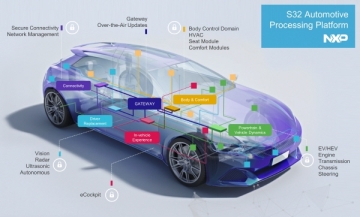
NXP Announces New Automotive Processing Platform S32
NXP Semiconductor announced the NXP S32 platform, a new control and computing architecture for future vehicles such as connected cars, electric vehicles, and autonomous vehicles.
2017.10.27by 명세환 기자

NXP Launches MCUs with Integrated NFC Technology
NXP Semiconductor has added the new LPC8N04 MCU to the MCU-based 32-bit ARM Cortex-M0+ LPC 800 series. The LPC8N04 MCU provides energy-harvesting functionality and an integrated near-field communication (NFC) interface. It is optimized to meet the surging demand for cost-effective, short-range bidirectional wireless communication.
2017.11.01by 김지혜 기자

Intel Unveils Next-Generation 'Core Ultra Series 3' and vPro Platform for Enterprise PCs
Intel has officially unveiled the "Intel Core Ultra Series 3" for next-generation enterprise PCs and the latest vPro platform, addressing a wide range of demands from enterprise notebooks to high-performance workstations.
2026.03.26by 배종인 기자
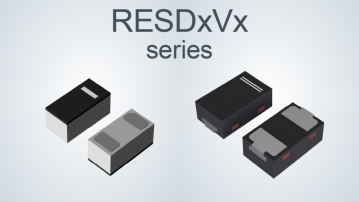
ROHM Launches ESD Protection Diode Compatible with High-Speed Interfaces of 10Gbps or Higher
Semiconductor specialist ROHM has developed the 'RESDxVx series' of ESD (electrostatic discharge) protection diodes capable of responding to next-generation high-speed data communication environments exceeding 10Gbps, simultaneously enhancing both signal quality maintenance required in high-speed interfaces and IC protection performance.
2026.03.26by 배종인 기자











