



SK Telecom Records Q3 Revenue Growth Driven by IPTV and LTE Subscriber Increases
 Published2017.11.07 16:09
SK Telecom announced that it recorded consolidated revenue of 4.4427 trillion won, operating profit of 392.4 billion won, and net income of 793 billion won for the third quarter of 2017 based on K-IFRS consolidated financial statements.
Revenue increased 4.7% year-over-year, driven by growth in wireless subscribers and major subsidiaries including SK Broadband and SK Planet. Operating profit declined 7.5% year-over-year due to increased marketing expenses and depreciation. Net income rose 146.2% year-over-year, influenced by improved equity method earnings from SK Hynix.
As of the end of Q3, SK Telecom's total subscribers reached 30.16 million, an increase of 705,000 compared to the same period last year, with LTE subscribers at 22.57 million, representing 74.8% of total subscribers.
SK Telecom's major consolidated subsidiaries are showing improving performance trends.
SK Broadband recorded revenue of 760.2 billion won, a 1.2% year-over-year increase, driven by net IPTV subscriber growth and increased paid content sales, achieving operating profit of 29.8 billion won. Additionally, the mobile media platform Oksusu added 630,000 subscribers in Q3, securing a total of 8.11 million subscribers, demonstrating growth in the media sector.

SK Planet recorded revenue of 285.1 billion won, a 5.8% year-over-year increase, bolstered by growth in 11Street. Notably, 11Street achieved 26% revenue growth year-over-year through efficient marketing. Additionally, SK Hynix recorded its highest quarterly performance, contributing to increased consolidated net income.
SK Telecom is strengthening its growth foundation in new business areas including AI, IoT, and autonomous driving.
First, SK Telecom integrated its AI platform NUGU into T Map and Kids Phone to enhance customer convenience, while accumulating more voice data. SK Telecom plans to advance voice recognition performance through accumulated data and introduce customized products and services to customers. Additionally, NUGU will be continuously linked with services SK Telecom possesses, including mobile communications, media, IoT, and commerce.
In the IoT sector, SK Telecom has partnered with approximately 30 construction companies and applied its smart home system to 13,000 households. Furthermore, SK Telecom is expanding its IoT ecosystem by integrating over 350 home appliances from 65 manufacturers with its smart home system.
Additionally, SK Telecom is jointly developing autonomous driving technology with domestic and international partners including NVIDIA. Notably, in September, SK Telecom successfully conducted autonomous vehicle test runs on the Gyeongbu Expressway section from Meeting Plaza to Suwon Singal interchange, establishing a foundation to advance core autonomous driving technologies such as 3D HD mapping and V2X.
SK Telecom's Head of Strategic Planning Ryu Young-sang stated, "Although challenging circumstances surrounding the communications market make it difficult to maintain growth momentum, we will strengthen competitiveness in key business areas to minimize negative impacts," adding, "In particular, we will secure mid-to-long-term growth engines in new business areas including AI, IoT, autonomous driving, and media."
Related news
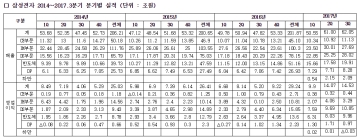
Samsung Electronics Reports Record Quarterly Earnings in Q3 2017
Samsung Electronics announced its third-quarter 2017 results with revenue of 62.05 trillion won and operating profit of 14.53 trillion won. Both revenue and operating profit represent record quarterly performance. Third-quarter revenue increased approximately 30% year-over-year due to continued strength in the memory market and expanded flexible OLED panel sales. Operating profit increased by 9.3 trillion won year-over-year as semiconductor business profitability improved and smartphone sales recovered. Quarter-over-quarter, revenue increased 2% and operating profit increased 0.47 trillion won. Component business performance improved significantly due to strong memory prices and expanded high-value-added LSI product sales. However, in the display business, despite expanded flexible OLED panel sales, results showed a slowdown quarter-over-quarter due to increased initial ramp-up costs at new production lines.
2017.10.31by 김지혜 기자

KT reports Q3 revenue of 5.8266 trillion won and operating profit of 377.3 billion won.
KT announced that on a consolidated basis, it recorded revenue of 5.8266 trillion won and operating profit of 377.3 billion won for the third quarter of 2017. Compared to the same period last year, revenue increased 5.4%, but operating profit declined 6.1% due to increased marketing costs and broadcasting development fund contributions. By service segment, sustained growth in the media and content sector stood out. The artificial intelligence TV 'GigaGenie,' which recently surpassed 300,000 subscribers, enhanced customer satisfaction with KT's media services and served as a foundation for the media and content segment to maintain double-digit growth rates compared to the same period last year. Total wireless subscribers increased by approximately 274,000 from the previous quarter as secondary device and Internet of Things (IoT) service subscribers steadily grew. However, wireless service revenue stood at 1.6634 trillion won, a 0.7% decrease from the same period last year, which was due to the exclusion of device insurance services and other items from revenue following changes in accounting treatment standards.
2017.11.01by 김지혜 기자

LG Uplus's operating profit increases thanks to stable growth in both wired and wireless businesses.
LG U+ disclosed that its operating profit for the third quarter of 2017 under Korean Adopted International Financial Reporting Standards recorded 214.1 billion won, a 1.3% increase compared to the same period last year, driven by stable growth in both wired and wireless businesses. Total revenue reached 3.05960 trillion won, up 11.8% compared to the same period last year and up 1.7% compared to the previous quarter. Operating revenue recorded 2.3772 trillion won, up 5.2% compared to the same period last year and up 1.9% compared to the previous quarter. Net profit for the period achieved 142.8 billion won, up 6.6% compared to the same period last year and up 4.8% compared to the previous quarter, due to decreased interest expenses resulting from debt repayment.
2017.11.03by 김지혜 기자
Nvidia invests $5 billion in Intel
NVIDIA and Intel, leaders in global AI computing technology, are now forging ahead in providing cutting-edge solutions through NVLink-based architecture integration. NVIDIA and Intel have officially announced a strategic partnership and stated that they will jointly develop customized data center and personal computing products to accelerate diverse applications and workloads ranging from hyperscale to enterprise and consumer markets, thereby laying the foundation for the next generation computing era.
2025.09.22by 배종인 기자
.jpg)
Applied Materials Launches Environmental Protection Campaign to Mark World Cleanup Day
Applied Materials Korea (CEO Park Kwang-seon) is carrying out environmental cleanup activities with employees and their families around the Dongtan Sinricheon area on the occasion of World Cleanup Day, evolving into a company that engages with the local community beyond technological innovation.
2025.09.22by 명세환 기자











