



Maxim launches security authentication device resistant to physical invasive attacks
 Published2017.11.21 17:16
Maxim Integrated Korea has launched the 'DS28E38' security DeepCover authentication device that is unaffected by physical invasive attacks. System design engineers can cost-effectively protect intellectual property and products through Maxim's solutions.
As cyber attacks consistently make news headlines, Internet of Things (IoT) devices have emerged as a security vulnerability. Cybersecurity Ventures forecasted global cybercrime damages in 2021 to reach $6 trillion. However, security design remains deprioritized. Most engineers view security implementation as a difficult and costly task requiring extensive time, and they rely on software for system protection. Some security integrated circuits (ICs) are subject to sophisticated attacks that steal encrypted keys and data.
The DS28E38 incorporates Maxim's 'ChipDNA'-based physical unclonable function (PUF) technology to resist invasive attacks. This is because ChipDNA-based root cryptographic keys do not reside in memory or other static states. Maxim's PUF circuit generates cryptographic keys based on random analog characteristics that naturally occur in basic metal-oxide-semiconductor field-effect transistor (MOSFET) semiconductor devices.
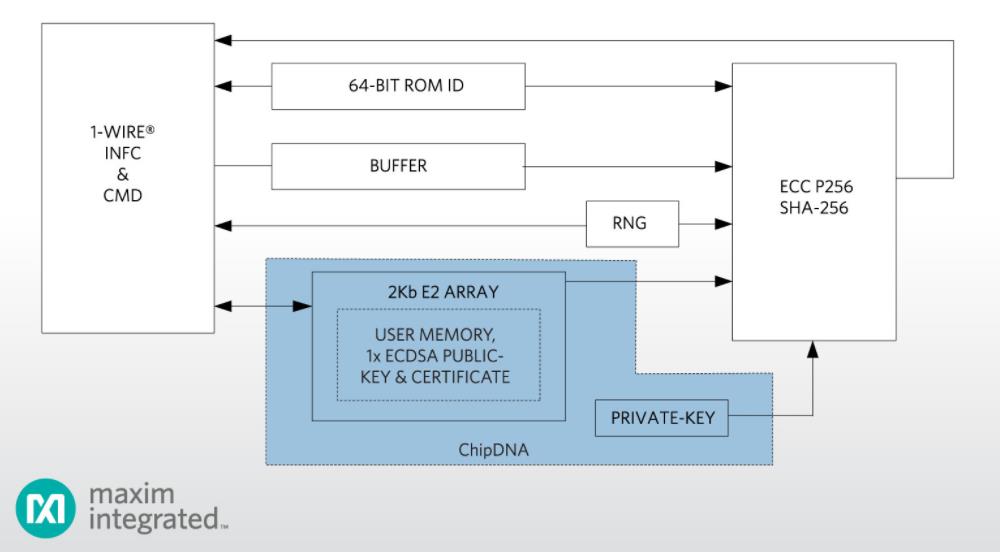
The circuit generates the device's unique key when needed, and the unique key disappears immediately when not in use. When subjected to physical invasive attacks, the DS28E38's sensitive electrical characteristics change, preventing additional security breaches. Additionally, since the security IC key is used directly in cryptographic operations, key management is simplified or becomes unnecessary altogether.
The ChipDNA circuit has demonstrated high stability regarding process, voltage, temperature, and aging, and has passed PUF output evaluation through the U.S. National Institute of Standards and Technology (NIST) random test suite for cryptographic quality assurance.
By using the DS28E38, anti-hacking functionality can be incorporated into the design from the beginning. The DS28E38 security authentication device can be easily integrated into customer designs at low cost through Maxim's single-contact 1-Wire interface combined with a simple fixed function instruction set that includes cryptographic operations.
Maxim's ChipDNA security cryptographic tool set provides robust security features including asymmetric (ECC-P256) ▲hardware engine ▲true random number generator (TRNG) ▲decrement-only counter with authenticated read capability ▲2KB security EEPROM (Electrically Erasable Programmable Read-only Memory) ▲64-bit ROM unique identification number.
Single-point operation is possible with 1-Wire, and device-level firmware development is not required. Simplified key management and free host system software tools enable cost-effective and easy implementation. A 5ppb PUF key error rate (KER) is achieved across time, temperature, and voltage, ensuring high stability.
Scott Jones, Senior Director of Embedded Security at Maxim Integrated, stated, "By designing hardware-based security in the early design phase, time, resources, and effort can be saved. Design engineers can apply the highest level of security to their products using the DS28E38 based on ChipDNA technology. It is impossible to steal keys that do not exist," he said.
Related news

Maxim launches converter tool to accelerate rapid development of power supply devices
Maxim Integrated Korea has launched the 'EE-Sim DC-DC Converter Tool,' which supports the rapid development of high-quality power supply devices. Powerful development tools are necessary to save time and resources during power design. Power designers can use the EE-Sim DC-DC Converter Tool to develop and simulate complex circuits more easily. Novice designers can complete designs in just a few minutes, while professional designers can visualize and control simulation parameters at an advanced level. The EE-Sim DC-DC Converter Tool recalibrates circuits according to components changed by the designer and compares and evaluates differences between designs. As a best-in-class waveform viewer, it allows users to explore simulation results and perform customized design, and can be utilized bidirectionally. The simple interface eliminates the need for training in customized design.
2017.09.06by 김지혜 기자
Solving wearable power issues with a compact battery-optimized solution.
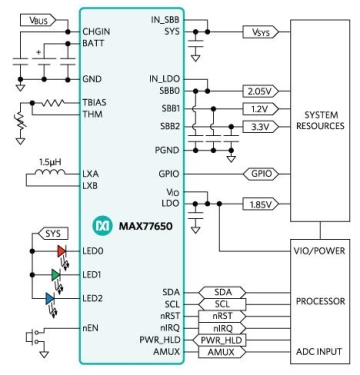
Wearable devices are being used for various purposes, such as smart belts that record daily activity levels and inform users about overeating, and wearable cameras that can be attached to bags or clothing to capture everyday photos. Additionally, as 'Hearable' products—wearables in the form of earphones inserted into the ear—have emerged, devices are becoming smaller and wireless in form. Since Hearable devices must accommodate various sensors such as accelerometers and heart rate sensors in a compact size, the internal components must also be miniaturized. Most PMICs for small lithium-ion battery-powered devices require current regulators such as boost, buck, LDO, regulator chargers, and LED indicators. In response, Maxim Integrated has launched the MAX77650 and MAX77651, which can be used in compact power solutions with a size of 19.2mm² or less—half or smaller than conventional PMICs. Both products are designed to suit low-power wearables where size and efficiency are critical. Both devices feature three independently programmable power rails on a single inductor and SIMO buck-boost regulation that minimizes overall solution size.
2017.09.29by 김지혜 기자
Maxim Solves Fast In-Vehicle Data Transmission with Serial Links
Last week, the 'Autonomous Driving Motor Show' held in Pangyo concluded. The event demonstrated how far autonomous driving technology has advanced, featuring autonomous vehicle test drives, synchronized driving, and obstacle races against human drivers. The pre-registered test drive sessions and obstacle races attracted numerous applicants. What is driving such widespread interest in autonomous vehicles among so many people? It is said that 94% of traffic accidents occur due to human negligence. Accordingly, there are expectations that the introduction of autonomous driving could reduce traffic accidents. Beyond this, liberation from driving would allow people to engage in other activities during travel time, enabling more efficient use of time.
2017.11.20by 김지혜 기자

Intel Unveils Next-Generation 'Core Ultra Series 3' and vPro Platform for Enterprise PCs
Intel has officially unveiled the "Intel Core Ultra Series 3" for next-generation enterprise PCs and the latest vPro platform, addressing a wide range of demands from enterprise notebooks to high-performance workstations.
2026.03.26by 배종인 기자

ROHM Launches ESD Protection Diode Compatible with High-Speed Interfaces of 10Gbps or Higher
Semiconductor specialist ROHM has developed the 'RESDxVx series' of ESD (electrostatic discharge) protection diodes capable of responding to next-generation high-speed data communication environments exceeding 10Gbps, simultaneously enhancing both signal quality maintenance required in high-speed interfaces and IC protection performance.
2026.03.26by 배종인 기자











