



The rapidly growing autonomous driving components market: Are there opportunities for domestic companies?
 Published2017.12.01 17:10
Fully autonomous vehicles won't be available until 2050. But by 2040, half of all cars on the road will be partially autonomous.
Fully autonomous vehicles are expected to be on the road by 2050, but autonomous driving technology is rapidly advancing. With 1.5 million people killed in traffic accidents each year, countries around the world are mandating safety regulations. Consequently, automakers are generating additional profits through services like autonomous emergency braking (AEB) and lane keeping.
According to Mirae Asset Daewoo, Level 3 partially autonomous vehicles are expected to enter mass production in 2020. Rather than abruptly transforming the industry, this is expected to be a period in which new technologies are integrated into the traditional automotive industry. The market for advanced driver assistance systems (ADAS) corresponding to Level 1 and 2 is expected to grow to $37 billion in 2021.
Companies ranging from automakers like BMW and Daimler to component manufacturers like Continental and Bosch, semiconductor companies like Intel, NXP, and Infineon, and IT companies like Google and Naver are competing for driving environment recognition technology, position sensor and direction technology, judgment technology, control technology, and interaction technology for autonomous vehicles.
With large corporations scrambling to prepare, what opportunities are there for latecomers?
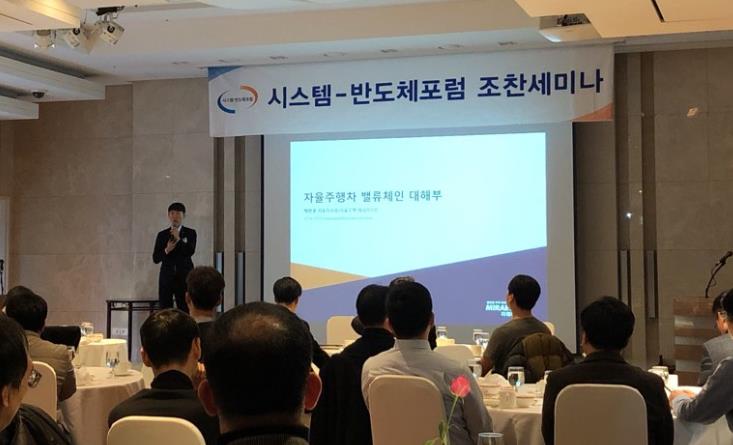
Park Hyeon-woo, an analyst at Mirae Asset Daewoo for automotive parts/autonomous driving, said, “The radar and camera sensor markets have already been formed and key players have been established, so it is difficult for latecomers to enter the market.” He added, “However, the LIDAR market has not yet opened, so there is an opportunity for latecomers to jump in,” and said that there are opportunities for small and medium-sized enterprises and startups as well.
Lidar is a sensor that measures distance by firing millions of laser beams per second and calculating the time it takes for them to return to the sensor. It boasts high precision and resolution, and can identify objects in three dimensions. It is a technology that can measure 360 degrees around a vehicle and provide accurate distance information in real time. Currently used Lidar is 2D scanning Lidar, but the market for 3D scanning Lidar, which can obtain precise 3D distance information, is expected to open soon. Partially autonomous vehicles scheduled for mass production in 2030 are expected to be equipped with Lidar in the front and radar in the rear.
The lidar released so far is expensive, costing up to 80 million won, so making it price competitive is a top priority. Analyst Park said, "In Israel, startups like Innobiz are entering the lidar market." In Korea, Jeongsang Lidar, Kanevicom, the Korea Electronics Technology Institute (KETI), and the Electronics and Telecommunications Research Institute (ETRI) are also developing lidar technology. The price per lidar module is expected to drop below $300 by 2020.
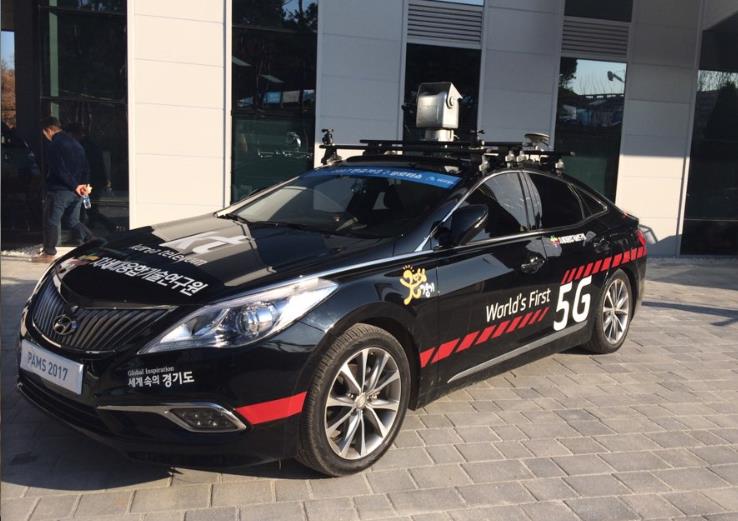
LiDAR chips are being developed by Infineon, NXP, and STMicroelectronics, and in Korea, Mando-Hella Electronics is close to commercializing them. Hyundai Mobis has yet to internalize the software and is targeting 2019.
High-precision digital maps (HD maps) are crucial for implementing Level 3 autonomous vehicles and enhancing safety. HD maps for ADAS provide three-dimensional information on all static driving conditions on the road with a precision of approximately 10 cm. To use these maps for autonomous driving, dynamic driving conditions within a 2-3 km radius must be added.
Among ICT companies, Google is leading the charge, followed by Apple, Alibaba, Tencent, and Uber, who are independently strengthening their mapping services. Among mapping companies, Here and TomTom are leading the pack. Both companies have released HD maps of US and German highways, comparable to those for ADAS, and are adding dynamic driving environment information.
Japan plans to commercialize HD maps in 2018 through cooperation between the government and the private sector's joint venture, the Dynamic Map Initiative (DMP). The technology to update maps with dynamic driving environment information in real time is being led by IT engineering companies.
We are collaborating with NVIDIA, Here, TomTom, Tesla, and others on technology, and Mobileye is also building technological partnerships with Here, BMW, GM, and others.
Analyst Park also forecasts that the market for driver-vehicle interfaces (HVIs), which allow humans to interact with machines, will grow to $2 billion by 2021. Key technologies include driver situational awareness, control transfer, multimodal input, augmented reality HUDs, and large displays, with Germany's Continental and Bosch and Japan's Denso preparing to dominate the market.
In addition, next-generation IVN-based DCUs, complex positioning modules, and V2X communication modules were cited as promising markets for autonomous vehicles. Analyst Park said, “With the advancement of autonomous driving technology, the overall opportunity market size is expected to grow from $12.2 billion in 2016 to $48.5 billion in 2021.” He added, “Although the market growth will not occur in the short term, there are ways for latecomers to cooperate with automakers in technologies that are being adopted as partial autonomous driving approaches.”
Comments
Related news
ETRI Increases Autonomous Vehicle Processor Cores to 9
The Electronics and Telecommunications Research Institute (ETRI) announced that it has developed a chip to process data collected from all sensors in autonomous vehicles. It is a processor chip that executes image recognition and control functions required by autonomous vehicles with low power consumption around 1 watt (W). This processor was named "Aldebaran" last year. It is one of the first-magnitude star designations. The core processor that determines autonomous vehicle performance had previously relied on overseas technology, but with domestication, there is no longer any need for overseas dependence. In this research, following last year, the field where performance was improved is that processor cores were increased from 4 last year to 9. As the number of processing cores increased, processing speed accelerated, enabling clearer and larger image implementation.
2017.09.21by 김지혜 기자
LG Electronics partners with Qualcomm to secure a leading position in the autonomous vehicle parts market
LG Electronics is moving to secure a foothold in the autonomous vehicle components market alongside Qualcomm, a leading company in mobile communication semiconductors. LG Electronics and Qualcomm held a "Next-Generation Connected Car Solution Joint Development Agreement Ceremony" at LG Science Park in Magok on the 19th. The ceremony was attended by LG Electronics CTO Division President Ahn Seung-kwon, Smart Business Division Vice President Kim Jin-yong, and Qualcomm Automotive Division President Nakul Duggal, among other representatives from both companies.
2017.10.20by 김자영 기자
Autonomous vehicle cooperating with road demonstrates driving test
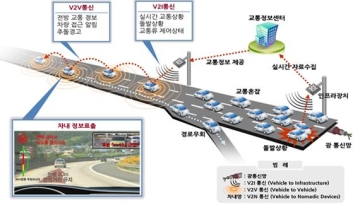
Autonomous vehicles will demonstrate 'cooperative autonomous driving' technology in Korea for the first time, in which vehicles communicate with road infrastructure or other vehicles and overcome dangerous situations independently. The Ministry of Land, Infrastructure and Transport will hold an international event demonstrating seven cooperative autonomous driving technologies at the Yeoju test road on the Jungbu Inland Expressway. The demonstration will be attended not only by domestic research teams and industry representatives, but also by government and industry officials from major developed countries including the U.S. Department of Transportation and the European Road Transport Telematics Organisation (ERTICO, Europe's intelligent transportation systems research and oversight agency).
2017.11.22by 김지혜 기자

[Technical Contribution] Caltera: "Evolution of Precision Sensing, UWB Infrastructure Enhances Parking Safety"
Discussing new possibilities in parking assistance and precision sensing with UWB, Lee Sang-min, Korea Branch Manager at Caltera.
2026.10.23by 편집부
Professor Jeong Gu-min from Kookmin University, "QNX RTOS will become an important foundational technology in the physical AI era"
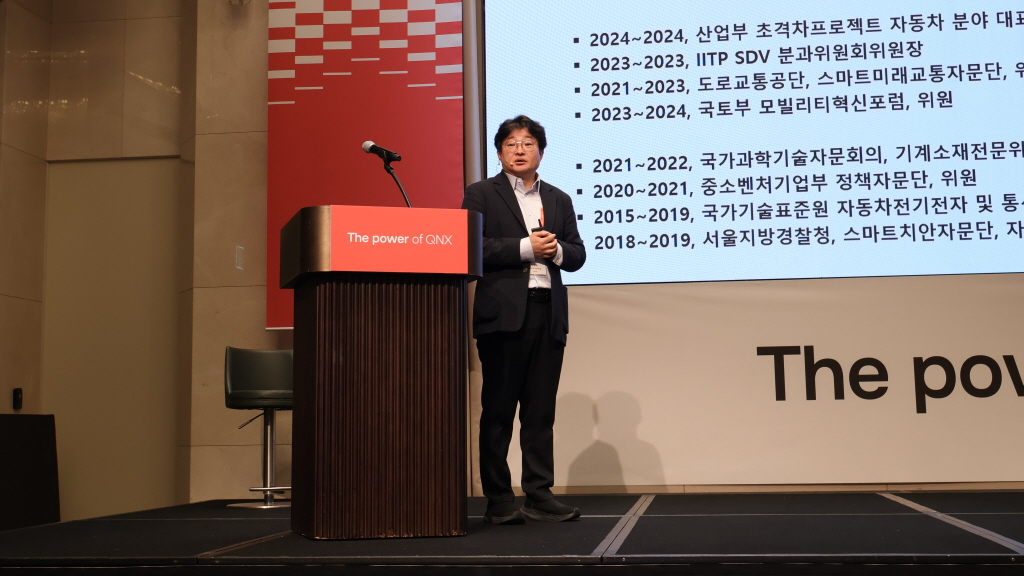
As software-defined vehicles (SDV) establish themselves as a new standard in the automotive industry, forecasts indicate that future competitiveness will be determined not by vehicle hardware but by software platforms and AI utilization capabilities. With the automotive industry rapidly transitioning to centralized architecture and AI-based development systems, an analysis suggests that how effectively vehicle platforms can be simplified and operated cost-efficiently will become core competitiveness for next-generation SDV and AI-defined vehicles. Professor Jeong Gu-min from Kookmin University emphasized at QNX TechForum Korea 2026 that "the automotive industry is now shifting from hardware competition to software ecosystem competition," highlighting that API-centric platforms and AI utilization will determine success or failure in the future automotive industry.
2026.10.23by 배종인 기자











