



Public Sector Must Innovate with Cloud Services
 Published2017.12.08 10:51
There are growing calls to adopt cloud technology in the public sector.
On the 6th, Vice Minister Kim Yong-soo of the Ministry of Science and ICT held the third '4th Empathy' at Naver Green Factory in Bundang, Gyeonggi-do, and discussed 'measures to promote the adoption of cloud in the public sector' with various public and private experts.
This event was organized to discuss the causes and alternatives for the slow pace of adoption in the field, as the government has continuously urged the public sector to adopt the private cloud following the enactment of the Cloud Computing Act in 2015.
The meeting was attended by about 30 experts, including members of the 4th Empathy Software (SW) Subcommittee, cloud companies, public institutions, academia, and associations, and was moderated by Noh Kyung-won, Director General of Software Policy at the Ministry of Science and ICT, and lasted for about two hours.
Prior to the discussion, Vice Minister Kim Yong-soo stated, “The paradigm of information resource utilization is rapidly shifting globally to a cloud-based approach,” adding, “As a core foundation of the Fourth Industrial Revolution, the cloud will drive innovation not only in the public sector but across all industries.”
Lee Woo-jin, Head of the Software Promotion Division at the Ministry of Science and ICT, introduced the government's cloud policy direction and presented various support programs, including the direction of ongoing cloud-related institutional improvements and leading projects for the public sector's use of private cloud services.
Lee Jae-ho, Head of the National Information Society Agency (NIA), shared opinions from public institutions and companies gathered through the operation of the NIA Public Cloud Support Center and consulting projects, and also introduced excellent adoption cases.
Many attendees expressed the opinion that while the government encourages public institutions to prioritize the use of private cloud services through laws and basic plans, there are no incentives for adoption and the usage procedures are cumbersome.
In particular, it was stated that under the current usage guidelines, the information resources of public institutions that can actually utilize private cloud services are extremely limited.
Furthermore, it was stated that although there are many public services in each local government that are convenient to use cloud services—such as regional festivals, community centers, lifelong education centers, facility corporations (parking, etc.), park management, and tourist information—there are limitations due to the lack of established guidelines or regulations for the use of private cloud services by local governments.
Meanwhile, public institutions pointed out that the procedures for using private cloud services are somewhat complex, and due to issues regarding budget items and execution methods for paying cloud usage fees, support for a distribution system suitable for cloud services (pay-as-you-go) is necessary, which differs from existing equipment or goods contracting methods.
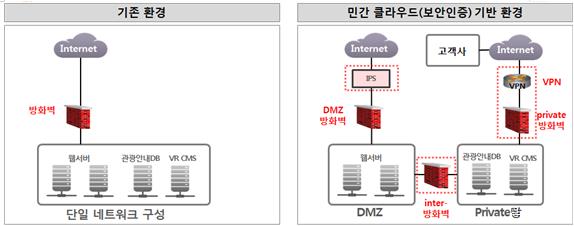
Lee Seon-woo, Head of KT’s Corporate Services Division, emphasized, “Cloud services provided to the public sector are safer than general systems because they are not only physically separated in accordance with government (Korea Internet & Security Agency) certification requirements, but also enable real-time monitoring and response to intrusion incidents by utilizing dual firewalls and further isolating critical information systems.”
Vice Minister Kim Yong-soo stated that he would pursue effective cloud policies that fully consider the voices of the field, such as preparing plans to promote cloud activation next year based on the discussions held today.
The Ministry of Science and ICT 201Based on the results of the 8-year demand survey and the survey targeting the public sector, we plan to continue discussing implementation measures with relevant ministries to expand the adoption of private cloud in the public sector, such as revising the guidelines for public institutions to use private cloud.
관련뉴스

Expanding the introduction of private cloud in the education sector, including elementary, middle, and high schools and universities
과학기술정보통신부는 교육 분야의 민간 클라우드 도입을 확대하고자 국내 9개 대학과 125개 초·중·고등 학교에 민간 클라우드 서비스를 보급한다고 밝혔다. 과기정통부는 한국정보화진흥원을 통해 지난 5월부터 전국 430개 대학을 대상으로 민간 클라우드 이용 희망수요를 받았다. 그 결과, 총 31개 대학기 신청하였으며 이 중 9개 대학을 지원 대상으로 선정하였다. 대학 민간 클라우드 이용 지원 대상 학교는 건국대, 경희대, 공주대, 동국대, 동서대, 서울대, 부산대, 세종대, 한동대이며 제공 서비스는 클라우드 기반 소프트웨어 교육, 수강신청, 글쓰기 첨삭지도, 이메일, 온라인 강의평가 등의 SaaS와 클라우드 기반 웹서비스를 위한 IaaS로, 학생과 교직원 약 6만 명이 서비스를 이용하게 된다.
2017.08.02by 김지혜 기자

LG유플러스, 클라우드 관제 시스템으로 드론 사업 진출 한다
LG유플러스가 관제센터에서 원격지에 있는 드론을 조종해 임무를 수행할 수 있는 ‘드론 관제 시스템’ 상용화를 밝히며 자율 비행 드론을 앞세워 드론 사업에 본격 진출한다. LG유플러스는 21일 서울 용산사옥에서 기자간담회를 열고, 통신망을 통해 비가시권이나 야간에도 안정적으로 재난감시, 측량, 물류수송 등에 드론을 사용할 수 있는 ‘U+ 스마트드론 클라우드 드론관제시스템’을 소개했다. 국토교통부는 11월 10일부터 ‘드론 특별승인제’를 도입했다. 이에 따라 안전기준을 충족하면 야간 시간대 비행과 육안 거리 밖 비행이 가능하다.
2017.11.21by 김지혜 기자
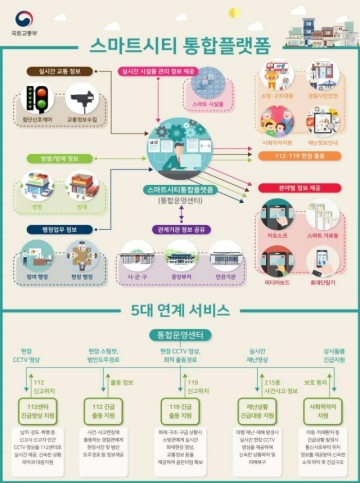
Signing of MOU to Establish Seoul City Urban Safety Network
The Ministry of Land, Infrastructure and Transport, the Ministry of Science and ICT, and the Seoul Metropolitan Government will sign a Memorandum of Understanding (MOU) on November 24 to establish a metropolitan urban safety network in Seoul by organically linking police, fire departments, and disaster centers. The specific cooperation details involve expanding and linking various information systems of Seoul (25 district offices), 112/119/disaster, and protection systems for socially vulnerable groups (children, elderly with dementia, etc.) by utilizing new technologies such as cloud and smart city solutions to dramatically shorten the golden time for protecting the lives and property of Seoul citizens in emergency situations. The Ministry of Land, Infrastructure and Transport will provide support for smart city integrated platforms and linked services for 112/119/disaster in Seoul, while the Ministry of Science and ICT will support business consulting, cloud-based various solutions, and demonstration projects.
2017.11.24by 김지혜 기자
.jpg)
SalePoint Signs Multi-Year Partnership Agreement with AWS… Promoting Identity Security that Integrates Even AI Agents
Sailpoint has entered into a multi-year strategic partnership agreement with AWS and is moving forward with establishing an integrated governance system that manages both human and non-human identities together. The plan is to consistently manage access permissions in an environment where AI agents are increasing as work execution entities, while applying the principle of least privilege and automated policy enforcement. The two companies plan to jointly expand capabilities to manage the identities of various entities, including AI agents, within a single layer in the AWS environment. This collaboration is interpreted as a move to design security and governance together in corporate environments where AI adoption is expanding.
2026.03.26by 배종인 기자
.png)
Databricks Unveils Open AI Security Monitoring 'Lakewatch'
Databricks entered the security market on March 24 by unveiling LakeWatch, an open-source agentic SIEM. The core functionality of this product is to integrate and analyze security, IT, and business data in a single environment to support AI-based threat detection and investigation. The company explained that it reduces the limitations of existing security operations centers, which have had to forgo some data due to high cost structures, and enables large-scale data analysis and automation based on open formats and ecosystems. LakeWatch is currently offered as a private preview, with Adobe and Dropbox mentioned as early customers. Databricks also announced an expanded partnership with Anthropic as well as the acquisition of Antimatter and SiftD.ai.
2026.03.26by 배종인 기자











