


Development of 'Real-Time Flex-Duplex' Technology Applicable to 5G Communication Systems Using NI Solutions
 Published2017.12.11 09:42
National Instruments announced that domestic research teams have developed 'Real-Time Flex-Duplex Radio' technology applicable to 5th generation (5G)/Beyond 5th generation (B5G) communication systems using NI solutions for the first time in the world.
The research team led by Professor Kim Sung-ryun and Professor Chae Chan-byung from Yonsei University showcased this real-time flex-duplex technology at the NI booth during 'IEEE GLOBECOM 2017' held in Singapore from December 4-8.
While millimeter-wave (28GHz, 37GHz, etc.) band technology is primarily expected to be utilized in 5G/B5G, sub-6GHz spectrum remains important. The Yonsei University research team successfully developed a frequency resource sharing-based real-time multilayer flex-duplex technology that senses existing radio conditions in the sub-6GHz spectrum to identify unused bands and flexibly utilizes multiple duplexing technologies such as Full-Duplex Radio and Half-Duplex Radio depending on circumstances.
For the demonstration, the research team transmitted sensed channel information to a remote server to generate a probabilistic map, and received the computation results back at the exhibition system to apply the flex-duplex technology. Notably, for this development and demonstration, the team used NI USRP-RIO for channel sensing, and NI PXI-based FlexRIO and NI 5791 transceiver for actual transmission and reception.
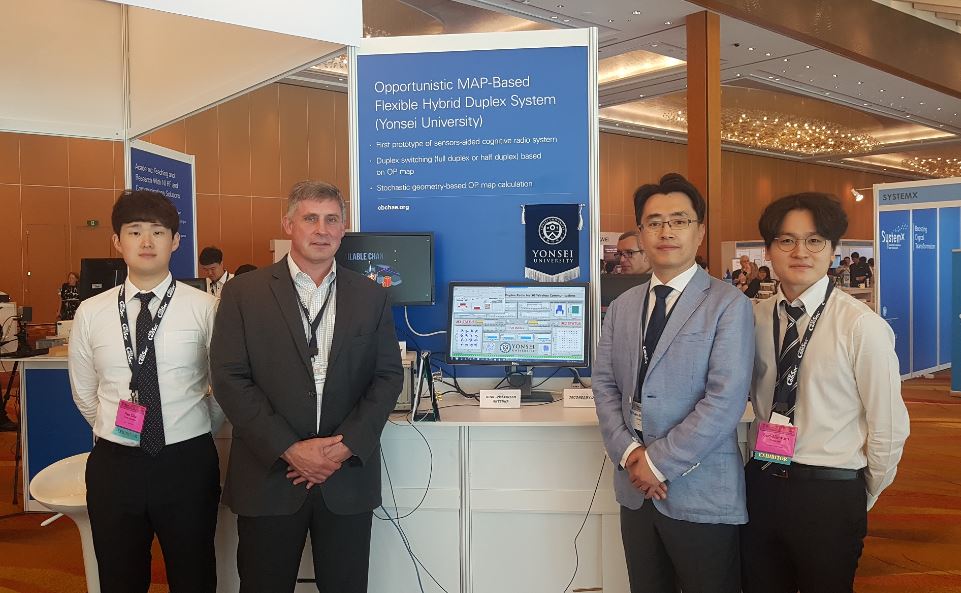
Through this real-time flex-duplex technology, the research team achieved network-level transmission rates up to twice as fast as conventional full-duplex technology. In other words, compared to the current half-duplex-based LTE system, a 4-fold speed was achieved without additional frequency allocation. This can reduce spectrum auction costs reaching trillions of won and bring us one step closer to 5G/B5G. Additionally, by combining multiple antenna technology with this, even faster transmission rates can be achieved. This technology development has laid the foundation for Korea to lead next-generation mobile communication standardization and advance-commercialize related technologies.
Professor Chae's research team is participating in NI's Lead User Program for the first time in Asia and has previously demonstrated in-real-time full-duplex technology in 2014, and real-time multi-antenna full-duplex technology jointly with LG Electronics for the first time in the world in 2015. Additionally, in 2016, they showcased wideband full-duplex technology and lens-based millimeter-wave technology. Meanwhile, at the GLOBECOM conference last week, Professor Chae's research team demonstrated low-loss high-gain RF lens antenna technology for millimeter-wave bands together with domestic company Sensorview (CEO: Kim Byung-nam).
Related news
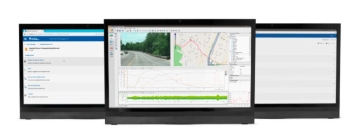
NI Releases Data-Verifiable Management Software
National Instruments announced the launch of its Data Management Software Suite. This enterprise software solution provides a complete workflow to standardize measurement data across all teams, mine data to obtain useful information, transform data through automated analysis, and deliver reports containing key insights. Dave Wilson, Vice President of NI Platform Software, stated, "The volume of data collected for device testing, physical asset monitoring, and product design analysis continues to grow explosively. As the amount of collected data increases exponentially, it is necessary to establish repeatable automated processes to derive critical insights. Since data inconsistencies and errors often lead to incorrect results, engineers must manually inspect and validate all data before sending it to manual or automated analysis processes."
2017.11.20by 김지혜 기자
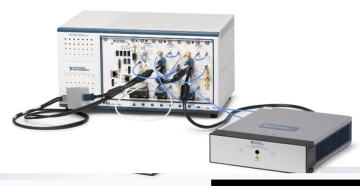
NI Launches Test System from Radar to ADAS
National Instruments announced the launch of a new Vehicle Radar Test System (VRTS). Using VRTS, engineers can test 76–81 GHz radar technology developed in R&D experiments for large-scale production testing, from individual radar sensors to advanced driver assistance systems (ADAS). VRTS is provided through NI Alliance Partners that offer advanced system integration and support. VRTS combines NI's mmWave front-end technology, PXI vector signal transceiver (VST), and application-specific software. Additionally, unlike conventional automotive radar simulators that can only generate static obstacles for functional operation testing, VRTS is equipped with a 76–81 GHz vector signal generator/analyzer designed for dynamic obstacle generation and comprehensive RF characteristic measurement.
2017.11.27by 김지혜 기자
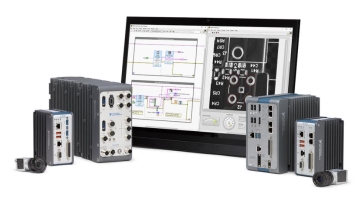
NI Launches IP67 Edge Node for Industrial IoT
National Instruments has announced the launch of the IC-3173 industrial controller, which carries an IP67 rating. The new controller is suitable for performing as an industrial IoT edge node without protective enclosures in non-particulate-generating manufacturing environments, test cells, outdoor settings, and other extremely harsh conditions. The IP67 rating, which complies with IEC standard 60529, ensures reliable operation even in dusty and humid environments. This industrial controller is a high-performance fanless device that delivers high-level processing capability and connectivity performance for automated image processing, data collection, and control applications in extreme environments. The fanless, rugged design is equipped with an Intel Core i7 dual-core processor up to 2.2 GHz, 8 GB DDR3 RAM, 64 GB storage, four PoE GigE ports, two USB 3.0 ports, and two DisplayPorts, while supporting up to IP67 rating reliability.
2017.12.06by 김지혜 기자
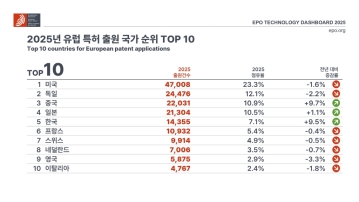
European Patent Applications Surpass 200,000 for the First Time… South Korea Maintains 5th Place, Led by Batteries and Telecommunications
According to the European Patent Office (EPO)'s 'Technology Dashboard 2025', European patent applications last year reached 201,974, surpassing 200,000 for the first time. Korean companies and inventors filed 14,355 applications, representing a 9.5% increase from the previous year and maintaining 5th place by country. Battery, digital communication, and semiconductor technologies led the growth, with Samsung ranking as the top EPO applicant for the second consecutive year and LG reaching 3rd place. The presence of major domestic cities such as Seoul, Suwon, and Yongin was also confirmed. It was also revealed that Korea's European patent strategy is expanding beyond individual technologies to span the entire industry.
2026.03.24by 명세환 기자

SK Telecom First Applies AI-Based Network Operations at Gwanghwamun K-Pop Concert
SK Telecom announced that it applied an AI-based network operation system for the first time at a large-scale K-pop concert held in the Gwanghwamun area of Seoul on March 21st, managing communication quality throughout the event. Mobile data usage during the three hours before and after the concert reached 12.15TB, approximately doubling compared to the same time slot the previous weekend. SK Telecom monitored traffic using the AI system 'A-One' in five-minute and 50-meter units to respond to potential overload situations, while also operating temporary communication facilities and on-site personnel in parallel. This case is interpreted as confirmation of the practical applicability of AI-based autonomous network operation in an environment where demand from dense events and foreign users increases simultaneously.
2026.03.23by 명세환 기자











