


ETRI, Chollian Satellite Communication Payload Achieves World-Class Level
 Published2017.12.14 11:13
Demonstrates Independent Development Capability of Communication Satellites, Bright Market Outlook
The Electronics and Telecommunications Research Institute (ETRI) announced that it has developed a communication payload—the core component of the Chollian satellite—and verified world-class technical excellence in performance through satellite control and other operations.
The research team has conducted satellite communication public services, satellite signal measurement, ground terminal testing, and satellite control over the past seven years.
The communication payload developed by ETRI operates in the Ka band, a high-frequency band of 20–30 GHz (gigahertz). The team developed three relay channels for communication and installed them on the satellite to provide satellite communication services.
The research team confirmed that the communication payload demonstrated superior performance and stability in satellite transmission output, reception sensitivity, and other performance metrics compared to leading commercial communication satellites worldwide. This served as a milestone in verifying Korea's independent technology development capability for communication satellites.
In particular, Chollian 1, as a public communication satellite, has been utilized free of charge by nine government agencies for Korea's security and public convenience, including ▲national emergency disaster communication (Ministry of the Interior and Safety) ▲weather data transmission (Korea Meteorological Administration) ▲marine observation data transmission (Ministry of Oceans and Fisheries) ▲military communication services (Ministry of Defense). In the case of KBS, a public broadcasting company, the Chollian satellite is being used for disaster test broadcasts from Hongdo Island in Shinan County, South Jeolla Province.
As such, communication satellites are critical national assets that cannot be dispensed with during emergency situations or disasters. If communication is disrupted due to war, there is no way to make phone calls or establish contact. Communication satellites play a unique role in responding when terrestrial communication networks are severed. Furthermore, beyond emergency communication, they are the only technology capable of providing nationwide Internet of Things (IoT) services and 8K-UHD services.
The Ka band satellite technology applied to Chollian 1 is next-generation core technology enabling broadband services such as 4K ultra-high-definition (UHD) television and high-speed internet. This latest frequency band technology is under competitive commercialization in the United States, Europe, and other regions.
To address the vulnerability of Ka band signals to rain attenuation, the research team developed adaptive modem technology that distinguishes between rainy and non-rainy conditions and automatically changes the signal to cope with rain attenuation.
Additionally, the research team redesigned the printed circuit board (PCB) within the payload using smaller semiconductor chips, improving stability and lifespan while reducing signal loss.
ETRI also developed second-generation ultra-compact satellite terminal (VSAT) technology for transmission and reception on the ground and from satellites. By utilizing ultra-compact satellite terminals to provide satellite communication services to public institutions such as the military, the Korea Coast Guard, and the Fire Department, the team verified that competitive broadband satellite services are possible with Ka band satellites.
The research team completed technology transfer of the developed second-generation ultra-compact satellite terminal (VSAT) technology to satellite communication equipment manufacturers NetCustomize and Asset. In the domestic satellite market, which has high dependence on foreign equipment, the team secured and successfully localized the entire satellite communication system technology, including Ka band communication repeaters.
The achievement is also significant in securing core technology for market entry into high-capacity satellite (HTS) payload markets led by developed countries such as the United States and Europe. Furthermore, communication satellites represent over 50% of the total global satellite market, presenting bright market prospects.
Lee Ho-jin, head of ETRI's Radio and Satellite Research Division, stated, "The United States, China, and Japan are utilizing space communication technology to pursue real-time information across the entire Earth from a space perspective, seeking market unification and market preemption from a global standpoint. Market preemption for clean internet in space utilizing the unique characteristics of space communication is accelerating, requiring preparedness."
The research team explained that while the recently launched Mugunghwa satellite is a communication satellite used for commercial satellite broadcasting communication, the Chollian 2A scheduled for launch next year is a satellite specialized for weather observation. Additional measures are needed to secure communication satellites for public purposes.
Ahn Myung-soo, CEO of NetCustomize, also stated, "The Chollian satellite industrial test bed established at ETRI provided infrastructure that domestic satellite companies can continuously utilize, and through this, we were able to successfully commercialize second-generation VSAT technology."
Related news
ETRI develops technology to create 360-degree VR content using smartphones
Domestic researchers have developed a technology that enables the creation of high-definition 360-degree VR (virtual reality) content using smartphones. ETRI (Electronics and Telecommunications Research Institute) has partnered with NextIon, a virtual reality solution provider, to develop and successfully commercialize YouVR technology, which enables the production of 360-degree VR content in a mobile environment without dedicated hardware. Users can download and utilize a dedicated app. Previously, producing 360-degree VR content required dedicated hardware such as a multi-camera rig—a device that precisely combines multiple cameras. Additionally, stitching software was necessary to connect photographs simultaneously captured by multiple cameras, as well as software to stitch and join multiple video frames together.
2017.11.10by 김지혜 기자
ETRI Approves International Standard to Promote Big Data Distribution
The Korea Electronics and Telecommunications Research Institute (ETRI) announced that it received approval for an international standard to promote the distribution and activation of big data at an International Telecommunication Union (ITU) standardization conference held in Geneva, Switzerland last month. The institute also announced that it achieved results by proposing and having two new agenda items adopted in the big data and cloud computing fields. ETRI explained that the 'Big Data Exchange Framework and Requirements (ITU-T Y.3601)' standard, which it has led development of for the past three years, received final approval at the Future Networks standardization research group (SG13) standardization conference. The standard was achieved with the participation of Lee Gang-chan, head of the Service Standards Research Department, and Ren Min-jiao, principal research engineer, since ETRI principal research engineer Ha Su-wook took on the role of editor starting in 2015.
2017.11.30by 김지혜 기자
ETRI Creates Smart Factories with NB-IoT
Domestic researchers have successfully applied mobile communication technology to smart factories, and this is expected to open the way for wireless remote control of factories in the future. The Electronics and Telecommunications Research Institute (ETRI) has successfully demonstrated industrial Internet of Things (IIoT) services by applying mobile communication technology to a smart factory production automation system for the first time in Korea. Until now, industrial sites such as factories have independently applied IT. Wired communication technology, which is widely used in factory operations, has higher reliability compared to wireless communication; however, it is not suitable for mobile operations, leaving room for improvement in wiring and safety. Therefore, there has been the inconvenience of having to completely reinstall the factory's wired communication infrastructure when rearranging the factory layout or moving machinery and robots in response to process changes.
2017.12.06by 김지혜 기자
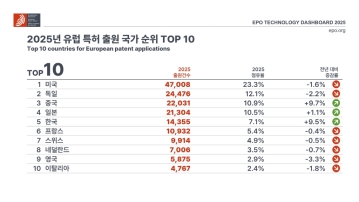
European Patent Applications Surpass 200,000 for the First Time… South Korea Maintains 5th Place, Led by Batteries and Telecommunications
According to the European Patent Office (EPO)'s 'Technology Dashboard 2025', European patent applications last year reached 201,974, surpassing 200,000 for the first time. Korean companies and inventors filed 14,355 applications, representing a 9.5% increase from the previous year and maintaining 5th place by country. Battery, digital communication, and semiconductor technologies led the growth, with Samsung ranking as the top EPO applicant for the second consecutive year and LG reaching 3rd place. The presence of major domestic cities such as Seoul, Suwon, and Yongin was also confirmed. It was also revealed that Korea's European patent strategy is expanding beyond individual technologies to span the entire industry.
2026.03.24by 명세환 기자

SK Telecom First Applies AI-Based Network Operations at Gwanghwamun K-Pop Concert
SK Telecom announced that it applied an AI-based network operation system for the first time at a large-scale K-pop concert held in the Gwanghwamun area of Seoul on March 21st, managing communication quality throughout the event. Mobile data usage during the three hours before and after the concert reached 12.15TB, approximately doubling compared to the same time slot the previous weekend. SK Telecom monitored traffic using the AI system 'A-One' in five-minute and 50-meter units to respond to potential overload situations, while also operating temporary communication facilities and on-site personnel in parallel. This case is interpreted as confirmation of the practical applicability of AI-based autonomous network operation in an environment where demand from dense events and foreign users increases simultaneously.
2026.03.23by 명세환 기자











