


7 Key Big Data Technology Predictions for 2018
 Published2017.12.20 11:33
MapR's Chief Application Architect Ted Dunning announced seven major big data technology trends and forecasts for 2018.
Innovation in analytics and big data management enables businesses to not only manage the rapid increase in data but also maximize its value. According to IDC, as the volume of data increases exponentially, the share of meaningful data will rise from 22% in 2013 to 37% in 2020.
1. Machine Learning Transforms from a “Technology Trend” to a “Technology Applied to Actual Business”
Machine learning is now expected to be increasingly utilized universally in business. As interest in machine learning grows alongside that in artificial intelligence (AI), its scope of application is expanding, delivering valuable insights to companies across various industries.
The most successful systems are likely to emerge when companies focus more on problems than on tools. It is crucial for companies to have practical goals, scale to access necessary data, and be prepared to ask the right questions for machine learning in order to establish realistic plans to apply machine learning results to actual business operations.
2. 90% of machine learning success is the execution plan (not the algorithm or model).
Effectively managing data is crucial for successfully using machine learning. Data management serves as the foundation for the entire lifecycle, ranging from utilizing input data for machine learning model development to the ongoing maintenance required for operations. Through effective architecture and strategic planning, it will become possible to manage everything at the platform level rather than the application level across various systems based on multiple machine learning tools. In other words, there will be no need to devise a new execution plan for every new project. As such, the importance of efficient machine learning execution planning is steadily increasing. Furthermore, the demand for stream-based architectures and global data fabrics will grow across the entire organization.
3. Laying the foundation for building a multi-cloud environment through the rapid adoption of Kubernetes
While it is predicted that Kubernetes will succeed, the pace of its adoption is already accelerating, so this can be considered the current state of the market rather than a prediction.
Many companies still perceive Kubernetes as a tool for managing and orchestrating computing within the cloud. However, within the next year, Kubernetes will be increasingly used by advanced enterprises seeking to manage and orchestrate computing across all cloud environments, including private and public ones. On-premises computing is evolving very rapidly toward container and orchestration methods.
4. Big Data Systems as a Core Element of an Enterprise (Implementation of Global Data Fabric)
In the past, big data and developed projects were separated, but now big data has become a major corporate asset, and companies are approaching their businesses in a data-centric manner. These changes enable big data systems, encompassing data scale, storage, operations, and analytical access, to become a core element of the enterprise. Businesses will find ways to break down silos and take a comprehensive approach to data through numerous sources to implement a global data fabric capable of computing for true multi-tenant systems.
5. Combine data flows into a data fabric
In 2018, more companies will come to view computing not simply as data residing in databases, but as data flows. Data flows collect key business events and replicate business structures. Integrated data fabrics will serve as the foundation for developing large-scale flow-based systems. Specific fabrics will support various types of computing to enable utilization in multiple contexts. Increasingly, databases will play the role of collaborators and complements to data flows. A new trend in 2018 is to implement data fabrics that provide both unused and in-use data for multi-cloud computing using tools such as Kubernetes.
6. DataOps, a key organizational approach to enhancing agility
Traditional DevOps teams, comprising data scientists and data-driven developers, will transform into DataOps teams. This provides enhanced communication, accelerated goal achievement through collaboration that transcends departmental roles, reduced time to value, and high agility. Managing work in a DataOps format enables the capability to respond to changing environments and take appropriate actions in a timely manner. This enables the flexibility and efficiency to reap the benefits offered by new technologies and architectures.
7. Expansion of IoT Edge
In 2018, not only will companies transitioning data fabric and computing from on-premises to multi-cloud environments, but now, with a maximally scalable data fabric, they will be directly connected to the edge at the location closest to the device or have the data fabric installed on the device.
Ted Dunning, MapR’s Chief Application Architect, stated, “The 2018 technology outlook is based on practical approaches to addressing data-related challenges and insights gained while supporting enterprises in achieving business innovation.” He added, “A recurring issue among companies when adopting new technologies is the desire to implement them efficiently without excessive costs. MapR’s Data Fabric supports customers in achieving innovation while simultaneously reducing the costs of legacy systems.”
관련뉴스
In what direction will future sensors be developed?
빅데이터, 인공지능(AI), 사물인터넷(IoT), 자율주행차 등 4차 산업혁명을 이끌 것으로 기대되는 기술들의 기반에는 센서가 있다. 특정 대상에서 선택적으로 정보를 수집하는 역할을 하기 때문이다. 감지뿐 아니라 정보를 처리하고 통신 기능이 하나로 통합된 지능형 센서인 첨단 센서에 대한 관심이 커지고 있다. POSRI 리포트에 따르면 센서 시장은 스마트카와 스마트폰을 주축으로 전 분야에서 수요가 늘어날 것으로 예상한다. 일반 핸드폰 한 대에서 이미지와 음향 센서 2가지만 사용했던 것이 스마트폰에서는 한 대에 20여 개 이상의 센서가 사용되고 있다. 이에 따라 2025년경에는 센서 1조 개 시대가 올 것이라고 보고 있다. 첨단센서 시장도 2010년 19%였던 것이 2020년에는 49%까지 비중이 증가할 것으로 전망된다. 한국산업기술평가관리원 손광준 PD는 “이전에는 정보통신이나 자동차 산업에서 반도체나 MEMS센서가 주로 쓰였다면 지능형 첨단센서의 시대가 오면 로봇, 자동차, 의료, 환경, 에너지 산업 등 사용되는 시장 자체가 커질 것”이라며 4차 산업혁명의 핵심분야별로 센서의 개발방향에 대해 설명했다.
2017.11.13by 김지혜 기자
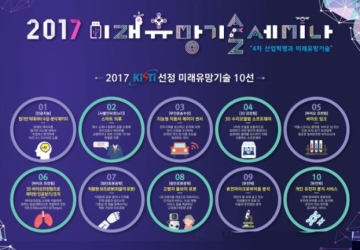
10 Things Small and Medium-Sized Enterprises Should Commercialize in the Fourth Industrial Revolution
빅데이터, 자율주행차, IoT, 인공지능까지 4차 산업혁명을 이끌 기술들은 많다. 4차 산업혁명을 준비해야 한다는 목소리는 높지만, 막상 어떤 아이템이 사업화에 적합한지는 모호하다. 이에 한국과학기술정보연구원(KISTI)은 4차 산업혁명에 대응하기 위해 중소기업들이 주목해야 할 사업화 아이템을 제시했다. 벤처캐피털 투자데이터, 시장데이터, 기술 트렌드 등을 기반으로 중소기업에 적합한지, 시장성이 있는지, 기술개발이 가능한지, 시장파급 효과가 높은지 등을 분석해 11개 분야에서 50개 기술을 선정했다. 이 중 유망사업화 아이템 10선을 소개한다.
2017.11.24by 김지혜 기자

ETRI Approves International Standard to Promote Big Data Distribution
The Korea Electronics and Telecommunications Research Institute (ETRI) announced that it received approval for an international standard to promote the distribution and activation of big data at an International Telecommunication Union (ITU) standardization conference held in Geneva, Switzerland last month. The institute also announced that it achieved results by proposing and having two new agenda items adopted in the big data and cloud computing fields. ETRI explained that the 'Big Data Exchange Framework and Requirements (ITU-T Y.3601)' standard, which it has led development of for the past three years, received final approval at the Future Networks standardization research group (SG13) standardization conference. The standard was achieved with the participation of Lee Gang-chan, head of the Service Standards Research Department, and Ren Min-jiao, principal research engineer, since ETRI principal research engineer Ha Su-wook took on the role of editor starting in 2015.
2017.11.30by 김지혜 기자
.jpg)
SalePoint Signs Multi-Year Partnership Agreement with AWS… Promoting Identity Security that Integrates Even AI Agents
Sailpoint has entered into a multi-year strategic partnership agreement with AWS and is moving forward with establishing an integrated governance system that manages both human and non-human identities together. The plan is to consistently manage access permissions in an environment where AI agents are increasing as work execution entities, while applying the principle of least privilege and automated policy enforcement. The two companies plan to jointly expand capabilities to manage the identities of various entities, including AI agents, within a single layer in the AWS environment. This collaboration is interpreted as a move to design security and governance together in corporate environments where AI adoption is expanding.
2026.03.26by 배종인 기자
.png)
Databricks Unveils Open AI Security Monitoring 'Lakewatch'
Databricks entered the security market on March 24 by unveiling LakeWatch, an open-source agentic SIEM. The core functionality of this product is to integrate and analyze security, IT, and business data in a single environment to support AI-based threat detection and investigation. The company explained that it reduces the limitations of existing security operations centers, which have had to forgo some data due to high cost structures, and enables large-scale data analysis and automation based on open formats and ecosystems. LakeWatch is currently offered as a private preview, with Adobe and Dropbox mentioned as early customers. Databricks also announced an expanded partnership with Anthropic as well as the acquisition of Antimatter and SiftD.ai.
2026.03.26by 배종인 기자











