



Supporting the Fourth Industrial Revolution through Researcher-Centered R&D
 Published2018.01.05 16:13
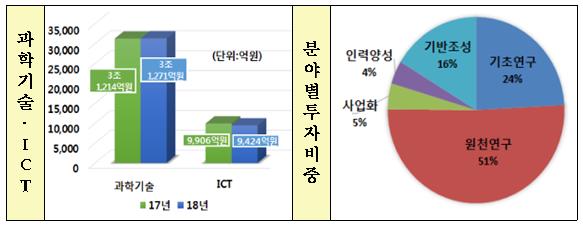
The Ministry of Science and ICT has finalized and announced the "2018 Comprehensive Implementation Plan for Science, Technology, and ICT R&D Projects" with a total scale of 4 trillion 695 billion won.
The comprehensive implementation plan targets 3 trillion 1,271 billion won in science and technology fields and 942.4 billion won in ICT fields, excluding the National Research Council of Science and Technology and research operation expenses of directly affiliated research institutes from the Ministry's total R&D budget of 6 trillion 9,670 billion won. It includes △basic research (982 billion won), △original source research (2,075.8 billion won), △R&D commercialization (183.1 billion won), △human resource development (164.7 billion won), and △R&D infrastructure establishment (663.8 billion won).
The "2018 Comprehensive Implementation Plan for Science, Technology, and ICT R&D Projects" aligns with recent science, technology, and ICT policies such as "R&D Project Planning/Selection/Evaluation/Compensation Process Innovation Plan" and "Fourth Industrial Revolution Response Plan," and aims to strengthen the role of science, technology, and ICT across all areas of social issues including disaster, safety, and environment. The main contents focus on △researcher-centered challenging and creative R&D innovation, △fourth industrial revolution response and fostering innovative growth engines, and △R&D strengthening for solving social problems and job creation.
Researcher-Centered Challenging and Creative R&D Innovation
To expand research opportunities based on researcher ideas and encouraging challenge and creativity, 971.8 billion won—an increase of 89.6 billion won compared to the previous year—will be invested in free-competition basic research. Support for early-career and female researchers will be strengthened through relaxing eligibility requirements for first-time researcher support, establishment of new innovative laboratories (52.5 billion won), and expanded support for female scientists and engineers ('17: 14.7 billion won → '18: 16.9 billion won).
ICT field R&D will also be innovated with a researcher-centered approach. For university small-scale projects under 100 million won, grant-type R&D that maximizes researcher autonomy will be implemented in earnest, including exemption from interim evaluation and self-accounting. To activate sustainable long-term research, existing university specialized research facilities will be expanded and reorganized into university and research institute specialized research facilities.
Additionally, for creative and challenging projects, the success/failure rating system will be abolished. To reduce evaluation burden, multi-year projects with blanket agreements and projects in their first year of implementation will adopt consulting methods instead of annual evaluation.
Strengthening R&D for Innovative Growth Support and Fourth Industrial Revolution Response
To support innovative growth, investment in future-promising original technology development will be expanded. In key leading areas of the bioeconomy era such as new drugs, medical devices, emerging infectious disease response, and brain research, 349 billion won—an increase of 20.7 billion won compared to the previous year—will be invested. For climate change response, 87.2 billion won will be invested in core technology package development ("Climate Industry Promotion Model") and carbon resource recycling that produces high-value-added products from greenhouse gases.
To prepare for the era of ultra-high speed, large capacity, and low power consumption, 84.4 billion won will be invested in nano field leading research and securing innovative material base materials. For advanced convergence research including land/sea/air unmanned mobility common technology (17.6 billion won) and high-risk/high-value convergence original technology (future leading technology development, 4.6 billion won), 44.7 billion won will be invested. Additionally, 350.2 billion won will be invested in space technology independence including Korean-type launch vehicle, lunar exploration, and satellite development, and 209.1 billion won will be invested in the nuclear energy field centered on public safety and life.
Furthermore, to respond to the fourth industrial revolution, strategic and intensive investment will be made in intelligent technology and convergence-based technology. New R&D will be promoted for blockchain (4.5 billion won), which is the foundation of trust in intelligent information society, and next-generation ultra-small IoT (4.7 billion won) used in precision monitoring across various fields such as environment, disaster, hazards, and facilities. Continuous development of core technologies for fourth industrial revolution response will be promoted, including 5G convergence services and Beyond 5G for post-5G mobile communication, human-machine collaboration, AI-based data analysis and management, and holographic reality (HR) for realizing user-friendly immersive content services across all industrial sectors including automobiles, education, and manufacturing.
Solving Social Problems and Creating Jobs through R&D
To fundamentally solve social problems that threaten public health and safety, a new R&S (Solution)D system will be implemented full-scale as national living research.
A system will be established including total solution-type R&D planning (technology development + service delivery + system improvement), emergency response research system, and expanded public participation (national living science advisory panel, etc.). A total of 16.4 billion won will be invested, including new initiatives such as law enforcement field-customized technology development ("Police Lab," 1.4 billion won) and multi-modal recognition technology development for identifying missing children and others (2 billion won).
In addition, linked with the fourth industrial revolution response plan, ICT R&D for solving social problems in six sectors—cities, transportation, welfare, environment, safety, and national defense—will be expanded.
To expand technology commercialization and job creation, five new science and technology-based job-focused universities will be selected (1.6 billion won), and university technology liaison offices and university technology holding companies will be supported for linkage (university TMC) to strengthen university technology commercialization capabilities.
For ICT R&D, companies with excellent employment records will receive preferential treatment in selection and evaluation, and incentives will be provided when SMEs and mid-sized companies conducting R&D newly employ young research personnel (ages 18-34), with plans to gradually reform toward employment-friendly initiatives.
R&D Ecosystem Advancement
Centered on special development zones, organic linkage among projects supporting "public technology transfer (investment) → commercialization → startup/growth support → overseas expansion support" will be strengthened. A region-led R&D system will be established that enables regions to autonomously plan and conduct R&D strategically needed based on regional demand (new "region-demand-customized R&D support" project, 7.5 billion won).
Meanwhile, to activate open innovation in SMEs, the scope of institutions providing R&D services through "ICT R&D Voucher" will be expanded from non-profit institutions (universities, research institutes, specialized research centers, etc.) to private R&D companies. A "standardization voucher" project (1.1 billion won) will be newly introduced, providing vouchers to SMEs and mid-sized companies lacking standardization capabilities and designating external standardization specialist organizations to commission standard development.
Additionally, R&D projects for international cooperation will be intensively identified to participate in solving humanity's common problems such as infectious diseases, fine dust, water scarcity, and disasters based on science, technology, and ICT. Through cooperation such as Korea/China/Japan collaboration (aging, energy, etc.) and inter-Korean cooperation (Mount Baekdu volcano, etc.), the message of "contributing to improving inter-country relations through science diplomacy" will be highlighted.
Related news
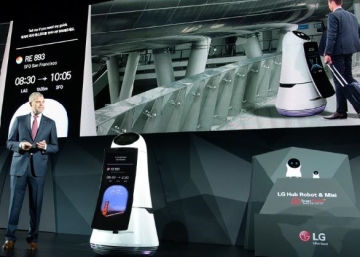
This year's government R&D will focus on investing in AI, IoT, and other areas to prepare for the Fourth Industrial Revolution.
The Ministry of Science, ICT and Future Planning and the Ministry of Trade, Industry and Energy held a briefing to announce their confirmed R&D investment strategy for this year. The Ministry of Science, ICT and Future Planning projects that the global ICT market will grow 2.9% this year, with software and IT services expected to grow centered on advanced and emerging countries. In particular, ICBM sectors such as IoT, cloud, and big data are expected to achieve high growth for two consecutive years due to expanded market demand. According to market research organizations, IoT is projected to increase 35.1%, cloud 18.2%, big data 32.6%, and mobile is expected to grow with smartphones and tablets at 6.1% and 3.2% respectively.
2017.01.23by 신윤오 기자
Making it the 'standard' for a sustainable future society
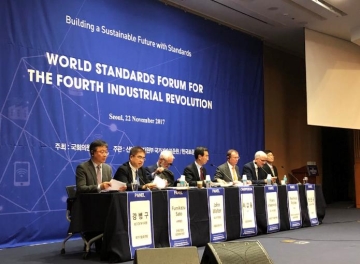
"International standards are necessary to minimize uncertainty in the Fourth Industrial Revolution, where boundaries across all physical and digital fields are becoming blurred." The pace of the Fourth Industrial Revolution is advancing faster than any previous revolution. Beyond the positive aspects of technological advancement, changes are occurring in unpredictable areas, including negative aspects such as social inequality and intensifying polarization. In this uncertain environment, the role of standards is to ensure interoperability and provide certainty. There are opinions that decentralized standardization systems need to be innovated and measures must be established to link R&D with standardization. Accordingly, the 'Fourth Industrial Revolution International Forum' was held under the sponsorship of Member Kim Tae-nyeon and the Korean Standards Association. Panel discussions were conducted on topics including standard policy for sustainable society, innovation of standardization systems, and standard-based smart cities.
2017.12.08by 김지혜 기자
Nvidia invests $5 billion in Intel
NVIDIA and Intel, leaders in global AI computing technology, are now forging ahead in providing cutting-edge solutions through NVLink-based architecture integration. NVIDIA and Intel have officially announced a strategic partnership and stated that they will jointly develop customized data center and personal computing products to accelerate diverse applications and workloads ranging from hyperscale to enterprise and consumer markets, thereby laying the foundation for the next generation computing era.
2025.09.22by 배종인 기자
.jpg)
Applied Materials Launches Environmental Protection Campaign to Mark World Cleanup Day
Applied Materials Korea (CEO Park Kwang-seon) is carrying out environmental cleanup activities with employees and their families around the Dongtan Sinricheon area on the occasion of World Cleanup Day, evolving into a company that engages with the local community beyond technological innovation.
2025.09.22by 명세환 기자
.jpg)
The combination of electrical and electronic technologies like AI, semiconductors, and electric vehicles with renewable energy will determine industrial competitiveness.
Professor Lim Chun-taek from Gwangju Institute of Science and Technology (GIST) stated in his keynote speech at the '2025 e4ds Tech Day' on the 9th, "Global energy investment is already shifting from fossil fuels to renewable energy, and the trend of electrification combined with electrical and electronic technologies is changing the industrial landscape."
2025.09.12by 배종인 기자











