



LONGi Solar achieves photoelectric conversion efficiency of 20.41% to meet photovoltaic market demand
 Published2018.02.02 10:21
Supporting development benefits for PV investors and environmental protection
Committed to adopting new module technologies for grid parity
LONGi Solar announced that according to TUV-SUD test results, its 60-cell PERC module achieved a photoelectric conversion efficiency of 20.41%.
The tested product is a P-type monocrystalline PERC module that realizes conversion efficiency reaching up to 20.41% based on efficient PERC cell technology and design.
As demand for solar modules with high conversion efficiency has recently increased in the photovoltaic market, technologies supporting high efficiency are advancing. In the Chinese market, competition to increase photoelectric conversion efficiency is intensifying through application and technology "top runner" project sponsorship.
LONGi Solar President Li Wenxue stated, "Our monocrystalline PERC module represents a major breakthrough in the efficiency sector," and added, "Through continuous technological innovation, we plan to launch more efficient monocrystalline module products, thereby supporting PV investors in gaining greater development benefits and contributing to efforts to protect clean water and blue skies."
.jpg)
Last October, LONGi Solar announced in Beijing that according to test results from Germany's Fraunhofer ISE CalLab, its monocrystalline PERC cell achieved a photoelectric conversion efficiency of 22.71%, setting a world record at that time.
LONGi Solar introduced 22% efficiency PERC cell technology at its production facilities to mass-produce PV products that meet the technical standards defined by the "top runner." LONGi Solar is also focusing on power generation. Additionally, to create greater value for the PV application market and accelerate the arrival of grid parity, the company plans to commit to adopting new module technologies in 2018.
Related news
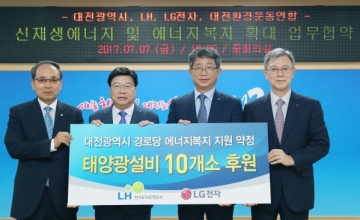
LG Electronics Provides Small-Scale Solar Power Generation Equipment to Vulnerable Groups
LG Electronics is moving forward with welfare provisions utilizing solar power generation technology for energy-vulnerable households. On the 7th, LG Electronics signed a memorandum of understanding (MOU) for "energy vulnerable group social contribution activities" with Daejeon City, LH Corporation, and the Daejeon Environmental Movement Association at Daejeon City Hall in the afternoon. LG Electronics Energy Business Center President Lee Sang-bong, Daejeon City Mayor Kwon Sun-taek, LH Corporation President Park Sang-woo, and Daejeon Environmental Movement Association Chairman Heo Jae-young attended, and all parties agreed to actively cooperate in expanding renewable energy supply and energy welfare for energy-vulnerable groups.
2017.07.10by 김자영 기자
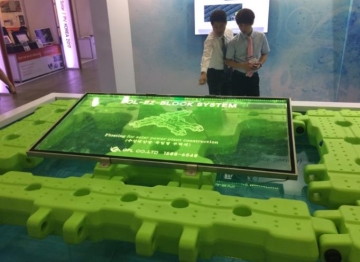
[Photo News] Park Chairs Transform into Solar-Powered Smart Benches
From September 6 to 8, the '2017 World Solar Energy Expo' was held at the First Exhibition Hall of KINTEX in Ilsan, where the latest photovoltaic technologies and trends could be comprehensively reviewed. Over 220 companies from 25 countries worldwide participated in this exhibition.
2017.09.07by 김지혜 기자
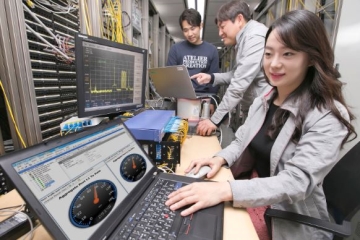
KT Develops Solution Capable of 100Gbps Optical Transmission
KT announced that it has developed a '100G-PON' transmission solution capable of data transmission at speeds of up to 100Gbps over existing optical internet lines. The '100G-PON' transmission technology developed by KT achieves maximum speeds of 100Gbps by applying 10 wavelengths, each capable of transmitting 10 gigabytes per second within a single line. Unlike the conventional approach of establishing 10 separate 10Gbps transmission lines to achieve 100Gbps speeds, this technology reuses existing optical cables, thereby reducing both construction time and costs. With this technology applied, '10 gigabit internet,' which is 10 times faster than the currently commercialized 'gigabit internet,' can be reliably provided through existing infrastructure. In particular, it also enables the provision of 'wireless 5G fronthaul,' which allows 5G networks to be constructed by leveraging existing wired networks, and is evaluated as a technology that can accelerate the realization of the 5G era.
2017.11.20by 김지혜 기자
Ecolab and K-water Discuss Innovation Collaboration in Advanced Industry Water Management
Ecolab and the Korea Water Resources Corporation jointly discussed cooperation directions for maximizing water use efficiency in advanced industries such as semiconductors and data centers and establishing sustainable water circulation. The two companies agreed to gradually develop a long-term cooperation model that combines water resource infrastructure and water management technology to promote water efficiency optimization, water reuse, and carbon reduction.
2026.08.28by 명세환 기자
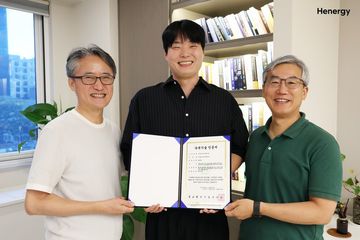
H.Energy Obtains Green Technology Certification…SolarOnCare Operating at 99.82% Uptime
H.Energy has obtained green technology certification from the Small and Medium Business Administration for solar power generation forecasting and I-V curve anomaly diagnosis technology. The AI-based asset management platform SolarOnCare is deployed across more than 3,000 power plants nationwide, achieving a system uptime of 99.82% and a 3.7% improvement in power generation performance. Through real-time data analysis, it protects power generation revenue by detecting and managing minor losses such as module degradation and partial shading early on.
2026.08.25by 명세환 기자











