


Manufacturing Productivity Direction Found in 'Collaborative Robots'
 Published2018.02.07 17:53
Regulatory Improvement through 'Collaborative Robot Safety Guidelines' for Expansion
The Ministry of Trade, Industry and Energy held an 'Intelligent Robot Industry Development Strategy Consultation Meeting' to advance the robot industry and secure competitiveness of small and medium-sized manufacturers.
This consultation meeting was held as part of resolving structural problems in the domestic industry and implementing follow-up measures to the 'New Government's Industrial Policy Direction' announced in December 2017. It was convened to find development strategies for the robot industry that can increase manufacturing productivity and contribute to creating new jobs.
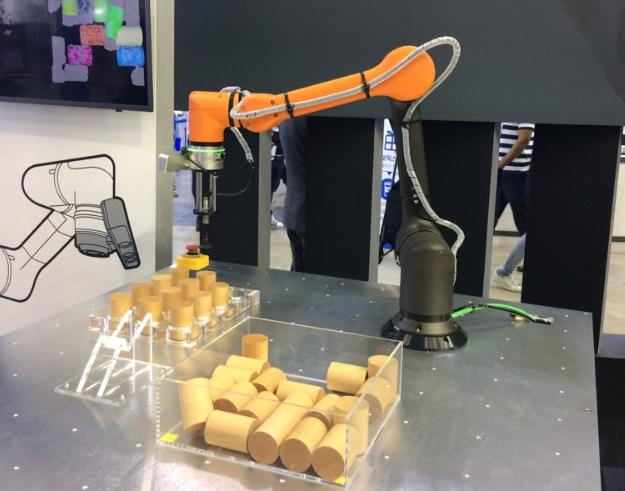
The Ministry plans to support productivity improvement by distributing collaborative robots to small and medium-sized manufacturing sectors. Accordingly, the policy is to provide new solutions to companies facing labor shortages by distributing and expanding robots centered on smart factory construction companies and root industries.
Additionally, the Ministry will promote commercialization of service robots in five promising fields with large growth potential: △smart home, △medical/rehabilitation, △disaster/safety, △unmanned transport, and △agricultural robots.
Service robots with high development demand and growth potential will be selected for each of the five fields, and joint development between robot companies and major users will be promoted along with test bed provision.
To secure competitiveness in the three major robot components—actuators, sensing, and control—a mid-to-long-term component development strategy will be established, and research and development will be concentrated in accordance with priorities. A joint 'Artificial Intelligence (AI)-Robot Application/Industrialization Promotion Team' will be organized by telecommunications companies, robot companies, and research institutions, and development of artificial intelligence (AI) platforms for robot integration will also be pursued.
To improve regulations that hinder robot proliferation, 'Collaborative Robot Safety Guidelines' will be established, and new robot service jobs providing specialized consulting for item verification and prototype production will be expanded.
In connection with the PyeongChang Winter Olympics, the world's first ski robot competition will be held, and robots for torch relay and guide robots will be showcased. Through competitions such as the International Robot Contest (October, Ilsan) and Robot Convergence Festival (August, Daejeon), the Ministry plans to discover talented individuals and enhance interest in robots.
Moon Seung-wook, Director of the Industrial Base Division at the Ministry of Trade, Industry and Energy, urged that "industry, academia, and research institutions work together so that our robot industry can acquire global competitiveness and further contribute to job creation for youth." He also emphasized that the government will make efforts to produce visible results through prompt implementation of the 'Intelligent Robot Industry Development Strategy' including leading projects for collaborative robots and service robots, strengthening innovation capabilities, and creating new markets.
Comments
Related news
[RoboWorld 2017] "High Growth Potential Across All Robotics Sectors; Focus on SI Firms"
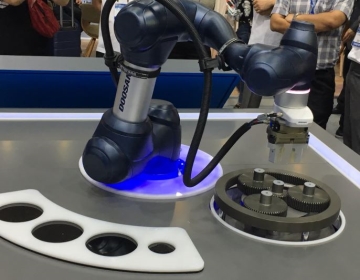
The 2017 RoboWorld, where you can see manufacturing robots and robot components, smart manufacturing, 3D printing, and service robots all in one place, will be held for four days starting September 13th at KINTEX in Ilsan. This event, with participation from 230 companies across 25 countries, is hosted by the Ministry of Trade, Industry and Energy and organized by the Korea Robotics Industry Association, Korea Robotics Industry Promotion Agency, and the Institute of Control, Robotics and Systems. This year's event theme is "Smart Industry, Smart Life!" and it will present directions for smart factories in the era of the Fourth Industrial Revolution. In particular, Hanwha Q Cells and Doosan Robotics participated in the manufacturing robot pavilion and each unveiled collaborative robots.
2017.09.13by 김자영 기자
What is included in the next 15-year plan for robot technology, a future growth engine?
As artificial intelligence technology has become a major focus, the robotics industry is experiencing a new wave of change. The influence of robots is expanding throughout society to such a degree that the simple definition of machines that autonomously operate by imitating humans has become obsolete. In response, the Ministry of Trade, Industry and Energy, along with approximately 80 experts from industry, academia, and research institutions, developed the 'Republic of Korea Robot Industry Technology Roadmap' through sector-specific subcommittee operations from January to June of this year. A public hearing was held in early June to review the draft and discuss future improvement measures. The completed 'Republic of Korea Robot Industry Technology Roadmap' was announced at '2017 Roboworld' held at Kintex in Ilsan on the 15th. The roadmap is divided into six categories: manufacturing robots, professional service robots, personal service robots, robot components, software and intelligence, and standardization, with each chapter containing current status, market, demand and prospects, challenges, and periodic target tasks.
2017.09.18by 김지혜 기자
[Issue] Doosan and Hanwha Unveil Large Number of New Products, Collaborative Robot Market Heats Up
Following Hanwha Techwin's collaborative robot in March of this year, Doosan Robotics unveiled four types of collaborative robots at RoboWorld 2017, drawing attention to the collaborative robot market. In 2015, ABI Research reported that the collaborative robot market share in the Asia-Pacific region stood at 18%, but is expected to grow to as much as 58% by 2020. Large confrms such as Hanwha and Doosan, which had previously been centered on small and medium-sized enterprises, announced new collaborative robot products, leveraging their own proprietary technologies from planning through research and development to production.
2017.09.18by 김자영 기자
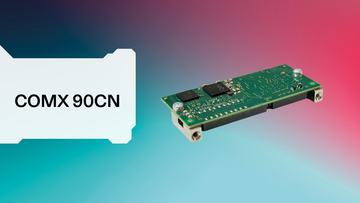
Hilscher Launches 'comX 90CN' Embedded Module Without Connector Integration
Hilscher has launched the 'comX 90CN' embedded communication module without connector integration. Designed in a compact 30×70mm form factor, this module features a structure where network connectors are separately connected to the baseboard, enabling flexible mechanical design for industrial equipment. Based on netX 90, it supports major industrial Ethernet protocols including PROFINET, EtherCAT, and EtherNet/IP, and incorporates security features such as hardware-based encryption and secure boot.
2026.10.19by 배종인 기자
Korea Institute of Machinery and Materials, Duwon University of Science and Technology, and Duwon Heavy Industries Sign MOU on Manufacturing AI Transformation Industry-Academy-Research Collaboration
The Korea Institute of Machinery and Materials has partnered with Duwon University of Science and Technology and Duwon Heavy Industries to establish an industry-academy-research collaboration system in response to AI transformation in the manufacturing sector. An industry-academy-research collaboration center will be established at the Anseong Campus, joint research in the mobility, aerospace, and defense sectors will be promoted, and specialized workforce development tailored to field demands will be pursued through the establishment of the AI Mobility Machinery Department starting in the 2027 academic year.
2026.10.19by 배종인 기자











