


Only 23% of domestic companies have a complete digital transformation strategy
 Published2018.03.23 17:53
Domestic Companies' Confidence in IT Capabilities Lower Than Asia-Pacific Average
According to a survey by CA Technologies, while most domestic companies are well aware of the impact of digital innovation on the industry, only 23% have a complete digital transformation strategy. Although this is higher than the Asia-Pacific average of 17%, it is considered insufficient for readiness for digital transformation.
CA Technologies Korea released the 'CA Technologies Asia Pacific Digital Transformation Impact and Readiness' report, which assesses the impact of digital transformation in the Asia-Pacific region and surveys the status of corporate readiness. 900 business and IT decision-makers from nine Asia-Pacific countries, including Korea, China, and Japan, participated in the survey. 100 respondents from Korea took the survey.
The majority of domestic companies responded that their industries (93%), organizations (82%), and operations (81%) are being affected by digital innovation. This exceeds the Asia-Pacific average (80%, 78%, 78%). Countries in the Asia-Pacific region, including Korea, predicted that these changes will intensify over the next three to five years.
A survey revealed that companies in the Asia-Pacific region are failing to keep up with the pace of digital innovation. Only about half (52%) of domestic companies have embarked on digital transformation projects with clear corporate goals, such as increasing productivity and revenue. Furthermore, only 12% of domestic companies are pursuing full digitalization across the entire organization, ranging from redesigning operational methods to developing new business models. In both categories, the Asia-Pacific average also stood at only 51% and 9%, respectively, indicating that digital transformation is still in its early stages.
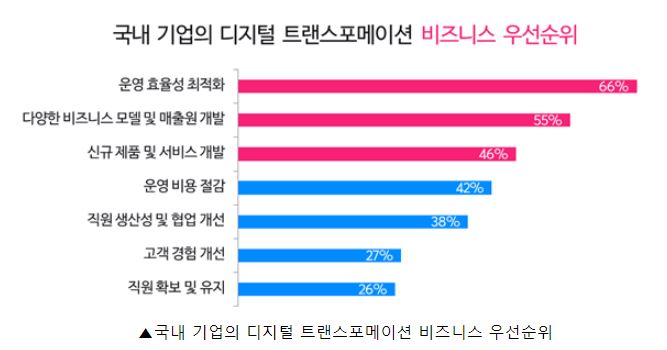
Digital Transformation Pressure Factors and Business Priorities
Asia-Pacific countries cited economic conditions and customer expectations as key driving forces for digital transformation. To address this, domestic companies were innovating their businesses to align with the changing market environment by prioritizing operational efficiency optimization (66%), development of diverse business models and revenue streams (55%), and the development of new products and services (46%) in their actual digital transformation projects. Improving customer experience (27%) was cited as a low priority, indicating room for improvement. In contrast, other Asia-Pacific countries placed high priority on operational and productivity improvements, including operational efficiency optimization (56%), workforce productivity and collaboration enhancement (49%), and operating cost reduction (46%).
Domestic companies show low confidence in their IT capabilities
While the majority of companies in Korea and the Asia-Pacific region were confident that they would achieve digital competitiveness within the next three to five years, they generally rated their current digital transformation capabilities as low. Domestic companies expressed confidence in a suitable corporate culture capable of accommodating risk-taking, innovative thinking, and talent diversity (50%) and strong leadership (46%). However, their evaluations of suitable technology and capabilities (34%) and appropriate operational processes (34%) were lower than the Asia-Pacific averages (40% and 41%, respectively).
Domestic companies showed lower confidence than the Asia-Pacific average regarding the IT capabilities required to drive digital transformation. Only a small number of domestic companies responded that they possess appropriate policies and technologies to prevent cyber attacks (27%), a clear technology roadmap and roles (27%), high-quality app development, launch, and maintenance (24%), and appropriate next-generation computing resources (24%). Meanwhile, domestic companies identified designing and executing the organization's digital transformation strategy as a core role of their IT teams.
Yoo Jae-sung, CEO of CA Technologies Korea, emphasized, “Recently, the government set out to secure national competitiveness by amending the Software Promotion Act for the first time in 18 years. CA Korea will also support domestic companies in building a modern software factory equipped with four core software capabilities—agility, automation, insight, and security—and succeeding in digital transformation.”
관련뉴스
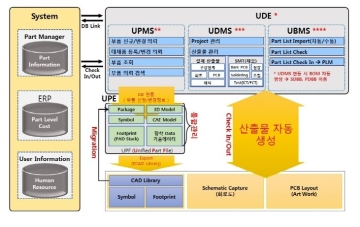
스마트 팩토리, 설계에서 제조까지 데이터 대동단결!
스마트팩토리에서 중요한 부분은 R&D 연구소와 제조업의 연계성이다. 이를 위해 제조에 필요한 기술 데이터를 축적해야한다. 국내 스마트팩토리는 기술 수준은 상당부분 증가했으나 원활한 데이터 공유를 위한 회로 관리, CAD 기술 확보는 아직 미흡한 단계이다. 전자부품연구원(KETI)에서 발표한 ‘스마트 팩토리 수준 비교서’를 보면 ERP, MES, 네트워크, PLC 등은 최대 90%까지 기술 수준이 오른 반면, CAD는 20%에 그쳤다. CAD기술 발전이 더딘 이유 중 가장 큰 문제는 많은 비용이 들어간다는 것이다. 데이터 일원화를 하려면 인트라넷과 네트워크를 구축하고 공장 내 수많은 센서를 설치해야 하는데 이를 위한 비용은 중소기업이 자체적으로 감당하기 어렵다. 그 다음 문제는 데이터 전환에 따른 왜곡이다. 연구 단계에서 산출한 데이터가 제조업에 전해지는 과정에서 회로는 거버, 도면, 페이퍼 등으로 바뀐다.
2018.02.09by 김학준 기자
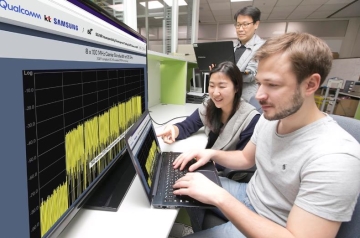
KT, Samsung Electronics, and Qualcomm Successfully Launch 5G Data Communications Based on International Standards
KT는 삼성전자-퀄컴과 함께 경기도 수원 삼성전자 디지털 시티에서 3GPP의 5G 국제 표준인 5G NR(New Radio) 규격 기반으로 데이터 통신에 성공했다고 밝혔다. 이번에 3사가 협력한 시연 내용은 2월 26일부터 스페인 바르셀로나에서 열리는 MWC2018에서 3사 부스에 전시될 예정이다. 이날 시연에선 초고속 5G 데이터 통신과 1ms 수준의 초저지연성을 검증하였다. 이러한 성능은 VR/AR, 실시간 게이밍, 스마트 팩토리, 자율주행차 등 대용량 데이터 전송과 빠른 응답속도가 필요한 미래 5G 서비스에 필수적이다.
2018.02.20by 김지혜 기자

Schneider Electric Korea-Hyundai Engineering & Construction Sign Smart Factory Technology Partnership Agreement
슈나이더 일렉트릭 코리아는 4차 산업혁명 시대 한국 제조 및 건설 산업 발달과 더불어 기술 인재 양성과 취업지원에 앞장선다. 슈나이더 일렉트릭 코리아는 건설전문인력 양성기관이자 현대건설이 직접 운영하는 현대건설 기술교육원과 4차 산업혁명 전문 인력 양성을 위한 ‘스마트 팩토리 기술 제휴 업무 협약(MOU)’을 체결했다고 밝혔다.
2018.02.21by 김지혜 기자

ST Microelectronics and NUS Establish Joint Research Center 'HELIX' for Edge AI
ST Microelectronics and the National University of Singapore have established the 'HELIX' joint research center aimed at implementing embedded AI in edge environments. Over a four-year period, the center will conduct research across the entire technology stack from algorithms to silicon, focusing on memory-centric architecture leveraging ST's 18nm FD-SOI technology and embedded PCM. The core objective is to implement intelligence directly in physical devices such as robots and drones while minimizing energy consumption.
2026.08.28by 배종인 기자

ams, 디지털 포토닉스로 휴머노이드 로봇 감각·소통 기능 지원
ams OSRAM이 디지털 포토닉스 기술을 활용해 휴머노이드 로봇의 감각·소통 기능을 강화하는 솔루션을 공개했다. dToF 센서, 광학식 힘 센서, 구조광 이미터 등으로 주변 환경 인식과 정밀 조작을 구현하며, EVIYOS·ALIYOS 플랫폼으로 LED 기반 비언어 소통을 지원한다. 시장조사에 따르면 휴머노이드 로봇 시장은 2025년 6억 달러에서 2035년 510억 달러로 성장할 전망이며, 로봇의 감각 능력 향상이 핵심 성장 동인으로 작용할 것으로 예상된다.
2026.08.27by 배종인 기자











