



PTC Launches 3D CAD Solution with Enhanced Productivity Features
 Published2018.03.27 09:36
PTC has announced the release of the latest version of its 3D CAD software Creo, "Creo 5.0."
Creo is a CAD software that enables users to seamlessly execute the entire workflow from concept review through manufacturing validation in a single design environment. This version of Creo includes five new functional module products to support rapidly evolving product design trends and various convenience features to enhance productivity.
Creo accelerates product innovation speed and supports faster development of better products by enabling the reuse of optimal designs or reflecting performance objectives derived from inference as actual operational data of products through IoT technology.
The newly released Creo 5.0 transforms planning-stage concepts into smart connected products by applying augmented reality (AR) across product dimensions, connecting the physical and digital worlds. Additionally, capabilities in topology optimization, additive manufacturing, computational fluid dynamics (CFD), and computer aided manufacturing (CAM) have been strengthened.
John Mackrell, chairman of PLM consulting firm CIMdata, stated, "PTC is at the forefront of today's most prominent IoT and augmented reality technologies, while continuously expanding the fundamental technologies embedded in CAD. Creo, which consolidates new technologies and innovative features, is a product capable of successfully driving business transformation. In particular, the newly released Creo 5.0 reflects PTC's innovative direction and capabilities to precisely meet customer needs."
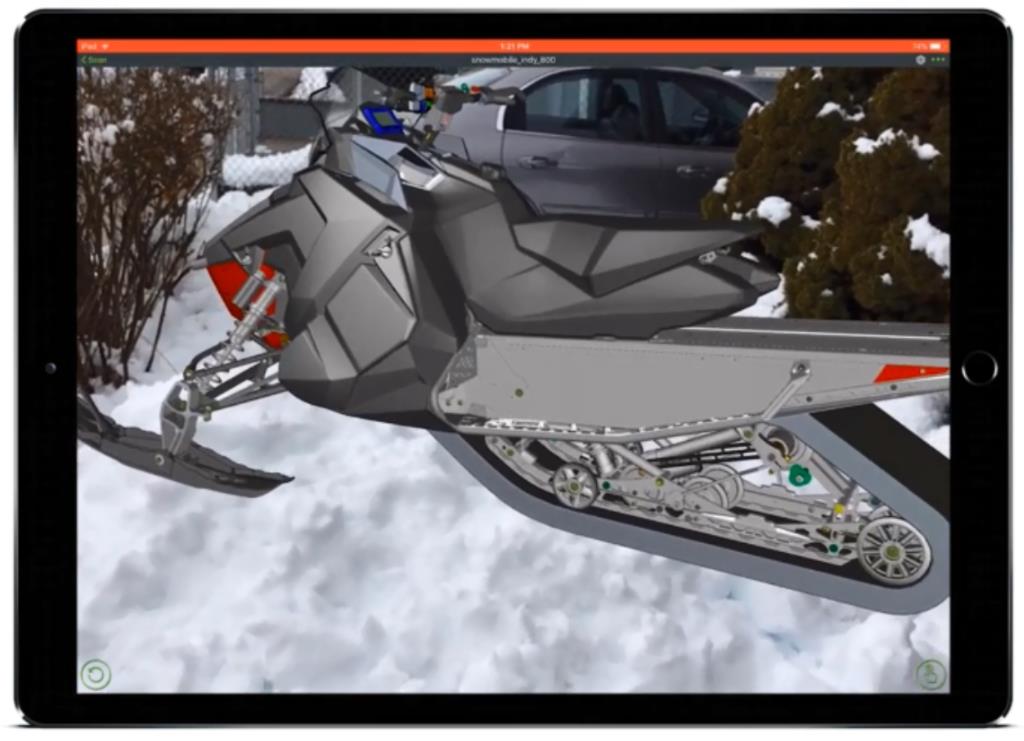
Product design optimization is often limited by experience from existing designs. The newly added Creo topology optimization feature automatically generates and supports optimized designs based on a set of design constraints and objectives defined by strength and weight optimization, enabling designers to efficiently save time and accelerate innovation.
For leveraging 3D printing technology, Creo allows users to complete the entire process from design and optimization through 3D print verification and additive manufacturing directly within a single product, eliminating the need to use multiple software applications. By streamlining the additive manufacturing process and eliminating the need to re-convert design models, users can focus entirely on critical design work.
Creo 5.0 now includes the "Additive Manufacturing Plus Extension" from Materialise, a specialized 3D printing software, enabling additive manufacturing capabilities to be applied to metal parts. Users can directly print production-level components in Creo. Additionally, users can access print drivers and profiles through the Materialise online library.
The newly added "Creo Mold Machining" feature in this version provides dedicated high-speed machining for mold processing and supports 3-axis machining and 5-face (3+2) machining.
"Creo Flow Analysis," a computational fluid dynamics (CFD) solution, enables designers and analysis specialists to simulate fluid flow. The workflow between CAD and CFD integrates seamlessly, allowing flow characteristics and performance to be verified from the initial design stage. This product is user-friendly and integrated with Creo, enabling quick and accurate fluid analysis results.
Creo 5.0 also applies an improved user interface to support the rapidly changing product design environment and includes numerous productivity-related features such as geometry generation using sketch regions and volume helical sweep. Additionally, it includes multiple features for improving productivity such as surface generation, sheet metal design, and draft application with rounds, while supporting design with a perspective display mode similar to real-world views.
Furthermore, in addition to the previously supported CATIA, NX, and Solidworks, multi-CAD collaboration environments are now supported for Autodesk Inventor. The "Creo Collaboration Extension" integrates design work through a single CAD system, reducing time and costs associated with operating and integrating multiple systems while facilitating data reuse and sharing.
Brian Thompson, senior vice president of the CAD Division at PTC, stated, "Product design is fundamentally changing. Creo continues to evolve to meet customer needs, and users can successfully complete the smart connected product design process by using Creo. With improved performance and new capabilities such as additive manufacturing providing differentiated competitiveness, Creo will serve a practical role in driving concepts through to the manufacturing stage."
Related news
PTC Achieves Top Score in Forrester Research Evaluation Report
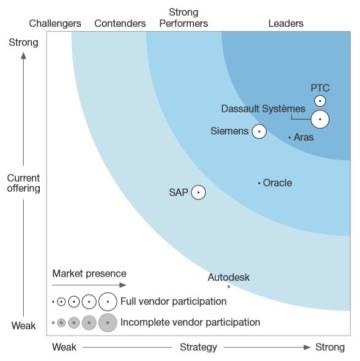
PTC recently announced that its Product Lifecycle Management (PLM) solution Windchill® achieved the highest score in an evaluation report from market research firm Forrester Research. PTC recorded the highest score in the product and strategy categories of Forrester Research's latest report, "Forrester Wave Q4 2017: PLM Solutions for Discrete Manufacturers." In this report, Forrester evaluated the products and strategies, as well as market positioning, of seven vendors including PTC. The analysis was conducted based on comprehensive evaluation criteria including Bill of Materials (BOM) management, quality and compliance, supply management and collaboration, configuration and flexibility, deployment ease, and sustainability. Additionally, PLM market strategy based on product vision, partner ecosystem, and delivery models considering cloud environments were also used as evaluation factors. In this report, Forrester described PTC's market position as follows: "For manufacturing enterprises seeking to operate PLM solutions quickly and flexibly based on IoT capabilities, PTC will be the best choice."
2017.12.18by 김지혜 기자

PTC and Microsoft Partner to Empower IoT Customers to Drive Digital Transformation
PTC has announced a partnership with Microsoft to enable its industrial innovation platform ThingWorx to work in conjunction with the Microsoft Azure cloud platform. Through this partnership, both companies plan to identify business opportunities targeting customers in industrial sectors, including manufacturing, by leveraging complementary technologies. PTC and Microsoft plan to deliver a robust solution for industrial IoT and digital product lifecycle management (PLM) by combining their respective technologies and expertise. At the center of this solution are Microsoft Azure IoT and the industrial innovation platform ThingWorx, which enable customers to drive innovation in products and operations through IoT connectivity, rich contextual information, business system orchestration, and mixed reality that enhances user experience.
2018.02.02by 김지혜 기자

PTC Korea Signs MOU with University of Ulsan for IoT Specialist Talent Development
PTC Korea announced that it has signed a Memorandum of Understanding (MOU) with University of Ulsan to nurture specialized workforce in digital transformation utilizing Internet of Things technology. Key officials including Park Hye-kyung, Branch Manager of PTC Korea, and Oh Yeon-cheon, President of University of Ulsan, attended the signing ceremony and exchanged the MOU for industry-academic cooperation. With this collaboration as an opportunity, PTC Korea and University of Ulsan plan to support future core talents in directly experiencing the IoT-based digital transformation process and designing related projects. To this end, PTC Korea will provide IoT solutions valued at 2.1 billion won to University of Ulsan free of charge for three years and operate support programs for students to build IoT technical capabilities.
2018.03.23by 김지혜 기자
.jpg)
SalePoint Signs Multi-Year Partnership Agreement with AWS… Promoting Identity Security that Integrates Even AI Agents
Sailpoint has entered into a multi-year strategic partnership agreement with AWS and is moving forward with establishing an integrated governance system that manages both human and non-human identities together. The plan is to consistently manage access permissions in an environment where AI agents are increasing as work execution entities, while applying the principle of least privilege and automated policy enforcement. The two companies plan to jointly expand capabilities to manage the identities of various entities, including AI agents, within a single layer in the AWS environment. This collaboration is interpreted as a move to design security and governance together in corporate environments where AI adoption is expanding.
2026.03.26by 배종인 기자
.png)
Databricks Unveils Open AI Security Monitoring 'Lakewatch'
Databricks entered the security market on March 24 by unveiling LakeWatch, an open-source agentic SIEM. The core functionality of this product is to integrate and analyze security, IT, and business data in a single environment to support AI-based threat detection and investigation. The company explained that it reduces the limitations of existing security operations centers, which have had to forgo some data due to high cost structures, and enables large-scale data analysis and automation based on open formats and ecosystems. LakeWatch is currently offered as a private preview, with Adobe and Dropbox mentioned as early customers. Databricks also announced an expanded partnership with Anthropic as well as the acquisition of Antimatter and SiftD.ai.
2026.03.26by 배종인 기자











