


Improvement of Net Neutrality Needed Ahead of 5G Commercialization..."Revenue and Investment Costs Must Be Considered"
 Published2018.03.27 15:52
Necessity to Improve Current Net Neutrality Regulations
As preparation for commercialization in March 2019 of fifth-generation (5G) mobile communication services progresses, there are calls to revise the 'net neutrality guidelines.' The United States abolished its net neutrality policy at the end of last year.
Following this, Democratic Party lawmaker Byun Jae-il held a '5G Convergence Era, New Directions in Net Neutrality Policy Discussion Forum' regarding the reestablishment of domestic net neutrality policy.
Net neutrality is a concept that all data transmitted over Internet networks should be treated equally regardless of content, type, or provider. This concept emerged in the early 2000s. It was raised due to concerns that Internet service providers (ISPs) could discriminate against or block traffic due to insufficient high-speed Internet infrastructure, concerns about abuse of dominance, and infringement of users' right of access.
Net neutrality issues stem from the conflict between Internet content service providers (ICPs) and ISP companies that build Internet networks and provide wired and wireless Internet services. 5G is expected to provide specialized networks through network slicing technology and conduct traffic management to guarantee network quality. As the need for network investment incentives increases due to recent proliferation of smart devices and the advent of 5G, arguments for change are being raised.
Ko Sam-seok, standing committee member of the Broadcasting and Communications Commission, stated, "5G must be provided in a customized manner suited to each service. To do this, discrimination in network connectivity is necessary. It is time to reconsider the net neutrality policy that has been maintained for 20 years," and added, "Rather than making definitive statements about the existence or abolition of net neutrality policy, we should review it with the goals of industry revitalization, enhancement of national competitiveness, and user protection."
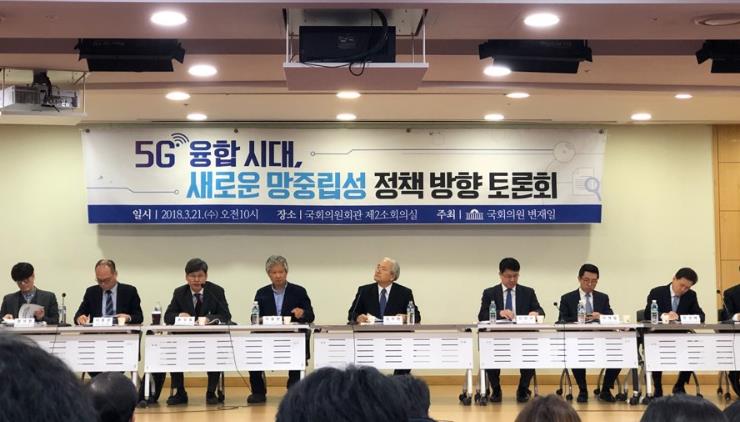
Shin Min-soo, professor at Hanyang University, stated, "Considering the global universality of net neutrality policy, while maintaining transparency that can directly impact user quality in line with Korea's industrial competitiveness, there is a need to increase economic management flexibility," and explained, "Measures must also be developed to resolve policy uncertainties regarding managed services and similar offerings."
He added, "Uniform net neutrality regulations that hinder uncertain 5G market prospects and the launch of new business models may pose risks to investment and innovation."
Yoon Sang-pil, director of external cooperation at the Korea Telecommunications Business Association, stated, "Due to the explosion of Internet traffic, we are making large-scale investments of 5 to 8 trillion won annually. This is not a scale that can be handled by telecommunications companies alone," and argued, "Network investment is led by telecommunications operators, but Internet service providers are capturing the revenues. There is a need for a method to also burden large-traffic-generating Internet service providers."
He continued, "5G has quality differences in speed and connectivity, which conflicts with current net neutrality principles. There is a need to modify it in line with current times to match commercialization," and pointed out, "5G convergence services have different network quality by service and different rates for provision. If the current net neutrality is maintained, pricing will fall into chaos."
In opposition to this, Cha Jae-pil, policy director at the Korea Internet Enterprise Association, stated, "There is strong backlash against net neutrality abolition even within the United States. Internet service providers are already paying network usage fees," and said, "Network operators are not only receiving usage fees from Internet service providers but also double-charging from users. Users pay fixed costs only on wired networks and pay-per-use fees on wireless networks for what they use."
He countered, "Net neutrality must be upheld. Currently, telecommunications companies are also guaranteed business autonomy through guidelines. Rather, net neutrality should move from guidelines to legislation."
Opinions also emerged that how the Internet environment has changed should be considered in net neutrality policy. In the early Internet market environment, no single operator dominated the market. The question is whether the concepts from that time remain valid today.
In response, Kim Jae-young, director of the Broadcasting and Communications Commission's User Policy Bureau, stated, "Because the Internet environment is global, domestic policies cannot be pursued independently. We must reconsider based on post-regulation criteria such as network investment activation issues, fair competition issues, and user welfare," and concluded, "The Broadcasting and Communications Commission is establishing an Internet Co-Prosperity Development Council to gather diverse opinions from operators regarding net neutrality."
Comments
Related news
Development of core technologies related to providing mobility between 5G and WiFi
Seamless service between 5G and WiFi becomes possible even while moving. The Electronics and Telecommunications Research Institute (ETRI) announced that it has successfully developed foundational technology enabling seamless mobility service between 5G and WiFi without limitations, even when users are moving, through research conducted with domestic small and medium-sized enterprises including KT, Ranbird Technology, and S-NetICT. In the existing network system, 3G networks, 4G LTE networks, and wired networks operated separately, and users had to manually choose whether to use WiFi or 4G LTE.
2018.03.14by 김지혜 기자

What is KT's faster-than-anyone 5G commercialization strategy?
KT held a 5G achievement presentation and commercialization strategy press briefing to announce the 5G technologies used during the 2018 PyeongChang Winter Olympics and Paralympics, as well as future strategies. Oh Seong-mok, head of KT's Network Division, stated, "After announcing at the Mobile World Congress (MWC) that KT would showcase the world's first 5G trial service at the 2018 Olympics, KT made efforts in developing various technologies and services for early 5G commercialization." During this Olympics, KT applied 5G-based technologies such as SyncView, Time Slice, and OmniView to events including figure skating, short track speed skating, and skiing. Through these technologies, KT delivered three-dimensional images capturing key moments such as aerial jumps and championship goals, as well as competition scenes from 360-degree angles to spectators and viewers. For bobsleigh, SyncView equipped on the top 10 teams was also used by US-based NBC. Additionally, approximately 3,000 people, including government officials, media executives, and telecommunications company CEOs, boarded KT's 5G Connected Bus.
2018.03.22by 김학준 기자
We must prepare for future communications through 'THz'-based 6G research
Through development from the first to fourth generation, mobile communication speed has increased and latency has been reduced. Research and development speed for transitioning to each new generation is also decreasing. As a result, commercialization of 5G is imminent. Recently, the U.S. Defense Advanced Research Projects Agency (DARPA) and the Chinese government have initiated the '6G Advanced Communication Research Project' and begun preparing for future communications. 6G research, which has commenced even before 5G standards have been finalized, is attracting significant attention. Domestically, the 1st and 2nd generations started with voice-oriented mobile services, and upon entering the 3G/4G era, mobile internet through 'smartphones' became possible. Recently, with the PyeongChang Winter Olympics as an opportunity, 5G pilot projects were launched. 5G provides speeds exceeding 20Gbps with expanded bandwidth. This represents a 20-fold difference compared to 4G with 1Gbps speed. Additionally, response latency is one-tenth or less of 4G, with response speed as fast as one-thousandth of a second. With characteristics of ultra-high speed and ultra-low latency, 5G is a core element of the fourth industrial revolution based on the Internet of Things.
2018.03.22by 김학준 기자
European Patent Applications Surpass 200,000 for the First Time… South Korea Maintains 5th Place, Led by Batteries and Telecommunications
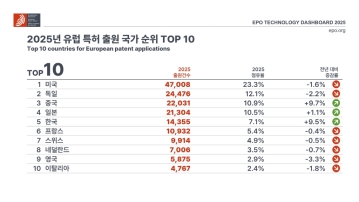
According to the European Patent Office (EPO)'s 'Technology Dashboard 2025', European patent applications last year reached 201,974, surpassing 200,000 for the first time. Korean companies and inventors filed 14,355 applications, representing a 9.5% increase from the previous year and maintaining 5th place by country. Battery, digital communication, and semiconductor technologies led the growth, with Samsung ranking as the top EPO applicant for the second consecutive year and LG reaching 3rd place. The presence of major domestic cities such as Seoul, Suwon, and Yongin was also confirmed. It was also revealed that Korea's European patent strategy is expanding beyond individual technologies to span the entire industry.
2026.03.24by 명세환 기자

SK Telecom First Applies AI-Based Network Operations at Gwanghwamun K-Pop Concert
SK Telecom announced that it applied an AI-based network operation system for the first time at a large-scale K-pop concert held in the Gwanghwamun area of Seoul on March 21st, managing communication quality throughout the event. Mobile data usage during the three hours before and after the concert reached 12.15TB, approximately doubling compared to the same time slot the previous weekend. SK Telecom monitored traffic using the AI system 'A-One' in five-minute and 50-meter units to respond to potential overload situations, while also operating temporary communication facilities and on-site personnel in parallel. This case is interpreted as confirmation of the practical applicability of AI-based autonomous network operation in an environment where demand from dense events and foreign users increases simultaneously.
2026.03.23by 명세환 기자











