



Verizon Joins NVIDIA Metropolis to Create Safer and Smarter Cities
 Published2018.03.30 14:43
NVIDIA announced that Verizon has joined over 100 companies using NVIDIA Metropolis to create safer, smarter, and more sustainable cities. NVIDIA Metropolis is NVIDIA's edge-to-cloud video platform that enables the development of intelligent, fast deep learning-based applications.
Verizon is a leading technology company providing the most reliable network services in the United States. Verizon's Smart Communities group is collaborating with multiple cities to connect communities and develop them for the future. A concrete example includes intelligent cameras based on NVIDIA Jetson mounted at street lights and other strategic locations throughout cities for monitoring urban conditions.
David Tucker, who oversees product management at Verizon's Smart Communities group, stated, "LED street lights provide significant cost savings in terms of operational expenses and are being rapidly adopted globally," adding, "Cities will expand their lighting infrastructure to establish smart city platforms, and through this, they will integrate various current and future applications to enhance efficiency and develop diverse citizen services."
Verizon designates these mounted intelligent cameras as video nodes. These cameras leverage Jetson's deep learning capabilities to analyze multiple video data streams, improving traffic flow, enhancing pedestrian safety, and resolving parking issues in urban areas, among other functions.

Beta testing using proprietary datasets and models generated from neural network training is expected to conclude in the eastern and western coastal regions of the United States, and Verizon plans to announce detailed information regarding full-scale commercialization in the near future.
The NVIDIA Metropolis platform, which was unveiled last year, includes various tools, technologies, and support for building deep learning applications across nearly all sectors, from traffic and parking management to public safety and urban services.
High-performance deep learning inference tasks are performed at the edge where NVIDIA Jetson embedded computing platforms are deployed, as well as through servers and data centers equipped with NVIDIA Tesla GPU accelerators.
Verizon's video nodes utilize Jetson TX1 to collect and analyze data from the farthest edge of the city network. The supercomputer located on the module accelerates deep learning at the edge, enabling real-time video analysis. Through this edge computing process, data analysis can be performed more efficiently and at near real-time speeds, while also reducing the high cost of streaming and storing video through LTE and Wi-Fi networks.
The video nodes capture and classify objects such as vehicles, bicycles, and pedestrians, and identify their interactions at near real-time speeds, providing city officials with 24-hour data streams covering nearly all information ranging from illegal right turns at red lights to pedestrian movements outside crosswalks and parking lot conditions.
David Tucker stated, "Through Jetson, we discovered that we can create a consistent deep learning perspective that leverages GPUs to span the entire stack from cloud to edge."
While Jetson-based nodes quickly detect the movement of fast-moving vehicles and bicycles and handle other real-time tasks at the edge, when this data reaches the cloud, it can also be utilized for predictive analytics.
David Tucker explained, "We are moving forward in a direction where we can capture what happens at intersection A and understand in real-time the impact it will have on intersections B and C several blocks away."
Related news
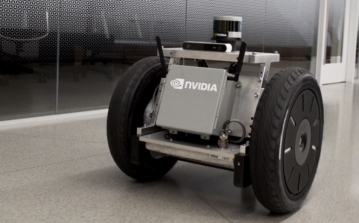
NVIDIA Unveils Isaac SDK to Accelerate Autonomous Robot Development
Nvidia announced an expansion of its Isaac platform for building robotic applications, accelerating momentum in efforts to expedite robot development and deployment across diverse industrial sectors. Jensen Huang, Nvidia's founder and CEO, unveiled the Isaac software development kit at the GPU Technology Conference, which consolidates libraries, drivers, APIs, and various other tools into a single offering. Through the newly released SDK, manufacturers, researchers, startups, and developers can more conveniently apply AI to next-generation robots for sensing, navigation, and manipulation, while saving hundreds of hours of development time. The SDK provides a framework that manages communication within robot architecture and facilitates data transfer, while also enabling users to readily add sensors, manage sensor data, and control actuators in real time.
2018.03.29by 김지혜 기자

NVIDIA's deep learning computing platform's performance has improved tenfold in just six months.
Nvidia announced at GTC 2018 successive performance improvements to its deep learning computing platform, achieving a 10-fold performance improvement compared to the previous generation in deep learning workloads over a six-month period. Key improvements to the Nvidia platform include doubling the memory of Nvidia Tesla V100, a data center GPU, and introducing Nvidia NVSwitch, a groundbreaking GPU interconnect fabric. Utilizing NVSwitch, up to 16 Tesla V100 GPUs can simultaneously communicate at a record-breaking speed of 2.4 terabytes per second. Additionally, updates and optimizations to the software stack were announced. With the launch of Nvidia DGX-2, Nvidia unveiled the first single-server system capable of delivering 2 petaflops of computational performance in the deep learning computing field. The deep learning processing performance of DGX-2 is comparable to 300 servers occupying 15 racks in a data center, yet its physical size is approximately 60 times smaller and its power efficiency is approximately 18 times superior.
2018.03.29by 김학준 기자
Ecolab and K-water Discuss Innovation Collaboration in Advanced Industry Water Management
Ecolab and the Korea Water Resources Corporation jointly discussed cooperation directions for maximizing water use efficiency in advanced industries such as semiconductors and data centers and establishing sustainable water circulation. The two companies agreed to gradually develop a long-term cooperation model that combines water resource infrastructure and water management technology to promote water efficiency optimization, water reuse, and carbon reduction.
2026.08.28by 명세환 기자
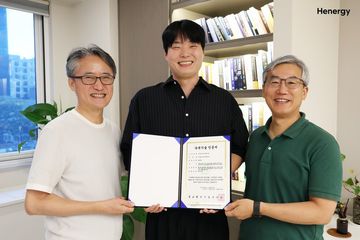
H.Energy Obtains Green Technology Certification…SolarOnCare Operating at 99.82% Uptime
H.Energy has obtained green technology certification from the Small and Medium Business Administration for solar power generation forecasting and I-V curve anomaly diagnosis technology. The AI-based asset management platform SolarOnCare is deployed across more than 3,000 power plants nationwide, achieving a system uptime of 99.82% and a 3.7% improvement in power generation performance. Through real-time data analysis, it protects power generation revenue by detecting and managing minor losses such as module degradation and partial shading early on.
2026.08.25by 명세환 기자
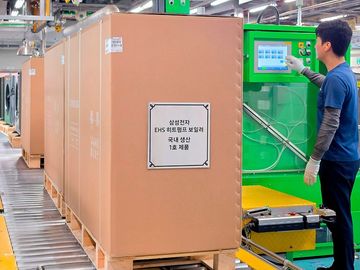
Samsung Electronics Establishes Domestic Production of EHS Heat Pump Boilers in Gwangju…Annual Production Capacity of 100,000 Units
Samsung Electronics is establishing a domestic production system for EHS heat pump boilers at its Gwangju business site in line with the promotion of heating electrification. The company will begin trial production this month on a dedicated line spanning 2,132㎡ and is scheduled to commence full-scale mass production by the end of September, with annual production capacity exceeding 100,000 units. This product generates approximately 5 times the heat relative to input power, recording a seasonal performance coefficient of 4.9, and offers higher energy efficiency compared to fossil fuel-based boilers while reducing carbon emissions.
2026.08.24by 명세환 기자











