

.png)

Independent Power Technology Development for IoT Wireless Sensors
 Published2018.04.06 10:50
Reached a level capable of semi-permanent operation without batteries
Technology that converts electrical energy by utilizing magnetic field noise has been confirmed to be at a level capable of commercialization as autonomous independent power for Internet of Things (IoT) wireless sensor networks.
Professor Ryu Jung-ho's team at Yeungnam University developed a technology that converts everyday magnetic field changes into electrical energy by combining magnetostrictive metal materials (Ga-Fe alloy) that expand or contract with minute changes in magnetic field and piezoelectric materials that generate electrical energy when deformed.
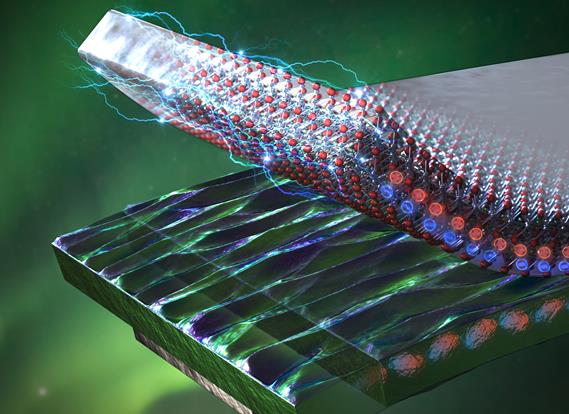
By utilizing the principle that the characteristics of piezoelectric materials and magnetostrictive metal materials vary according to their crystallographic orientation, the two materials were fabricated with crystallographic orientation most sensitively responsive to magnetic fields, and an energy conversion device was designed using hybrid interface coupling technology combining these two materials. Furthermore, they successfully generated direct current power of mW or higher, which is sufficient to continuously operate IoT wireless sensors without batteries.
Director Kim Kwang-ho of the Future Materials Research Unit based on Hybrid Interface and Professor Ryu Jung-ho of Yeungnam University stated, "We have secured patent rights related to the technology in Korea, the United States, Europe, Japan, and China," and explained the research significance, saying "We have now reached a level capable of operating wireless sensor networks that previously required batteries to function on a semi-permanent basis without batteries, therefore widespread application as autonomous independent power for future fourth industrial revolution wireless sensor networks is anticipated."
Related news
Reduce power consumption by half with IoT Wi-Fi devices
Silicon Labs has developed a Wi-Fi® portfolio. With this, the company announced that it has simplified the design of battery-powered Wi-Fi products with low power consumption characteristics that are important for IP security cameras, point-of-sale (PoS) terminals, and consumer healthcare devices. The new WF 200 transceiver and WFM 200 module, optimized for superior energy efficiency, support 2.4GHz 802.11 b/g/n Wi-Fi and provide connectivity with excellent performance and reliability. Daniel Cooley, Senior Vice President and General Manager overseeing Silicon Labs' Internet of Things (IoT) product portfolio, stated, "By providing low-power Wi-Fi products designed specifically for IoT, we have brought innovation to the design of secure, battery-powered connected devices that were previously impossible to implement." He further forecasted, "There will be a significant increase in customer demand for Wi-Fi technology that meets the limited power and space requirements of battery-powered devices that free users from AC power connection cables."
2018.02.28by 김학준 기자

Silicon Labs Launches Two New Highly Integrated PoE ICs for IoT
Silicon Labs announced the launch of two Power over Ethernet (PoE) Powered Device (PD) product families that deliver industry-leading integration and efficiency for Internet of Things (IoT) applications. Silicon Labs' Si3406x and Si3404 product families integrate the necessary high-voltage discrete components into a single PD chip. These PD IC products support IEEE 802.3at standard PoE+ power performance, flexible power conversion options delivering over 90% efficiency, sleep/wake/LED support modes, and superior EMI immunity. Thanks to these features, developers can reduce system development costs and time-to-market for high-power, high-efficiency PoE PD applications. As IoT rapidly expands, demand for PoE+ connectivity is increasing in IP cameras, smart lighting fixtures, multifunction video IP phones, advanced 802.11 wireless access points, and smart home appliances. These applications are driving demand for PD devices supporting the PoE+ standard, which typically require high power. Modern motor-equipped IP camera products with pan/tilt/zoom functionality and heater elements place significant loads on power supply units. PoE+ technology provides 30W of power for such applications. Silicon Labs' Si3406x product family is a PD interface solution suitable for a new generation of IoT products supporting PoE+ in residential, commercial, and industrial environments.
2018.03.07by 김학준 기자
ST Launches Multiprotocol Bluetooth & 802.15.4 SoC for IoT Devices
STMicroelectronics (ST) has launched an advanced dual-processor-based wireless chip that enhances the performance of next-generation smart connected devices such as digital home products, wearable electronics, smart lighting, and smart sensors. The device extends battery life while delivering new features and improved performance to enhance the end-user experience. The STM32WB wireless SoC device integrates an Arm Cortex-M4-based microcontroller with full capabilities to run key applications, and an Arm Cortex-M0+ core that offloads the main processor and can operate BLE (Bluetooth Low Energy) 5 and IEEE 802.15.4 wireless functionality in real-time.
2018.03.26by 김지혜 기자

Ecolab and K-water Discuss Innovation Collaboration in Advanced Industry Water Management
Ecolab and the Korea Water Resources Corporation jointly discussed cooperation directions for maximizing water use efficiency in advanced industries such as semiconductors and data centers and establishing sustainable water circulation. The two companies agreed to gradually develop a long-term cooperation model that combines water resource infrastructure and water management technology to promote water efficiency optimization, water reuse, and carbon reduction.
2026.08.28by 명세환 기자

H.Energy Obtains Green Technology Certification…SolarOnCare Operating at 99.82% Uptime
H.Energy has obtained green technology certification from the Small and Medium Business Administration for solar power generation forecasting and I-V curve anomaly diagnosis technology. The AI-based asset management platform SolarOnCare is deployed across more than 3,000 power plants nationwide, achieving a system uptime of 99.82% and a 3.7% improvement in power generation performance. Through real-time data analysis, it protects power generation revenue by detecting and managing minor losses such as module degradation and partial shading early on.
2026.08.25by 명세환 기자











