


Why LiDAR for Autonomous Vehicles?
 Published2018.04.13 16:01
For autonomous vehicles to become a reality, multiple technologies are required. Dozens of systems must be fulfilled, including HDA (which automatically maintains inter-vehicle distance), Lane Departure Warning System (LDWS), Lane Keeping Assist System (LKAS), Blind Spot Detection (BSD), AEB, ACC, and others.
The ultimate goal of all these technologies is defined as 'safety'. To realize this technology, development of LiDAR performance and technical capabilities is necessary. LiDAR is a sensor that uses light to determine distance and velocity. Interest in LiDAR is increasing due to growing demand in industrial fields requiring distance information, such as unmanned mobile objects, autonomous vehicles, safe operation, drones, robots, and machine vision.
LiDAR form factors are evolving into fixed-type, beam-splitting, 360-degree scanning, and multi-channel types. The Korea Electronics Technology Institute (hereinafter KETI), a government-funded research institution, is developing all four types and leading efforts to advance Korea's LiDAR market.
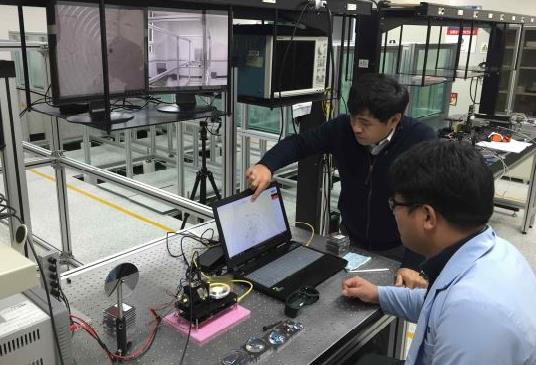
To achieve the technological capabilities mentioned earlier, inter-vehicle distance must be identified and controlled. Radar, ultrasonic, and LiDAR are available for this purpose, with radar being most widely used. However, due to radar's several limitations, transition to LiDAR is expected.
Radar is vulnerable at close range when using a single channel, but adding LiDAR improves close-range performance. Additionally, while radar has weak pedestrian recognition capability, LiDAR can recognize pedestrians. However, KETI projects that each technology has its own advantages and disadvantages, and in the future, radar, laser, and camera-based vision will complement each other's functions and be used together.
LiDAR, like radar, uses TOF (Time of Flight) method to determine distance and velocity. KETI developed a 'beam-splitting optical device' where a single laser passes through one lens and splits into three beams. It consists of a 'transmitting lens' that sends light with three beams and a 'receiving lens' that receives light from the left, right, and center.
KETI developed lenses, signal processing units, distance extraction algorithms, relative velocity extraction algorithms, and noise removal algorithms. Information obtained through these is available for real-time confirmation in the UI.
Additionally, KETI developed a compact Laser Range Finder (LRF) small enough to fit in a CCTV dome for supply to major corporations. The system features a modularized 'sensor unit' enabling channel expansion without significant modifications, a 'signal unit' responsible for angular resolution relative to scan speed during rotation, and a 'signal processing unit' that determines signal processing channels, precision levels, and noise/disturbance removal and amplification methods. These three modules can be customized and utilized according to customer requirements for enhanced functionality.
Another advantage is the ease of channel expansion. If operating 16 channels with a 5mm-wide laser, the width would be approximately 8cm. An 8cm transmitting lens would be around 20cm. In other words, significant modification to the sensor unit's optical structure would be necessary. KETI integrated the laser in chip form at 200 micrometers in size. This means channel expansion results in minimal size change, enabling independent sensor expansion. Consequently, signal processing unit size modification is also facilitated. Additionally, using invisible infrared laser eliminates performance degradation in poor visibility conditions such as nighttime or yellow dust.
Lee Han-young, researcher at the Korea Electronics Technology Institute, stated, "Demonstration of partially scannable laser fence and fixed-type LiDAR is possible, and 360-degree single-channel and 360-degree multi-channel development is expected to be completed in the near future."
Comments
Related news
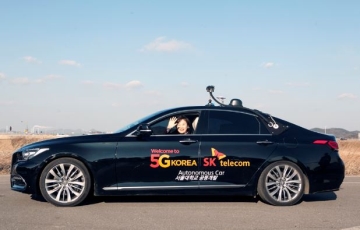
Stop worrying about accidents and emergencies with 5G autonomous vehicles!
SK Telecom (hereinafter SKT) Park Jin-hyo, Head of ICT Technology, said at a 5G autonomous vehicle demonstration conducted by SKT and the Korea Road Traffic Authority, "I am pleased to be able to showcase 5G technology," and "Through autonomous driving, we will prevent traffic accidents and create a world without accidents, improving quality of life." For safe and convenient autonomous vehicle operation, which SKT emphasized on this day, 5G implementation is essential. At CES 2017, Intel announced a 5G modem, signaling innovation in various fields such as wireless broadband and the Internet of Things. 5G, which is a concern for mobile carriers, the automotive industry, and various companies, has the following characteristics in autonomous vehicle operation.
2018.02.08by 김학준 기자
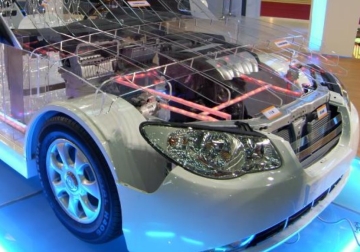
Autonomous vehicle sensors must increase MIMO and multi-path precision and reduce prices
Safety is an inherent requirement in autonomous vehicles. Regarding the direction of radar and lidar technologies to achieve this, researcher Lee Sun-young from the Electronics and Telecommunications Research Institute stated, "Radar must focus on precision enhancement based on MIMO technology and multi-path improvement, while lidar must continuously address the issues of expensive equipment and low resolution." Domestic and international companies are targeting the commercialization of autonomous vehicles by 2020. According to a market research firm, demand for autonomous vehicles is projected to increase during 2020-2025. Aligned with this, while companies continue research and development, the Tesla collision accident last month and Uber's recent fatal accident have caused vehicle owners and many people to develop anxiety and skepticism regarding Tesla's Autopilot and full commercialization of autonomous vehicles. Autopilot is Tesla's autonomous driving system in which radar and lidar, cameras, sensors and other components continuously monitor the vehicle's surroundings and independently perform calculations to prevent accidents and collisions. Autopilot is divided into four levels: Level 1 where driving is conducted without sensor assistance, Level 2 with sensors playing a supporting role, Level 3 where autonomous driving is possible in specific sections, and Level 4 where complete autonomous driving is possible.
2018.04.09by 김학준 기자
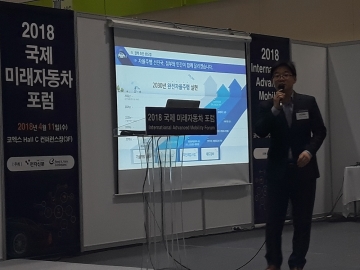
Domestic Autonomous Vehicle Roadmap Must Be Drawn Together with the Public and Private Sectors
The Ministry of Land, Infrastructure and Transport is advancing autonomous vehicles to Level 4 and 5, which enable fully autonomous driving by 2022, and is moving beyond early commercialization toward widespread adoption. Major companies such as BMW, Mercedes-Benz, Audi, Honda, Toyota, and Ford are pursuing commercialization of autonomous vehicles targeting 2020. Major developed countries including the United States, Europe, and Japan are establishing smart infrastructure tailored to traffic characteristics by city and accelerating commercialization timelines. Accordingly, domestic private enterprises, government, and national agencies are focusing on 'safety' and working to develop autonomous cooperative driving integrated with infrastructure. Kim Chang-gi, assistant director at the Ministry of Land, Infrastructure and Transport, stated at the 2018 International Future Automobile Forum that "the government is establishing the foundation for commercialization this year, targeting the commercialization of Level 3 autonomous vehicles capable of autonomous driving during specific periods by 2020, and the expansion of Level 4 and 5 based autonomous vehicles by 2022."
2018.04.12by 김학준 기자

[Technical Contribution] Caltera: "Evolution of Precision Sensing, UWB Infrastructure Enhances Parking Safety"
Discussing new possibilities in parking assistance and precision sensing with UWB, Lee Sang-min, Korea Branch Manager at Caltera.
2026.10.23by 편집부
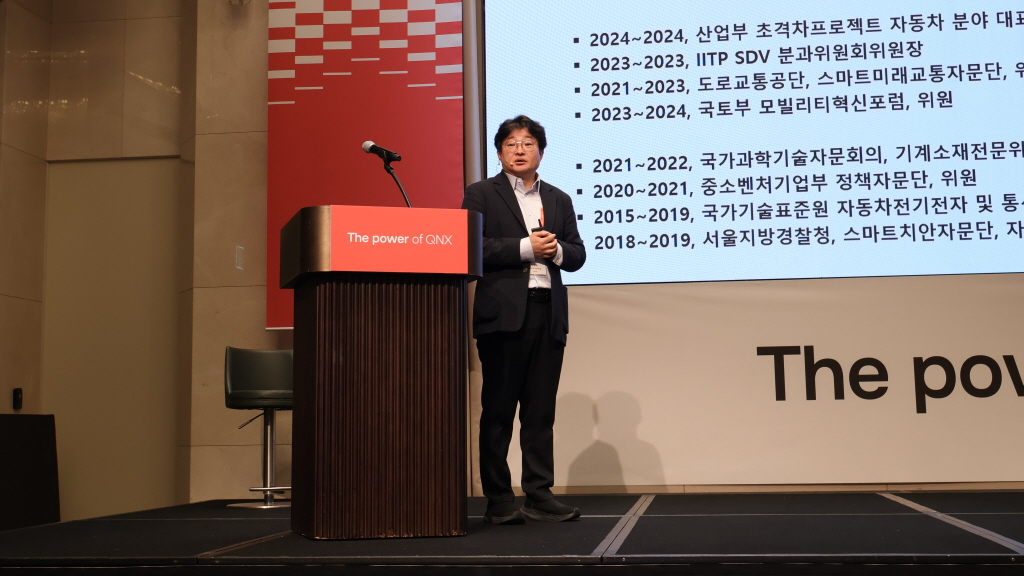
Professor Jeong Gu-min from Kookmin University, "QNX RTOS will become an important foundational technology in the physical AI era"
As software-defined vehicles (SDV) establish themselves as a new standard in the automotive industry, forecasts indicate that future competitiveness will be determined not by vehicle hardware but by software platforms and AI utilization capabilities. With the automotive industry rapidly transitioning to centralized architecture and AI-based development systems, an analysis suggests that how effectively vehicle platforms can be simplified and operated cost-efficiently will become core competitiveness for next-generation SDV and AI-defined vehicles. Professor Jeong Gu-min from Kookmin University emphasized at QNX TechForum Korea 2026 that "the automotive industry is now shifting from hardware competition to software ecosystem competition," highlighting that API-centric platforms and AI utilization will determine success or failure in the future automotive industry.
2026.10.23by 배종인 기자











