



ETRI Develops 5G Small Cell Hardware Following Software Success
 Published2018.08.25 07:02
Base Station Development by 2020, Commercialization in 2022
Driving 5G Convergence Service Ecosystem
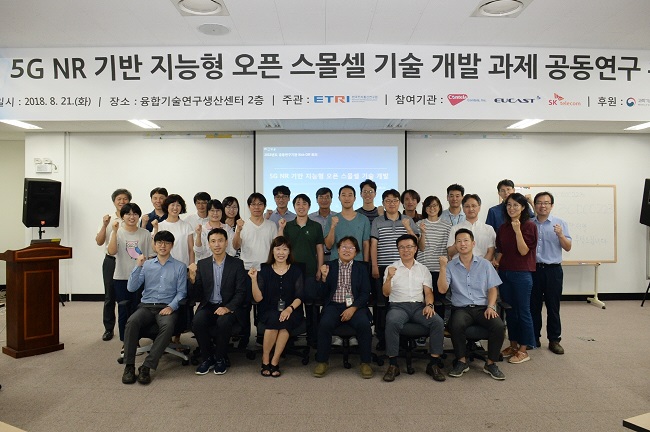
The Electronics and Telecommunications Research Institute (ETRI) has achieved localization of LTE small cell software for compact base stations used like wireless access points within a radius of 10m to 1km, and has now begun research for localization of small cell equipment essential to future 5G infrastructure. ETRI is targeting commercialization by 2022.
ETRI has initiated development of intelligent open small cell technology based on 5G wireless access (NR) under the Ministry of Science and ICT's direction, and held a workshop on the 21st with joint research institutions and related personnel participating onsite.
The technology ETRI is developing focuses on enhancing user-perceived transmission speed among improvements to maximum transmission speed (eMBB), which is a core 5G requirement.
ETRI has identified two advantages from commercialization of this technology.
First, since the radio access network aims for an open architecture, a new convergence ecosystem can be established. That is, while existing equipment has been mostly integrated small cells, this technology is developed to enable separation of equipment by function. This characteristic allows operators to divide equipment separately according to purpose, thereby creating a diverse equipment ecosystem.
Second, by providing an open API on top of the small cell, services tailored to purpose become easier in areas where small cells are deployed, such as buildings, shopping malls, and stadiums. Accordingly, a matching ecosystem can be established, enabling operators to provide service enabler functions.
Through joint development with SK Telecom, Contela, and uCast, ETRI has set as its first goal the development of a 5G NR small cell base station that provides 3GPP NR first-stage specifications by 2020.
The plan is to develop technology that uses the LTE network but employs 5G only when large-capacity, ultra-high-speed data communication is required, and then develop technology to use 5G network without an LTE network.
To make the leap from LTE to 5G, ETRI will develop 5G NR specifications capable of accommodating millimeter wave based on experience with LTE small cell technology in which prior R&D was successful, and develop location-based beamforming technology to enhance user-perceived transmission speed, applying these to new base stations.
Additionally, by 2022, ETRI plans to add intelligent and open interfaces to 3GPP NR second-stage specifications and advance the 5G small cell base station to a commercial level.
Meanwhile, small cells can easily accommodate not only residential, building, and special-purpose applications but also diverse convergence services of small scale seeking to utilize 5G infrastructure, making it a field accessible to SMEs. This requires significant participation from SMEs in establishing 5G infrastructure, and is expected to contribute greatly to job creation. Costs can also be reduced by avoiding foreign equipment.
Based on research outcomes, ETRI plans to secure core source patents and actively participate in international standard technology development in the small cell field through these patents.
ETRI believes that in the coming 5G era, the importance of small cells will be highlighted due to the propagation characteristics of the newly adopted high-frequency band (millimeter wave). Small cells, which have relatively narrow coverage but superior performance, will be utilized to handle exploding traffic growth.
Kim Tae-joong, Head of ETRI's Future Mobile Communications Research Division, stated, "Localization of 5G small cell foundational technology will serve as a breakthrough for domestic SME and mid-sized enterprises' participation in the mobile communication equipment market. This will provide a foundation for applying diverse 5G convergence services."
Lee Jae-hak, Future Communications/Radio Spectrum PM at the Information and Communications Technology Promotion Center (IITP), said, "5G small cells represent an equipment market accessible to Korea's hidden champion companies and will greatly contribute to enhancing national technology competitiveness."
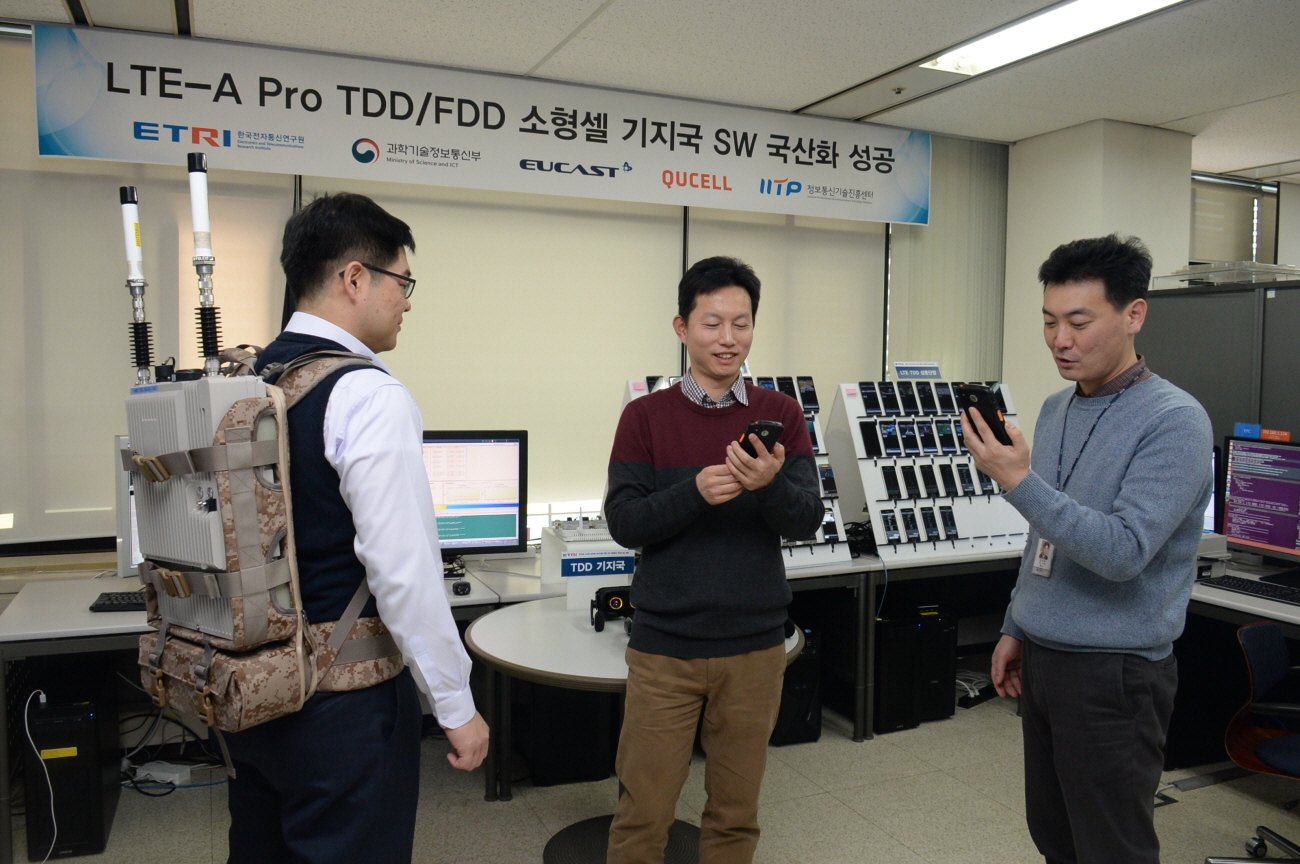
Meanwhile, ETRI successfully developed LTE-based small cell SW in 2016 that eliminates communication dead zones, and earlier this year achieved development of more upgraded LTE-A Pro-based small cell SW and transferred the technology to SMEs. The company receiving the technology transfer is creating backpack-type base station products and exploring overseas market entry.
Comments
Related news
KT Leads SME Ecosystem Revitalization with Open 5G Standards
Open 5G networks, unlike closed existing wireless networks that used dedicated base station equipment, enable interoperability between equipment from different manufacturers through open interfaces, thereby providing an environment where small and medium-sized enterprises can easily develop network equipment.
2018.06.28by 명세환 기자
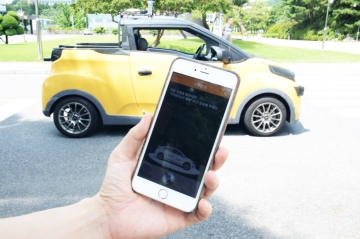
Self-driving cars that come and go automatically according to smartphone instructions
The Electronics and Telecommunications Research Institute (ETRI) has developed autonomous vehicle technology that enables vehicle boarding through mobile call-up and successfully demonstrated it.
2018.08.03by 이수민 기자
ETRI succeeds in developing satellite frequency interference cancellation technology.
The Electronics and Telecommunications Research Institute has successfully developed technology for efficiently utilizing limited frequency resources currently used in satellites. This technology overlaps transmit and receive frequencies and enables signal separation of terminal signals from the overlapped frequencies. As a result, it is possible to allocate twice as many additional channels compared to existing methods while reducing costs.
2018.08.16by 이수민 기자
European Patent Applications Surpass 200,000 for the First Time… South Korea Maintains 5th Place, Led by Batteries and Telecommunications
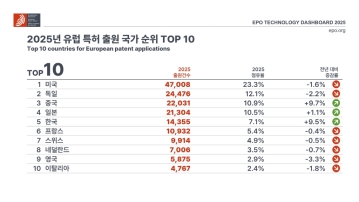
According to the European Patent Office (EPO)'s 'Technology Dashboard 2025', European patent applications last year reached 201,974, surpassing 200,000 for the first time. Korean companies and inventors filed 14,355 applications, representing a 9.5% increase from the previous year and maintaining 5th place by country. Battery, digital communication, and semiconductor technologies led the growth, with Samsung ranking as the top EPO applicant for the second consecutive year and LG reaching 3rd place. The presence of major domestic cities such as Seoul, Suwon, and Yongin was also confirmed. It was also revealed that Korea's European patent strategy is expanding beyond individual technologies to span the entire industry.
2026.03.24by 명세환 기자

SK Telecom First Applies AI-Based Network Operations at Gwanghwamun K-Pop Concert
SK Telecom announced that it applied an AI-based network operation system for the first time at a large-scale K-pop concert held in the Gwanghwamun area of Seoul on March 21st, managing communication quality throughout the event. Mobile data usage during the three hours before and after the concert reached 12.15TB, approximately doubling compared to the same time slot the previous weekend. SK Telecom monitored traffic using the AI system 'A-One' in five-minute and 50-meter units to respond to potential overload situations, while also operating temporary communication facilities and on-site personnel in parallel. This case is interpreted as confirmation of the practical applicability of AI-based autonomous network operation in an environment where demand from dense events and foreign users increases simultaneously.
2026.03.23by 명세환 기자











