


"Now it's about touch" ETRI Successfully Develops 25Gbps Tactile Internet Technology
 Published2018.11.27 09:56
Optical Transceiver Module and MAC, Channel Bonding Technology Developed
Expectations for Activation of Personal Media Broadcasting and Immersive Entertainment
Domestic researchers have successfully developed core technologies for utilizing significantly faster internet. They have increased capacity by up to 10 times and reduced latency by 10 times through equipment improvements alone, without additional optical fiber installation—solving a long-standing challenge of establishing communication networks from users to telephone exchanges.
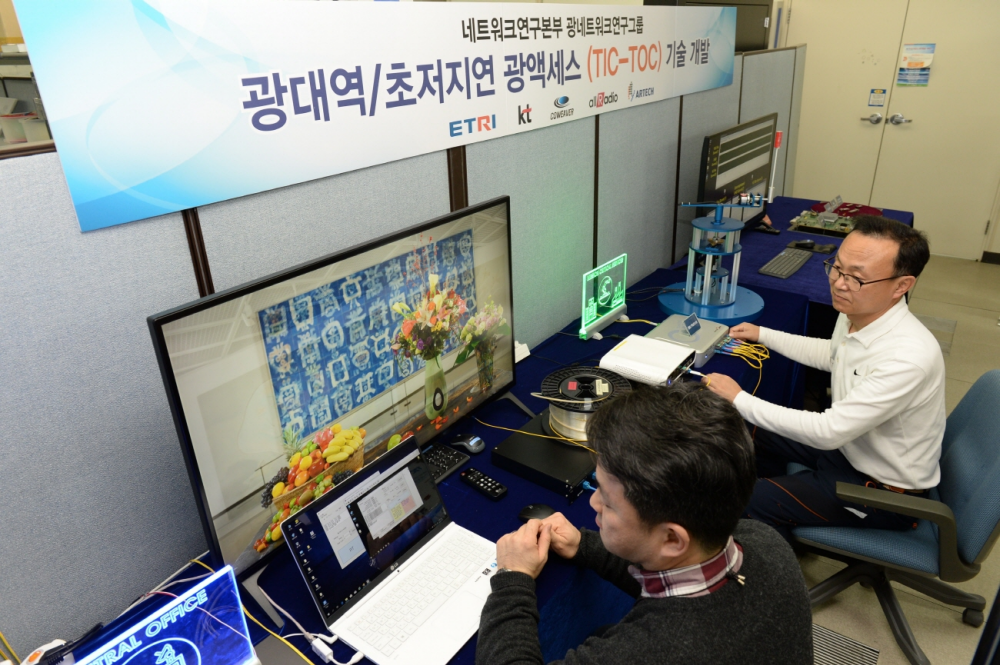
ETRI has developed TiC-TOC, a 25Gbps-class tactile internet technology
The Electronics and Telecommunications Research Institute (ETRI) announced that it has successfully developed core source technologies enabling 25Gbps-class internet, surpassing the existing maximum speed of 2.5Gbps for wired internet. Through this technology, data transmission is possible in 0.001 seconds—the speed at which humans can perceive tactile sensation—fast enough to download a 3GB movie in 1 second. This technology opens the era of tactile internet in the future.
Until now, internet has had limitations: when many users connect through mobile base stations or Wi-Fi, traffic increases in access networks existing within approximately 20km to nearby telephone exchanges, resulting in slower processing speeds and longer service times. Researchers have resolved this technological challenge with 25Gbps-class tactile internet technology, naming it 'TiC-TOC (Time Controlled-Tactile Optical Access)'.
ETRI explained that high-speed optical reception module technology and MAC (Medium Access Control) technology are the core of this technology. Through this, while using existing optical fiber lines as internet infrastructure, laser operating speed has been increased 10 times, enabling rapid transmission of vast amounts of data.
The high-speed optical reception module was developed to cleanly restore signals even with low optical input intensity. Additionally, MAC technology manages packets to enable traffic transmitted through optical fiber to be processed with ultra-low latency.
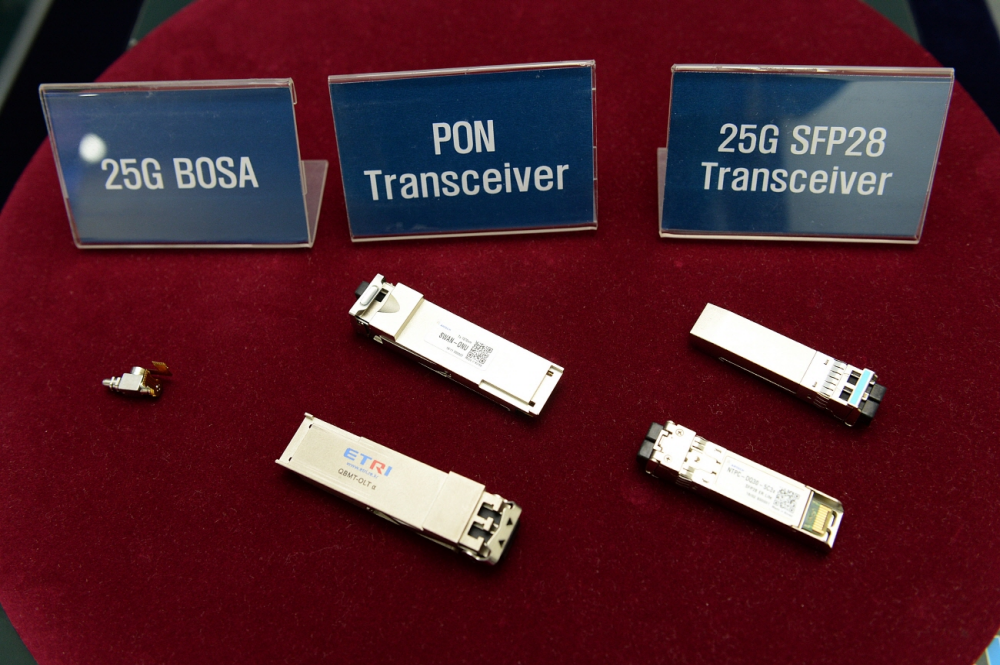
ETRI has integrated the optical transceiver module and optical transceiver MAC technology as one unit within the line card
Researchers combined the developed optical transceiver module and optical transceiver MAC technology into a single unit, embedding it in a line card as if it were one board. Subsequently, by upgrading the existing Optical Line Terminal (OLT) installed at telephone exchanges and Optical Network Units (ONU) at apartments or buildings, ultra-high-speed, ultra-low-latency internet service becomes possible.
Researchers stated that this technology is based on previously developed ETRI technologies including ▲channel bonding technology ▲low-latency bandwidth allocation technology ▲high-sensitivity optical reception modules and optical transceiver technology. They noted that while existing internet divides user speeds through a single channel, this new technology increases the number of channels and speeds, enabling more people to use faster internet without speed degradation.
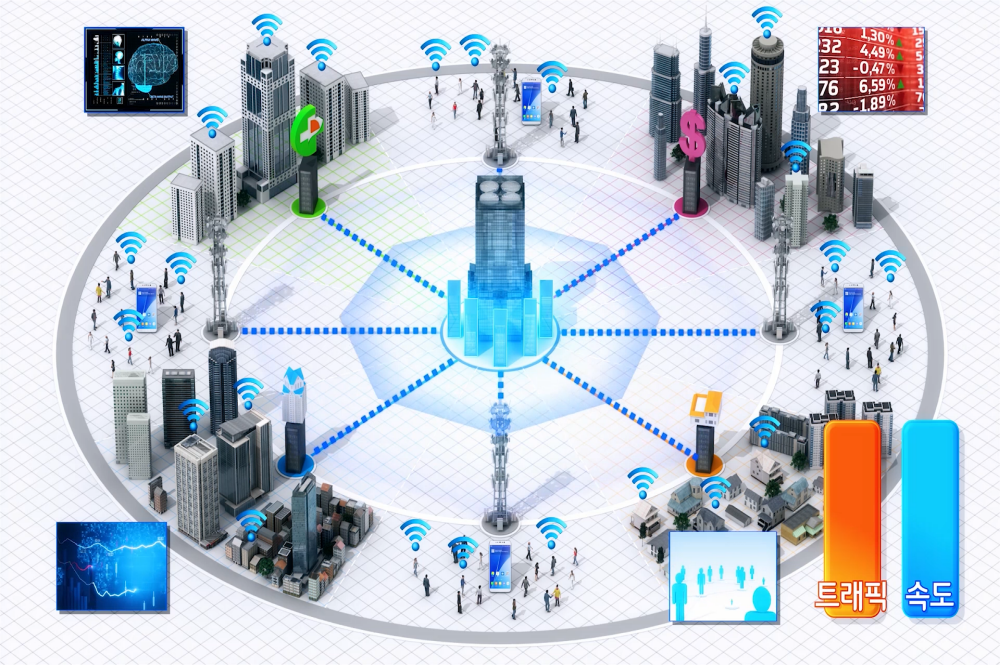
KOREN
ETRI announced that on the 7th, to demonstrate this technology, it successfully conducted data transmission tests through KOREN (Korea Research Environment Open NETwork), a leading-edge future network test bed established between Seoul and Daejeon. The developed tactile internet technology was demonstrated through Coweaver's long-distance optical transmission equipment (POTN) installed on KOREN. Researchers confirmed this by successfully controlling in real-time a robot (pendulum device) installed in the experimental laboratory on the first floor of ETRI Building 7 in Daejeon from the control center at the Korea Information Society Development Institute in Seoul, 260km away, and also succeeding in 4K UHD-level video transmission.
This research has been progressing with support from the Ministry of Science and ICT since 2015 for the "Development of SDN-based Integrated Wired and Wireless Access Optical Networking Technology" project. Through the project, researchers have completed 9 SCI-level papers, filed approximately 40 domestic and international patents, and completed technology transfer to optical module and system companies. Commercialization is expected to be possible next year.
ETRI, together with KT, Coweaver, Olaedio, and ARtech, has developed 25Gbps tactile internet technology that has resolved existing internet capacity and information transmission time issues.
ETRI estimates the direct and indirect global market size related to this technology at $15.3 billion in 2020 and approximately $21.2 billion in 2024.
Researchers plan to further pursue research on intelligent optical access networks that intelligently accommodate ultra-immersive, ultra-connected, ultra-low-latency services while enabling rapid provision by service type. Through this, researchers plan to develop 50Gbps-class tactile internet technology and secure future intellectual property rights to drive domestic industry development.
Yang Sun-hee, head of ETRI's Network Research Division, stated: "Through the developed tactile internet technology, not only will affluent living become possible through the spread of immersive digital life, but activation of related equipment industries and service ecosystems is also expected."
Comments
Related news
ETRI Develops 5G Small Cell Hardware Following Software Success
The Electronics and Telecommunications Research Institute (ETRI) has achieved localization of LTE small cell software for compact base stations used like wireless access points within a radius of 10m to 1km, and is now embarking on full-scale research for localization of small cell equipment essential to future 5G infrastructure. ETRI is targeting commercialization by 2022.
2018.08.25by 이수민 기자
ETRI introduces Ethernet to prevent in-vehicle hacking.
The Electronics and Telecommunications Research Institute (ETRI) is developing core security technologies tailored to new environments that are necessary for the commercialization of next-generation automotive networks based on Ethernet. ETRI is conducting research that reflects vehicle characteristics, drawing on accumulated expertise and know-how from performing encryption technologies, authentication technologies, communication security technologies, and application service technologies including IoT and vehicle V2X projects.
2018.10.13by 이수민 기자
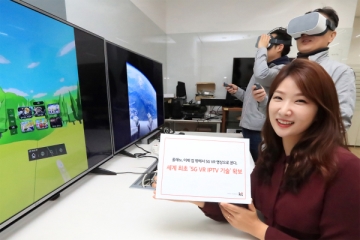
"Now IPTV Outside the Home" KT Develops 5G VR IPTV Technology
KT has developed "5G VR IPTV technology" for the first time in the world, enabling its IPTV service Olleh TV to be viewed in external environments through a wireless-based standalone VR device. Existing LTE network-based smartphone video services have had difficulty providing high-quality immersive services due to limitations in speed and display size. However, with this technology applied, users can view high-definition UHD real-time channels and VoD services identical to IPTV services provided by conventional set-top boxes by utilizing 5G mobile networks that are 20 times faster and HMDs.
2018.11.27by 이수민 기자
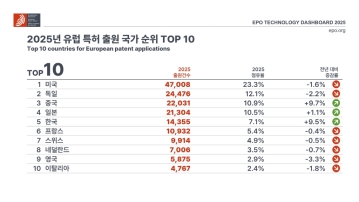
European Patent Applications Surpass 200,000 for the First Time… South Korea Maintains 5th Place, Led by Batteries and Telecommunications
According to the European Patent Office (EPO)'s 'Technology Dashboard 2025', European patent applications last year reached 201,974, surpassing 200,000 for the first time. Korean companies and inventors filed 14,355 applications, representing a 9.5% increase from the previous year and maintaining 5th place by country. Battery, digital communication, and semiconductor technologies led the growth, with Samsung ranking as the top EPO applicant for the second consecutive year and LG reaching 3rd place. The presence of major domestic cities such as Seoul, Suwon, and Yongin was also confirmed. It was also revealed that Korea's European patent strategy is expanding beyond individual technologies to span the entire industry.
2026.03.24by 명세환 기자

SK Telecom First Applies AI-Based Network Operations at Gwanghwamun K-Pop Concert
SK Telecom announced that it applied an AI-based network operation system for the first time at a large-scale K-pop concert held in the Gwanghwamun area of Seoul on March 21st, managing communication quality throughout the event. Mobile data usage during the three hours before and after the concert reached 12.15TB, approximately doubling compared to the same time slot the previous weekend. SK Telecom monitored traffic using the AI system 'A-One' in five-minute and 50-meter units to respond to potential overload situations, while also operating temporary communication facilities and on-site personnel in parallel. This case is interpreted as confirmation of the practical applicability of AI-based autonomous network operation in an environment where demand from dense events and foreign users increases simultaneously.
2026.03.23by 명세환 기자











