


Webinars
# VCSEL Test Requirements and 10 μs Pulse Test Solution
There is a growing demand for distance and speed measurement in three-dimensional space in autonomous driving in the automotive industry, augmented reality in games and consumer products, and electronic products used in industrial fields.
As the number of 3D sensing applications increases, the development and production of optoelectronic devices such as laser diodes are also accelerating.
In particular, 'VCSEL (Vertical Cavity Surface Emitting Laser)', one of the key components of 3D sensing systems, was introduced to smartphones with the launch of iPhone X with FaceID functionality at the end of 2017.
Since then, VCSEL has been integrated into various other flagship models, marking the beginning of full-scale application of VCSEL technology. Currently, the automotive sector, particularly the application of VCSEL to 'autonomous driving sensors', is expected to be the broadest field of utilization for VCSEL.
Generally, autonomous driving sensors are classified into three main categories: cameras, radars, and LiDAR sensors. In particular, there is a need to apply VCSEL technology to 'LiDAR (Light Detection and Ranging)'.
Therefore, this webinar will examine the applications requiring VCSEL and their technology trends, and explore how Tektronix's proprietary solutions can efficiently address the challenges of VCSEL testing.
Generally, VCSEL testing is performed using 'Pulsed DC' to minimize device heat generation. However, at current levels of up to 10A in test requirements, short pulses of 10µs must be used to maintain self-heating levels at reasonable levels. In other words, precise adjustment of pulses to minimize overshoot and undershoot is the main challenge in VCSEL testing.
Previously available solutions on the market had the drawback of requiring engineers to manually adjust pulses. However, Tektronix's 2601B Pulsed SMU is the industry's first to be capable of directly generating 10A pulses at up to 10V with a short pulse width of 10µs. That is, when pulse sourcing, accurate pulse output as well as fast rise time and high-fidelity results can be obtained.
Additionally, the following content will be covered.
- Understanding cases requiring short current pulse generation and testing
- Effects of inductance in the test circuit
- Importance of cable ringing used in test circuits
- Practical limitations such as pulse adjustment that occur during testing
- Key features and advantages of Keithley Model 2601B-PULSE SMU
Speaker Biography
David Kim (Kim Soo-gill), Director, is a Keithley Applications Engineer on the Product Marketing team at Tektronix headquarters. He has over 10 years of experience in the AE field in Korea. He holds a bachelor's degree and master's degree in electrical engineering from Seoul National University. He has worked for over 10 years in the semiconductor device and optical device testing field, including Keithley and Tektronix, in Korea, and has been leading SMU (Source Measure Unit) product line marketing at Tektronix headquarters since 2018.
As the number of 3D sensing applications increases, the development and production of optoelectronic devices such as laser diodes are also accelerating.
In particular, 'VCSEL (Vertical Cavity Surface Emitting Laser)', one of the key components of 3D sensing systems, was introduced to smartphones with the launch of iPhone X with FaceID functionality at the end of 2017.
Since then, VCSEL has been integrated into various other flagship models, marking the beginning of full-scale application of VCSEL technology. Currently, the automotive sector, particularly the application of VCSEL to 'autonomous driving sensors', is expected to be the broadest field of utilization for VCSEL.
Generally, autonomous driving sensors are classified into three main categories: cameras, radars, and LiDAR sensors. In particular, there is a need to apply VCSEL technology to 'LiDAR (Light Detection and Ranging)'.
Therefore, this webinar will examine the applications requiring VCSEL and their technology trends, and explore how Tektronix's proprietary solutions can efficiently address the challenges of VCSEL testing.
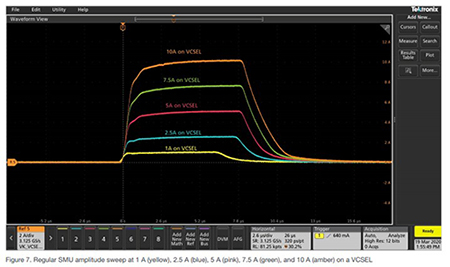 |
Generally, VCSEL testing is performed using 'Pulsed DC' to minimize device heat generation. However, at current levels of up to 10A in test requirements, short pulses of 10µs must be used to maintain self-heating levels at reasonable levels. In other words, precise adjustment of pulses to minimize overshoot and undershoot is the main challenge in VCSEL testing.
Previously available solutions on the market had the drawback of requiring engineers to manually adjust pulses. However, Tektronix's 2601B Pulsed SMU is the industry's first to be capable of directly generating 10A pulses at up to 10V with a short pulse width of 10µs. That is, when pulse sourcing, accurate pulse output as well as fast rise time and high-fidelity results can be obtained.
Additionally, the following content will be covered.
- Understanding cases requiring short current pulse generation and testing
- Effects of inductance in the test circuit
- Importance of cable ringing used in test circuits
- Practical limitations such as pulse adjustment that occur during testing
- Key features and advantages of Keithley Model 2601B-PULSE SMU
Speaker Biography
David Kim (Kim Soo-gill), Director, is a Keithley Applications Engineer on the Product Marketing team at Tektronix headquarters. He has over 10 years of experience in the AE field in Korea. He holds a bachelor's degree and master's degree in electrical engineering from Seoul National University. He has worked for over 10 years in the semiconductor device and optical device testing field, including Keithley and Tektronix, in Korea, and has been leading SMU (Source Measure Unit) product line marketing at Tektronix headquarters since 2018.
Comments
- 24 Comments
- 이*승 (2020-06-25 오전 11:00:30)
- 좋은 방송 기대합니다.
- 박*혁 (2020-06-25 오전 10:18:31)
- 재미있고 유익한 세미나 부탁드려요!
- 최*휴 (2020-06-25 오전 8:03:51)
- 무척 기대합니다.
- 최*휴 (2020-06-25 오전 8:03:45)
- 완전 기대합니다.
- 이*광 (2020-06-23 오후 7:00:45)
- 기대합니다
- 김*태 (2020-06-23 오전 11:01:13)
- 유익한 세미나 기대합니다
- 박*용 (2020-06-16 오전 10:42:00)
- 유용한 세미나 기대합니다.
- 최*휴 (2020-06-12 오전 8:18:44)
- 완전 기대합니다.
- 김*문 (2020-06-09 오후 4:46:25)
- 기대되는 세미나 입니다.
- 김*용 (2020-06-09 오후 4:38:37)
- 좋은 내용 기대합니다.