



Thread + Zigbee = 'Dotdot', Presenting New Possibilities in the Wireless Field
 Published2019.01.28 17:06
Collaboration between RF protocols Thread and Zigbee
The interconnectedness of all everyday objects in a single language
Concepts such as smart homes, connected homes, and home IoT are already becoming a reality around us. End-device manufacturers are also developing a variety of products, although they have so far focused on niche markets. In particular, the pace of adoption is expected to accelerate further as the use of voice command devices, such as Amazon's Echo and Apple's HomePod, increases.

Smart Home
Voice commands such as “Alexa, make the lights brighter” will facilitate the installation of systems that provide more sensor data, enabling Alexa to perceive the current space, recognize the surrounding environment, and control 'objects' through control channels. At the same time, as new wireless networking technologies are developed, continuously improved performance and flexibility, as well as excellent interoperability, must be provided.
Stable low-power wireless networks utilizing a mesh architecture are an attractive solution for both industrial and residential environments. For the technology to succeed, the product must be easy to operate, ready for immediate use, and defect-free. For example, in the case of homeowners, simple setup and stable operation must be enabled, taking into account the possibility of returns.
Similarly, while early adopters may be satisfied with incompatible devices from independent product families, an environment where products from multiple vendors can be used together must be established to maximize market potential. Therefore, standards are necessary.
We have already experienced a series of processes that enable the initiation of discussions on redefining standards. A brilliant idea at a moment preempts the technology to be used in the industry. There are various concepts regarding how to successfully commercialize such ideas. Fundamentally, these include grouping and collaboration, as well as competing against various other candidate technologies within a very short period of time to become the standard.
Compared to the historical standards 'wars' that unfolded during the development of technology-based products in other fields, low-power short-range wireless technology has faced relatively few difficulties relative to the benefits gained in this field. Bluetooth, ANT, Zigbee, and Thread, which provide proprietary and non-interoperable products using several of the same basic elements, have essentially established their own technological domains.
Maturity of standards
The basic idea behind low power consumption dates back about 20 years to using wireless protocols with slow data speeds for monitoring and product control.
The Zigbee Alliance, formed in 2002, has developed a wide range of standards and now has specifications suitable for various applications including home automation, lighting control, and smart energy. These member companies are currently establishing numerous products in global markets.
The Thread protocol, for which the Thread Group was formed in 2014, subsequently emerged in the field of low-power mesh networking. At the time of the group's formation, Arm, Samsung Electronics, and Qualcomm were listed as member companies. The Thread protocol is configured using the Internet Protocol (IPv6 addressing) and follows the 6LoWPAN standard. Like Zigbee, it utilizes IEEE 802.15.4 RF hardware and can use silicon from various vendors.
The Thread Group presented a protocol designed specifically for the home automation sector by embedding security features using existing IP-based techniques. It also introduced technology that requires 'battery-friendly' operation and can be 'used as an Internet standard on resource-constrained embedded devices.'
Meanwhile, in the field of home automation, a different approach to Bluetooth has emerged, targeting wireless point-to-point and device-to-device connectivity. Following its evolution into Bluetooth LE (Bluetooth Low Energy), the latest version (Bluetooth 5) has improved range and throughput (simultaneous operation is not supported), and supports mesh networking through the release of Bluetooth Mesh 1.0.
Bluetooth Special Interest Group (SIG) announced that it is making successful market strides as an option for mesh networks, particularly in the smart lighting sector. Bluetooth LE is natively supported on all smartphones and tablets currently in use, and Bluetooth SIG expects consumers to benefit from a familiar interface for controlling wireless home automation devices.
Implemented in a single language
While the Bluetooth SIG was improving products for home automation applications, Thread and Zigbee were not idle. Rather, these groups joined forces to support new standardization efforts, resulting in 'Dotdot'. Dotdot represents a movement to extend standardization to the upper application layers of the existing standards stack.
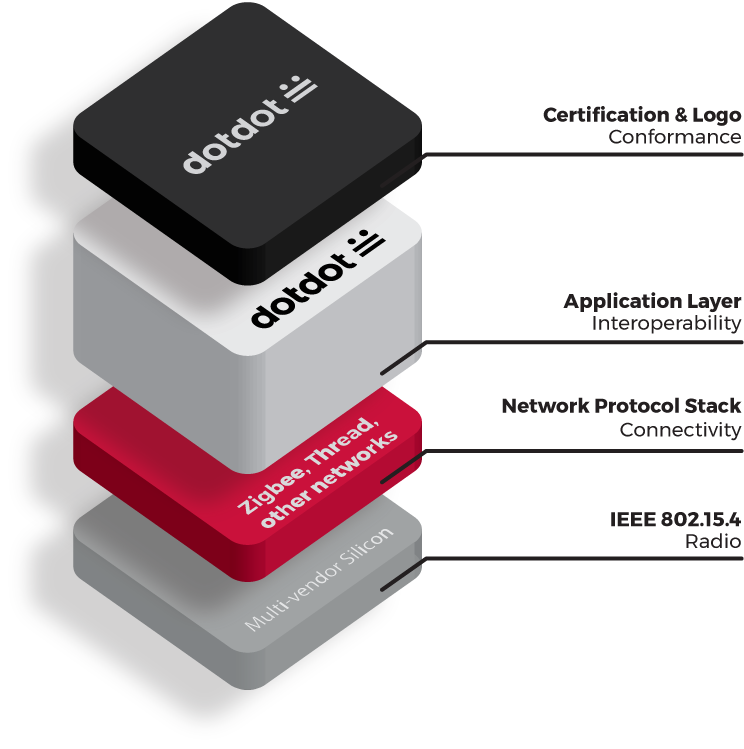
Dotdot uses an IEEE 802.15.4 compliant PHY and runs on thread-based IP platforms.
Dotdot is the result of efforts to create a single language capable of handling the connectivity attributes of all everyday objects with the goal of enabling IoT. It can be described as an 'open, general-purpose protocol' developed by Zigbee that uses an IEEE 802.15.4 compliant PHY (Physical Layer). At the same time, it runs on Thread's IP-based platforms.
Therefore, Dotdot is not a new standard. Zigbee regards it as a 'universal layer for threads and IoT (devices) as a universal platform.' Furthermore, Dotdot is not entirely newly developed, but is based on application-level functions already presented in the Zigbee specification, ZCL (Zigbee Cluster Library).
ZCL is now named Dotdot. Dotdot is a set of commands and attributes encompassing various Zigbee profiles that developers can use to implement interoperability with products from other manufacturers or to implement products utilizing public Zigbee profiles, such as Zigbee Smart Energy. Similar to the app store model used in smartphones, Dotdot enables applications to run on all appropriate compatible devices.
Developers are the ones who need Dotdot's feasibility the most. Therefore, they will have no difficulty writing interoperable device-level code. On the other hand, consumers will see the Dotdot brand name and logo, but they will not be very interested in technical details. This is because what matters to these consumers is that networked devices are simple, intuitive, and function properly.
Standard wars are resolved through various methods. Some competitors may disappear, or they may choose between collaboration and convergence. Alternatively, assistance may be obtained depending on the situation on the hardware side. As ICs continuously evolve in specific technology fields, experience accumulates and integration density increases. Early-generation product lines may consist of different silicon with distinct firmware/software standards. Subsequently, through iterative work, the optimal choice for the feature set configuration will be realized through multi-protocol components capable of accommodating all relevant protocols and standards, freeing developers from the risks of narrow options.
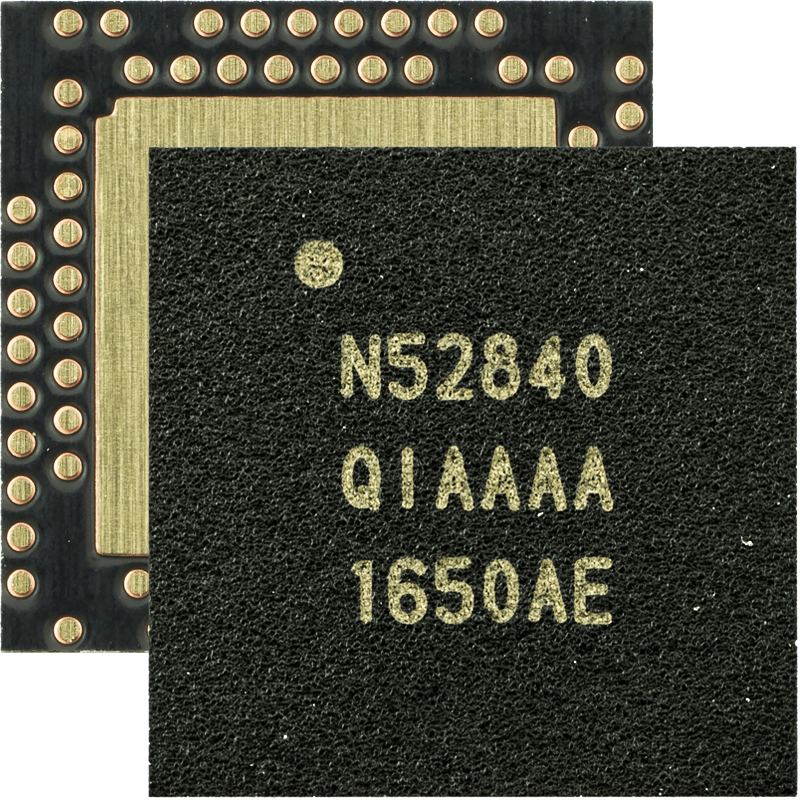
Nordic Semiconductor nRF52840
For example, Nordic Semiconductor's nRF52840 multi-protocol SoC is based on an Arm 32-bit Cortex-M4F microprocessor and integrates 1MB of flash and 256kB of RAM. This chip supports Bluetooth 5 and ANT, as well as configurable proprietary 2.4GHz operation. The nRF52840 also includes an IEEE 802.15.4 PHY to support all standard-based protocols.
This chip has obtained Thread 1.1 certification (OpenThread stack execution) and comes with the nRF5 SDK (Software Development Kit) for Thread and Zigbee. In addition, by supporting simultaneous operation between Zigbee/Thread and Bluetooth LE environments, it enables the implementation of the most flexible products suitable for next-generation residential, commercial, and industrial networks.
This article was written by Graham Prophet. Prophet previously worked as a reporter for EDN Europe and is currently working as a freelance journalist in the electronics field.
관련뉴스

Bluetooth Mesh Networking Enables Smart Industries
Bluetooth mesh networking technology is being actively used in the implementation of smart buildings and smart industry within one year of its launch.
2018.07.26by 이수민 기자
.jpg)
Nordic Launches Module for Implementing Cellular IoT in Any Product
Nordic Semiconductor supplies the nRF9160 SiP, the first product in the nRF91 series of cellular IoT modules. The nRF9160 has obtained GCF certification, the quality mark of the mobile communications industry regarding 3GPP LTE specification compliance and global cellular network interoperability, and has additionally acquired certifications for the separately required FCC and CE regulations. With the official supply of the nRF9160 commencing, it is anticipated that cellular IoT wireless technology can be easily implemented across all applications.
2018.12.13by 이수민 기자
.jpg)
Nordic Supplies SoC for SoluM Bluetooth LE Air Quality Monitor
Nordic Semiconductor announced that Soluem, a domestic electronics specialist, has adopted Nordic's nRF52832 SoC for Bluetooth LE wireless connectivity in Kico Air, a smart air quality meter based on Bluetooth LE and Wi-Fi. Once installation and configuration of Kico Air is complete, users can pair the device with Bluetooth 4.0 or higher compatible smartphones or tablets using the low-latency Bluetooth LE wireless connection provided by the Nordic SoC.
2019.01.21by 이수민 기자
Ecolab and K-water Discuss Innovation Collaboration in Advanced Industry Water Management
Ecolab and the Korea Water Resources Corporation jointly discussed cooperation directions for maximizing water use efficiency in advanced industries such as semiconductors and data centers and establishing sustainable water circulation. The two companies agreed to gradually develop a long-term cooperation model that combines water resource infrastructure and water management technology to promote water efficiency optimization, water reuse, and carbon reduction.
2026.08.28by 명세환 기자

에이치에너지, 녹색기술인증 획득…솔라온케어 가동률 99.82%
에이지에너지가 태양광 발전예측 및 I-V커브 이상진단 기술로 중소벤처기업부 녹색기술인증을 획득했다. AI 기반 자산관리 플랫폼 솔라온케어는 전국 3,000개 이상 발전소에 적용되어 99.82%의 시스템 가동률과 3.7% 발전성능 개선을 달성했다. 실시간 데이터 분석을 통해 모듈 노화와 부분 음영 등 미세한 손실을 조기에 감지하고 관리함으로써 발전 수익을 보호한다.
2026.08.25by 명세환 기자











