



ETRI succeeds in developing sensor technology to predict depression using biosignals
 Published2019.01.30 09:24
Diagnosis by measuring skin conductance
Diagnosis of mental illness through wireless communication
A domestic research team has succeeded in developing a technology that objectively diagnoses the condition and severity of depression patients using a skin conductance sensor. This opens the way to diagnosing and early predicting the onset of depression using biosignals.
(1).jpg)
ETRI succeeds in developing technology to diagnose depression using skin conductance sensor
The Electronics and Telecommunications Research Institute (ETRI) announced on the 29th that the results of an experiment conducted on depression patients in collaboration with the team of Professor Jeon Hong-jin of the Department of Psychiatry at Samsung Seoul Hospital using a skin conductance sensor capable of measuring minute sweat changes on the skin, noting that depression patients' sweat response becomes dull when they are stressed, were published in Scientific Reports.
The research team said that since the diagnosis and treatment of patients with mental illnesses such as depression have mainly relied on psychological tests or medical questionnaires, they began the study to provide medical professionals with a more objective method for early detection and prevention of mental illnesses.
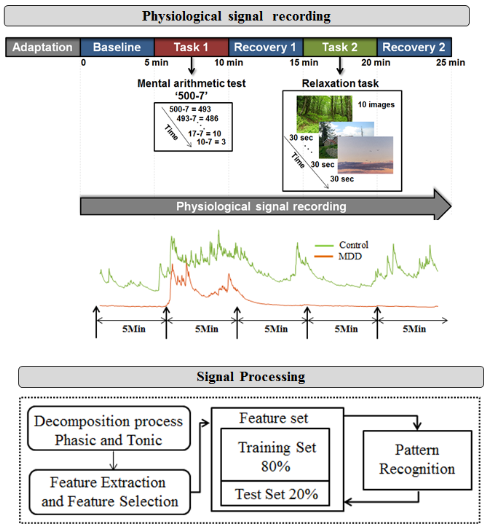
Schematic diagram of protocol and data analysis for predicting mental health symptoms
When the mental state of patients worsens, hormonal responses related to the brain become disrupted, which leads to autonomic nervous system responses. The research team began research and development to objectively measure physiological changes, such as minute amounts of sweat, using a skin conductance sensor attached to the fingertips to help doctors make more efficient diagnoses.
Afterwards, a noninvasive (diagnosing or treating a disease without penetrating the skin or passing through a hole in the body) biosignal data measurement was performed on people without depressive disorder, patients with major depressive disorder, and patients with panic disorder for three months. In this paper, it was explained that it is possible to distinguish between patients with depressive disorder and those without depressive disorder, targeting approximately 60 mental patients with major depressive disorder at the Department of Psychiatry at Samsung Seoul Hospital, including those without depressive disorder.
In particular, the research team revealed in this paper that it is possible to diagnose depressive disorder using skin conductance signals, and further developed an automatic diagnosis model based on machine learning that can objectively and more accurately diagnose and monitor the condition of depressive disorder patients.
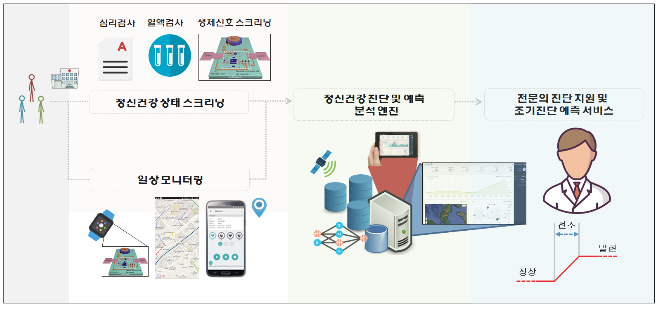
Mental health monitoring and symptom prediction concept
The research team emphasized that in order to predict disease signs more accurately, it is necessary to supplement the analysis techniques based on complex sensors such as brain waves, heartbeat, respiration, and temperature in addition to skin conductance. As a result, if the level of research completion is improved in the future, it is expected that it will be possible to diagnose and predict symptoms of various mental illnesses such as panic disorder, attention deficit hyperactivity disorder (ADHD), trauma, and autism in addition to depression.
To this end, ETRI conducted additional data analysis on four elements other than the skin conductance sensor through joint research with the team of Professor Jeon Hong-jin of the Department of Psychiatry at Samsung Seoul Hospital. Through follow-up observation, the patient’s diagnosis and psychological test results, blood and sweat, heart rate, respiration, blood pressure, and brain wave bio-signal data were obtained.
(1).jpg)
The developed sensor is expected to be installed in wearable devices in the future.
In addition, the research team created a composite module (sensor) capable of measuring multiple biosignals measuring 36.5 mm x 33 mm. The research team said that although the sensor is ready for immediate commercialization, the sensor size needs to be reduced and the level of completion needs to be increased to make it into a wearable device with wireless communication in order to reach a level where it can be applied to actual patients in the future. The plan is to apply it to the wrist through a wearable device in the future.
Therefore, if the results of this study are commercialized, it is expected that sensors can be attached to wearable watches to analyze sweat and measure blood pressure and heart rate. This will allow people to identify their condition at an early stage. If applied to patients in the future, it is expected that it will be possible to automatically notify guardians or hospitals of serious conditions and manage them.
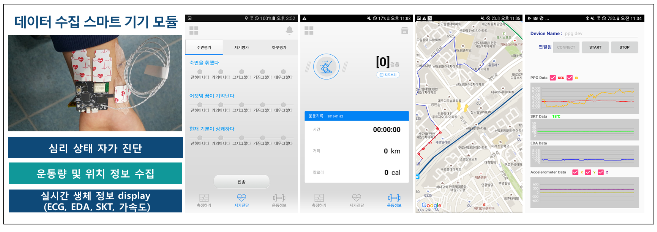
Data Collection Smart Devices and Applications
This study was developed over a period of three years from 2015 through the “Development of a skin-attachable sensor module for monitoring and predicting symptoms of mental illness” project of the Ministry of Science and ICT. Through this technology development, the research team applied for three international patents and 18 domestic patents. The number of SCI papers published reached 17.
ETRI Biomedical IT Research Center Director Seung-Hwan Kim, who is in charge of the research, said, “We have seen the potential for developing a biosignal-based mental illness diagnosis and prediction system that can objectively diagnose and predict mental illness.”
The research team plans to develop a technology that can predict early signs as well as objectively diagnose patients with mental illness by applying biosignal data to machine learning in the future. They also plan to produce additional research results on the classification of mental illness based on blood and complex biosignals.
Meanwhile, the main author of this paper is researcher Kim A-young of the Biomedical IT Research Center of ETRI. The research team of Professor Jeon Hong-jin of the Department of Psychiatry at Samsung Seoul Hospital and Professor Byeon Sang-won of the Department of Electronic Engineering at Incheon National University also participated in the research.
관련뉴스
ETRI Creates 4 International Patents by Preempting 3 International Low-Power IoT Standards
한국전자통신연구원은 지난 달 국제표준화단체인 IETF가 태국 방콕에서 주관한 회의에서 저전력 사물인터넷 통신 프로토콜 기술인 NFC 기반 IPv6 통신 표준 권고안이 최종 마감되어 내년 1월 초 공식 국제표준이 된다고 밝혔다. 이 기술은 한국전자통신연구원 표준연구본부가 보유하고 있는 독자기술이다. 이미 지난 2016년 유럽전기통신표준협회가 주최한 상호 운용성 시험 행사에서도 높은 점수로 항목을 통과, 기술력을 입증 받은 바 있다. 본 기술은 국제인터넷주소 관리 기구인 아태지역 네트워크 정보센터에서 우수기술로 소개되기도 했다.
2018.12.24by 이수민 기자

The Promising but Unpromising Smart Healthcare Industry <2> Build a Data Infrastructure
문재인 정부의 의료보장성 확대 정책은 의료비 하락을 통해 의료접근성을 개선하는 것에 초점을 맞췄다. 그러나 만성질환 유병률이 날로 높아지는 이 시대에 의료비 하락은 국민 건강의 증대에 큰 영향을 끼치지 못한다. 근본적인 해결방안은 헬스케어의 효율성을 개선하는 것이다. 헬스케어의 효율성은 빅 데이터의 적절한 활용과 큰 관련이 있다. 우리는 이 빅 데이터를 어떻게 해야 문제없이 효과적으로 사용할 수 있을지 고민해봐야 하는 시점에 온 것이다.
2019.01.21by 이수민 기자
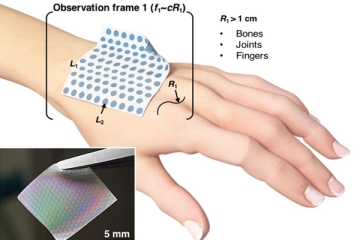
ETRI Successfully Develops Thermoelectric Device That Generates Electricity from Body Heat
한국전자통신연구원이 배터리를 쓰지 않고 사람 체온만을 활용, 팔목에 밴드형 파스처럼 붙여 에너지를 얻어 정보를 표현하는데 성공했다. 체온의 열에너지를 전기로 변환, 이를 증폭해 웨어러블 소자 전원으로 사용케 만든 것이다. 연구진은 이 기술이 향후 체온이나 맥박 센서 등과 결합된 소자로 만들어져 데이터를 무선으로 수집도 가능해질 것으로 보고 있다. 이를 통해 영유아, 환자의 모니터링이나 애완동물의 위치 모니터링 등에도 적용이 예상된다.
2019.01.28by 이수민 기자
ST Microelectronics and NUS Establish Joint Research Center 'HELIX' for Edge AI
ST Microelectronics and the National University of Singapore have established the 'HELIX' joint research center aimed at implementing embedded AI in edge environments. Over a four-year period, the center will conduct research across the entire technology stack from algorithms to silicon, focusing on memory-centric architecture leveraging ST's 18nm FD-SOI technology and embedded PCM. The core objective is to implement intelligence directly in physical devices such as robots and drones while minimizing energy consumption.
2026.08.28by 배종인 기자

ams, 디지털 포토닉스로 휴머노이드 로봇 감각·소통 기능 지원
ams OSRAM이 디지털 포토닉스 기술을 활용해 휴머노이드 로봇의 감각·소통 기능을 강화하는 솔루션을 공개했다. dToF 센서, 광학식 힘 센서, 구조광 이미터 등으로 주변 환경 인식과 정밀 조작을 구현하며, EVIYOS·ALIYOS 플랫폼으로 LED 기반 비언어 소통을 지원한다. 시장조사에 따르면 휴머노이드 로봇 시장은 2025년 6억 달러에서 2035년 510억 달러로 성장할 전망이며, 로봇의 감각 능력 향상이 핵심 성장 동인으로 작용할 것으로 예상된다.
2026.08.27by 배종인 기자











