


Over 90% of Global Telecom Operators Say "5G Will Increase Energy Costs"
 Published2019.03.04 10:01
2021 will be the true starting point for 5G services
Network energy consumption increased by 170% in '26
Vertiv announced on February 28 the results of an in-depth survey conducted with 451 Research on more than 100 global telecommunications operators.
This report contains an optimistic outlook on future services that 5G will realize and interactions with edge computing.
The majority of telecommunications operators participating in the survey expected the true 5G era to begin globally in 2021, and 88% of respondents indicated plans to deploy 5G services in 2021–2022.
However, more than 90% of respondents answered that energy costs will increase due to 5G technology, and as a result, they are interested in technologies and services that can improve energy efficiency. This is also consistent with the results of an analysis conducted by Vertiv itself.
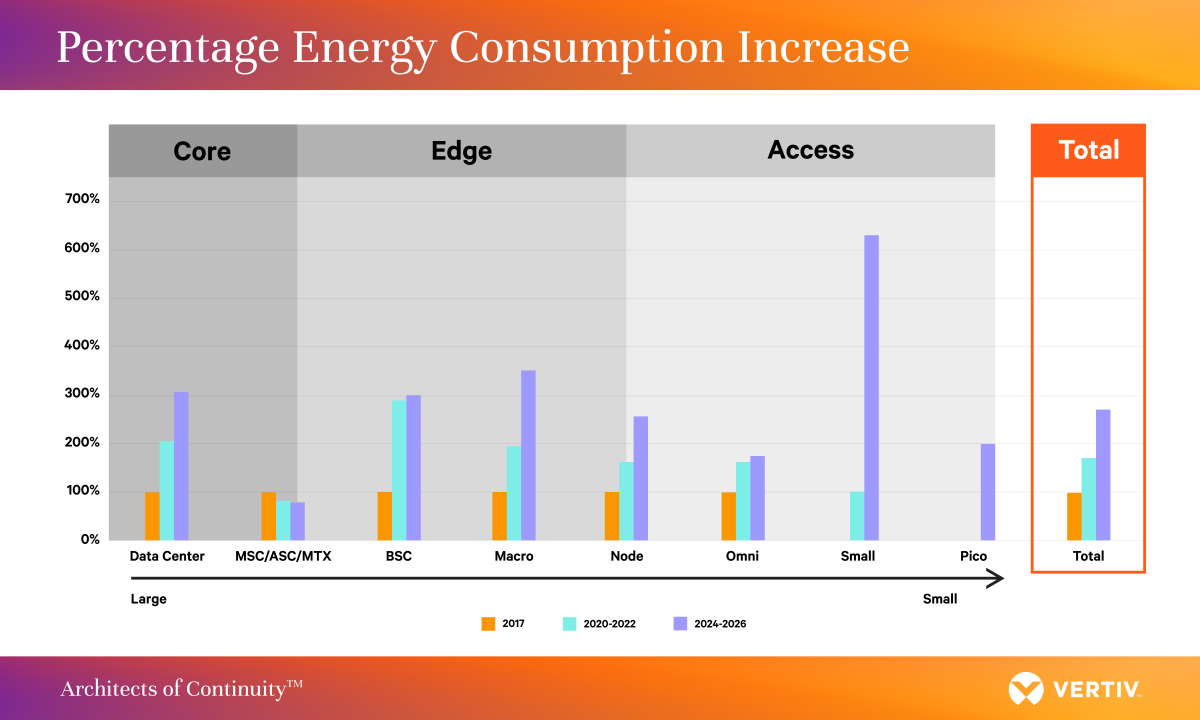
The transition to 5G will increase power consumption.
According to this, the transition to 5G is expected to increase total network energy consumption by 150–170% by 2026 compared to now, with the largest increase in energy consumption anticipated in the macro, node, and network data center sectors.
Danny Wong, Senior Director of Asia Telecom at Vertiv, said, “While there is no doubt that 5G is the mainstream for next-generation telecommunications and mobile networks, it is true that there are some concerns regarding the deployment of this technology,” adding, “It is of the utmost importance for telecommunications operators to select the optimal infrastructure to drive 5G most efficiently.”
"We hope that the various use cases revealed through Vertiv's own analysis and the results of this survey conducted jointly with 451 Research will help telecommunications operators make rational decisions regarding investment in their core infrastructure," they added.
Regarding edge and 5G, the survey results confirmed that the majority of operators have already deployed edge computing (37%) or plan to implement so-called 'Multi-Access Edge Computing (MEC)' which links edge computing with mobile infrastructure (47%).
Brian Partridge of 451 Research“Through this survey, we were able to understand what telecommunications operators want and are concerned about regarding the advancement of 5G and edge businesses,” said the Vice President of Research at dge.
“The two most difficult challenges to overcome in supporting 5G topologies are upgrading access and aggregation layer networks and adding new backhaul links,” said Vice President Partridge. “Respondents to this survey cited the ability to utilize high-quality connectivity technology at distributed POPs and the ease of securing sites as the key factors determining the success or failure of 5G businesses.”
He added, “I believe that through the results of this survey, we will be able to clearly confirm the current level of innovation in the industry.”
In addition to this study, Vertiv has identified four main edge computing archetypes by analyzing more than 100 use cases through extensive research related to this field.
Recently, it also quantified the potential impact of specific 5G implementations by publishing a report titled “Turning on 5G: Using Edge Archetypes to Identify the Most Mature Cases.”
This study by Vertiv and 451 Research examines not only the critical intersections between 5G and edge computing, but also some potential obstacles hindering 5G adoption and, in particular, methods that enable telecommunications operators to mitigate such issues, such as Energy Savings as a Service (ESaaS).all.
According to the survey results, the percentage of respondents who said they were interested in ESaaS was over 90%.
Comments
Related news
[5G! MWC19] 'From Core to Edge' Intel Announces New Products and Partnerships to Drive 5G Revolution
Intel unveiled new products, partnerships, and customer use cases at MWC19. Intel announced its 10nm SoC Snow Ridge for base stations to enhance computing capabilities at the edge, along with customer adoption examples. The company also highlighted how customers including AT&T, Ericsson, Nokia, Rakuten, Sony, and Warner Bros. are innovating and expanding their businesses through the ability to rapidly and efficiently move, store, and process large-scale data.
2019.02.26by 이수민 기자

[5G! MWC19] 5G to Account for 15% of Global Mobile Access by 2025
5G is experiencing steady growth with the successive launch of 5G networks and 5G devices, and is projected to account for 15% of global mobile access around 2025. In detail, China and Europe are estimated to reach 30%, while the United States is expected to approach 50%. Over the next 15 years, 5G's global economic contribution is projected to reach $2.2 trillion. The key sectors that 5G will contribute to are manufacturing, public infrastructure, and financial services, and the benefits from the adoption of new technologies are expected to be substantial.
2019.02.26by 이수민 기자

[5G! MWC19] "Welcome, have a cup of coffee": KT prepares experience space for the future envisioned by 5G
KT, which participated in MWC19, prepared diverse experiential spaces for visitors. 5G-based Sky Ship, Remote Cockpit, Smart Factory, and VR games captured the attention of attendees.
2019.02.27by 이수민 기자
European Patent Applications Surpass 200,000 for the First Time… South Korea Maintains 5th Place, Led by Batteries and Telecommunications
According to the European Patent Office (EPO)'s 'Technology Dashboard 2025', European patent applications last year reached 201,974, surpassing 200,000 for the first time. Korean companies and inventors filed 14,355 applications, representing a 9.5% increase from the previous year and maintaining 5th place by country. Battery, digital communication, and semiconductor technologies led the growth, with Samsung ranking as the top EPO applicant for the second consecutive year and LG reaching 3rd place. The presence of major domestic cities such as Seoul, Suwon, and Yongin was also confirmed. It was also revealed that Korea's European patent strategy is expanding beyond individual technologies to span the entire industry.
2026.03.24by 명세환 기자

SK Telecom First Applies AI-Based Network Operations at Gwanghwamun K-Pop Concert
SK Telecom announced that it applied an AI-based network operation system for the first time at a large-scale K-pop concert held in the Gwanghwamun area of Seoul on March 21st, managing communication quality throughout the event. Mobile data usage during the three hours before and after the concert reached 12.15TB, approximately doubling compared to the same time slot the previous weekend. SK Telecom monitored traffic using the AI system 'A-One' in five-minute and 50-meter units to respond to potential overload situations, while also operating temporary communication facilities and on-site personnel in parallel. This case is interpreted as confirmation of the practical applicability of AI-based autonomous network operation in an environment where demand from dense events and foreign users increases simultaneously.
2026.03.23by 명세환 기자











