



Cortex M4 Market, Beginning Full-Scale Market Entry?
 Published2012.07.18 16:41
July 14, 2012 - STMicroelectronics, which created a new sensation in the MCU field with its domestic Cortex-M3, is making headlines by announcing the STM32F3, equipped with a Cortex-M4 core, following the announcement of the STM32F4, which features a high-performance MCU-class Cortex-M4 core, last year.
The existing STM32F4 is ST’s top-tier Cortex Core MCU currently in existence, boasting the best performance with 168MHz and 210 DMIPS. However, there was some resistance due to its high price when trying to access the low-end market that requires FPU and DSP functions. It appears that the new STM32F3 addresses this issue and adds specifications that were lacking in the existing STM32F1, thereby enabling a more stable product configuration for the existing market.
Currently, the visible optimized parts include DACs, Advanced ADCS, Temp Sensor, Comparators, RTC, and Op Amps, which conventional MCUs could not replicate. By enabling all of these to be replicated in the F3, it appears that this will contribute to significantly reducing BOM costs.
With this announcement, ST is now able to offer a total of over 350 different solutions. This means that the benefits provided by STM32 devices and the related ecosystem can now be applied to applications such as high-performance motor controllers or embedded digital audio, which previously required high-performance analog and basic digital signal controllers.
<Related Technical Information>
The ARM Cortex-M4-based STM32 F3 family with an integrated FPU consists of four different product lines depending on the on-chip memory density and the peripherals installed. The peripherals achieve outstanding analog integration, delivering best-in-class performance through features such as a 12-bit ADC providing 5M samples per second. This superior analog integration offers designers the greatest flexibility to implement advanced system functions and characteristics without the need to add additional components to the PCB.
The STM32 F30x device features seven fast comparators with a response time of 50ns, four programmable gain amplifiers with 1% accuracy and supporting four different gain settings, two 12-bit DACs, and four 12-bit 5Msps ADCs. This represents the fastest ADC performance among ARM Cortex-M-based microcontrollers, achieving up to 18Msps in interleave mode. Because the STM32 F30x device is equipped with two advanced motor-control timers running at up to 144MHz, it is possible to control two motors and Power Factor Correction (PFC) via on-chip analog peripherals in products such as consumer electronics using a single microcontroller. Among the various capabilities of these advanced timers, the excellent timing resolution of 7ns or more enables modern applications such as digital power supplies for telecom infrastructure or data servers, micro-inverters for solar devices, and LED lighting to benefit from the power-saving and cost-effective features and scalability of the STM32 family.
To enable developers to optimize code execution time, the STM32 F30x device incorporates 8 KB of SRAM mapped to the instruction bus as core-coupled memory (CCM-SRAM). During initialization, critical routines loaded into the 8 KB CCM are completed at maximum speed without any waiting, enabling 94 Dhrystone MIPS (DMIPS) at 72 MHz. This compares significantly to 62 DMIPS when running on Flash or SRAM, representing a 52% improvement in critical routine performance. The STM32 F30x also features built-in 40 kbyte SRAM mapped to the data bus. 8K CCM-SRAM can also be used as data storage without performance degradation. These devices are pin-compatible with the STM32 F1 series and share the same APIs, allowing for a simple transition to devices with enhanced performance.
The STM32 F37x device offers a variety of peripheral capabilities. As the first ST microcontroller to feature an on-chip 16-bit Sigma-Delta ADC, it enables the STM32 family to deliver a wide range of precision-sensing applications and provides a single-chip solution that replaces designs using a general-purpose processor and an external ADC separately. Up to three 16-bit Sigma-Delta ADCs are included in the on-chip solution, and separate analog supplies are provided from 2.2V to 3.6V. Additionally, up to 21 single or 11 differential channels are available, each featuring 8 programmable gains.
Other STM32 F37x analog peripherals include two fast comparators, three 12-bit DACs, and one 12-bit 1Msps ADC. It also includes an enhanced CEC (Consumer Electronics Control) unit, making it ideal for consumer multimedia products. Compared to the STM 32 F1 series, the STM32 F37x device provides an SoC solution that can reduce BOM (material costs) and simplify board design.
Key features of STM32 F30x/F37x
1. Parity bit SRAM and CCM-SRAM for secure software data and code execution
2. Memory Protection Unit (MPU)
3. Capacitive touch-sensing capability (24 keys)
4. Supports USB and CAN connections
5. Communication Peripherals: SPI 18Mbps, I²C 1MHz (Fast Mode Plus), USART 9Mbps
6. Sub-ppm RTC (real time clock) equipped with a hardware calendar
7. Four power saving modes, including a 5µA Stop mode with a waking-up capability to wake up communication peripherals with a fast startup time.
8. Implementation of 2µA standby mode in RTC operation state
9. Less than 1µ in Vbat mode (battery backup)
10. Debug Mode: Serial Wire Debug (SWD), JTAG Interface, Cortex-M4 ETM
11. Power Supply: 2.0V ~ 3.6V or 1.8V+/-8% (Specific sales type)
For orders of 1,000 or more, the pricing for the STM32 F30x series ranges from a base price of $2.54 for the 128Kbyte Flash STM32F302 in an LQFP48 package to up to $3.86 for the 256Kbyte STM32F303 in an LQFP100 package. The pricing for the STM32 F37x series varies from $2.24 for the 64Kbyte STM32F372 in an LQFP48 package to $3.69 for the 256Kbyte STM32F373 LQFP100. Pricing options for larger unit orders are available upon inquiry.
Both series are currently being sampled with major customers, and full-scale mass production is scheduled to begin in the third quarter of 2012.

관련뉴스
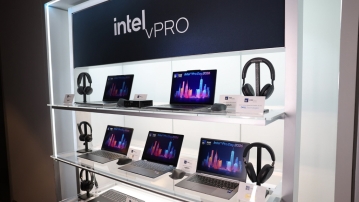
Intel Unveils Next-Generation 'Core Ultra Series 3' and vPro Platform for Enterprise PCs
인텔이 차세대 기업용 PC를 위한 ‘인텔 코어 Ultra 시리즈 3’와 최신 vPro 플랫폼을 공식 발표하며, 기업용 노트북부터 고성능 워크스테이션까지 폭넓은 수요 충족에 나섰다.
2026.03.26by 배종인 기자
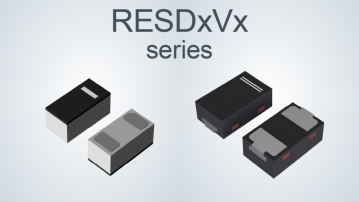
ROHM Launches ESD Protection Diode Compatible with High-Speed Interfaces of 10Gbps or Higher
반도체 전문 기업 로옴(ROHM)이 10Gbps를 넘어서는 차세대 고속 데이터 통신 환경에 대응할 수 있는 ESD(정전기 방전) 보호 다이오드 ‘RESDxVx 시리즈’를 개발하며, 고속 인터페이스에서 요구되는 신호 품질 유지와 IC 보호 성능을 동시에 끌어올렸다.
2026.03.26by 배종인 기자
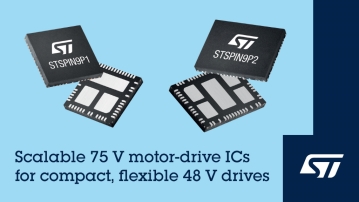
ST Launches 75V Drive IC Targeting 48V Industrial Motor Driving
ST마이크로일렉트로닉스가 48V급 산업용 구동 시스템 설계에 맞춘 75V 모터 드라이브 IC ‘STSPIN9P’ 시리즈를 공개했다. 새 제품군은 하프 브리지와 풀 브리지 구조로 구성돼 모터 종류와 출력 조건에 따라 설계를 확장할 수 있도록 한 것이 특징이다. 전원 회로와 보호 기능, 전류 감지 회로를 칩에 통합해 시스템 구성을 단순화했으며, 최대 500W급 애플리케이션까지 대응하도록 설계됐다. 회사는 레퍼런스 디자인과 데모 보드도 함께 제공해 산업 자동화, 로보틱스, 펌프, 팬, 조명, 섬유 기계 등에서 개발과 평가를 지원할 계획이다.
2026.03.26by 배종인 기자

Nordic supports security updates for the entire lifecycle of IoT devices at a single fixed cost
Nordic Semiconductor, a global leader in low-power wireless connectivity solutions, has unveiled a single fixed-cost licensing model that delivers FOTA (Firmware Over-the-Air) and device management capabilities throughout the device lifecycle via nRF Cloud, and introduced a new firmware update solution to prepare for the enforcement of the European Union's Cyber Resilience Act (CRA).
2026.03.26by 배종인 기자

Practical Training in Low-Noise, Low-Power Circuit Design All in One Place… Training Fee Support
고감도 아날로그 회로와 센서 기반 시스템 설계 역량을 강화할 수 있는 ‘2026 고급 엔지니어 실무 마스터 클래스’가 오는 4월16일 서울 가산동 e4ds 컨퍼런스 센터에서 열린다. 이번 과정은 온라인이 아닌 오프라인 유료 실습 교육으로 진행되며, 현장 중심의 심화 학습을 원하는 엔지니어를 대상으로 한다. 이번 교육은 텍사스 인스트루먼트(Texas Instruments)가 교육비를 지원해 정가 25만원에서 10만원 할인 된 15만원에 참가할 수 있다.
2026.03.26by 배종인 기자











