


EV Performance Tune-up, Now Easily with Your Smartphone
 Published2019.04.22 09:03
Download personal settings and apply them to other cars.
Automatic efficient operation settings considering distance and power consumption
Hyundai Motor and Kia Motors announced on the 22nd that they have developed 'mobile-based EV tune-up technology' that allows users to adjust the performance, efficiency, and driving feel of electric vehicles (EVs) using a smartphone according to their needs.
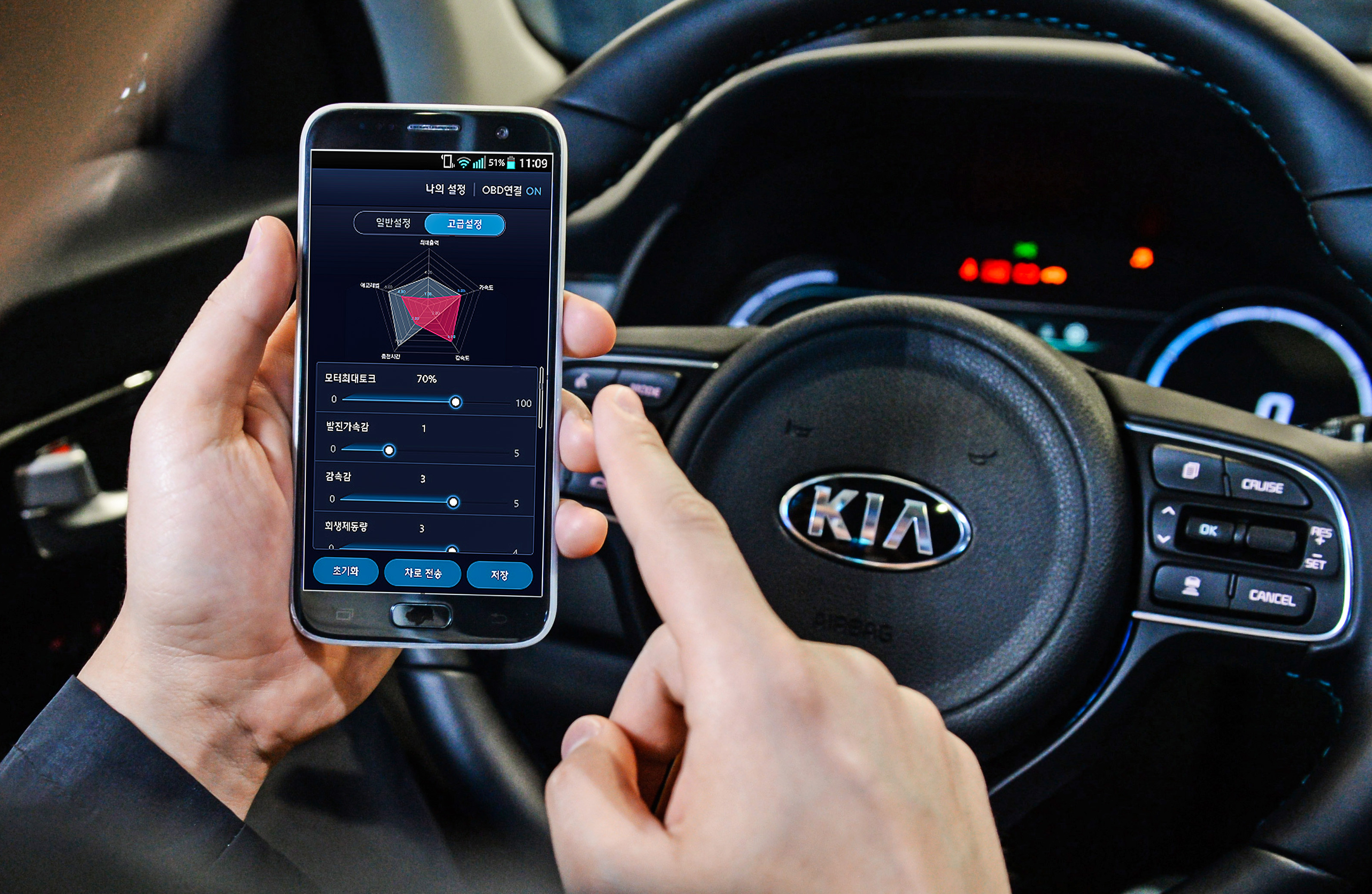
Hyundai Motor is considering applying this technology to new EVs to be released in the future. With EV tune-up technology applied, drivers can freely adjust a total of seven vehicle performance characteristics within a certain range using mobile devices such as smartphones or tablets, including motor maximum torque, acceleration, deceleration, regenerative braking amount, top speed limit, responsiveness, and heating/cooling energy.
Previously, when a specific driving mode such as 'ECO', 'NORMAL', or 'SPORT' was selected, all of the vehicle's performance was adjusted uniformly according to that mode, whereas this technology allows for different adjustments to seven different items.
While existing models from some manufacturers featured functions that linked convenience features, such as adjusting seats via smartphone, and capabilities to control certain vehicle performance via AVN like the Veloster N's 'N Mode,' there was no technology to change the car's overall settings using a smartphone.
With the proportion of EVs in car-sharing services expected to increase significantly in the future, the application of this technology will allow drivers to download their most familiar settings from the server and use them as is, regardless of the vehicle model.
It can automatically adjust the vehicle's performance to be optimized for energy efficiency by calculating the remaining distance and power so that the driver can arrive at their destination without worrying about running out of battery after setting the destination, and it can also recommend customized driving performance for drivers who desire driving enjoyment.
Users can share their vehicle settings and impressions with each other in the community, download and try out new settings, or apply vehicle-specific default recommended settings tailored to road conditions such as urban areas, highways, and mountains.
Hyundai Motor utilized blockchain technology to prevent the possibility of security issues, such as hacking, occurring during the process where users upload settings to a server and share them with one another.
During the process of uploading and sharing vehicle driving-related data to the server, key performance items are encrypted using a block generation method on a blockchain network and stored in a distributed data storage environment, making arbitrary manipulation through hacking virtually impossible.
Hyundai Motor's mobile-based electric vehicle tune-up technology was made possible thanks to the unique characteristics of EVs that differ from internal combustion engine vehicles. Unlike internal combustion engine vehicles, where the scope of performance modification is limited by emission regulations, EVs can apply technology relatively freely and control performance precisely.
"As Hyundai and Kia plan to have a lineup of 44 eco-friendly vehicles, including 23 EVs, by 2025, there is a growing need to develop technologies and services specialized for non-internal combustion engine vehicles," said an official from Hyundai-Kia Automotive Group. "We will create EVs that provide diverse customer experiences tailored to individual lifestyles by developing mobility technologies, such as technology that allows controlling vehicle performance via smartphone."
Meanwhile, Hyundai Motor is concentrating its entire corporate efforts on EV technology development to keep pace with the expansion of the eco-friendly vehicle market. Hyundai Motor revealed its development direction for EVs during its Q4 2018 IR presentation, stating that it would expand the marketability and efficiency of EVs by launching a dedicated EV platform in 2020, and achieve a top 3 ranking in the global EV market by 2025 by releasing dedicated EV models across various vehicle classes, while also announcing plans to invest 3.3 trillion won in the field of vehicle electrification.
Comments
Related news
New Sonata equipped with Kakao AI assistant... Natural conversation possible in natural language
Hyundai Motor Company will apply voice recognition conversational assistant service to the new Sonata for the first time. Vehicle voice recognition assistant service is a technology that optimizes smart speakers for vehicle application. Hyundai Motor and Kakao have initially established service categories focusing on content that does not interfere with safe vehicle operation, and plan to expand available in-vehicle services through continuous verification processes. Since all information in the vehicle voice recognition assistant service is processed through wireless networks between the vehicle and 'Kakao i' servers, BlueLink service application is essential. Hyundai Motor plans to provide the service free of charge as a standard feature to its BlueLink users without additional fees.
2019.03.18by 이수민 기자
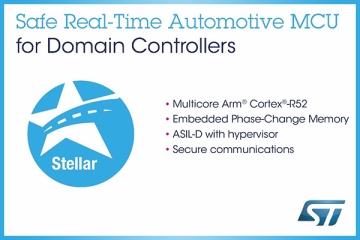
ST Launches Automotive Real-Time MCU 'Stellar Product Family'
STMicroelectronics has launched the Stellar product family of automotive MCUs for automotive domain controllers. The Stellar MCU supports next-generation automotive architectures where a wide range of domain controllers are critical. These domain controllers enable data fusion from connected sensors, transitioning to software and data-driven architectures while reducing harness complexity and electronic component weight. The Stellar product family combines the advantages of 28nm FD-SOI with on-chip PCM, advanced packaging, and multiple Arm Cortex-R52 cores, enabling operation at frequencies up to 600 MHz.
2019.04.18by 이수민 기자
.png)
Hyundai Motors Makes Strategic Investment in Startup ‘Code 42’ to Build ‘Future Mobility Integrated Platform’
Hyundai Motor Company is making a strategic investment in Code42, a startup founded by Song Chang-hyun, former CTO of Naver, and is embarking on multifaceted cooperation with the company. Code42 is an emerging startup that is focusing on paradigm shifts in the future mobility service market and innovative changes that customers can experience in their daily lives. To this end, it has begun development of UMOS, an integrated mobility platform that covers the entire A-to-Z process of urban mobility services. UMOS is a next-generation service platform designed to meet people's needs for shopping, fast delivery, and various transportation and mobility options.
2019.04.19by 이수민 기자

[Technical Contribution] Caltera: "Evolution of Precision Sensing, UWB Infrastructure Enhances Parking Safety"
Discussing new possibilities in parking assistance and precision sensing with UWB, Lee Sang-min, Korea Branch Manager at Caltera.
2026.10.23by 편집부
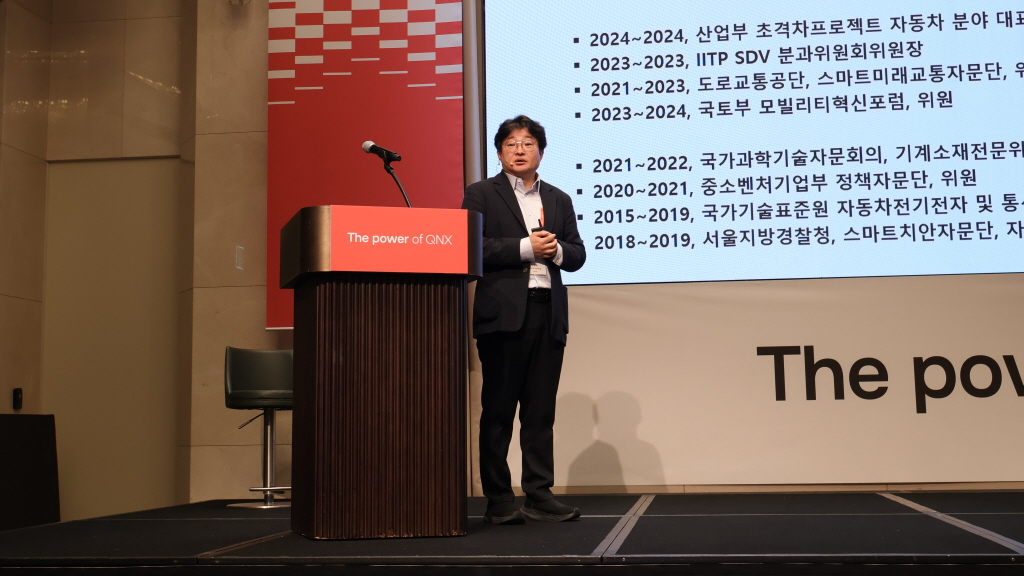
Professor Jeong Gu-min from Kookmin University, "QNX RTOS will become an important foundational technology in the physical AI era"
As software-defined vehicles (SDV) establish themselves as a new standard in the automotive industry, forecasts indicate that future competitiveness will be determined not by vehicle hardware but by software platforms and AI utilization capabilities. With the automotive industry rapidly transitioning to centralized architecture and AI-based development systems, an analysis suggests that how effectively vehicle platforms can be simplified and operated cost-efficiently will become core competitiveness for next-generation SDV and AI-defined vehicles. Professor Jeong Gu-min from Kookmin University emphasized at QNX TechForum Korea 2026 that "the automotive industry is now shifting from hardware competition to software ecosystem competition," highlighting that API-centric platforms and AI utilization will determine success or failure in the future automotive industry.
2026.10.23by 배종인 기자











