


Congratulations on CERN's discovery of the 'God particle' Higgs!
 Published2012.07.31 18:46
July 31, 2012, Seoul – STMicroelectronics (ST), a global semiconductor company providing various electronic applications, congratulated the research team that led the search on the news that the European Organization for Nuclear Research (CERN) had succeeded in tracking the Higgs boson after a long time.
ST specially developed and supplied components for the Compact Muon Solenoid (CMS) and ATLAS (A Toroidal LHC Apparatus), the two detectors of CERN's Large Hadron Collider (LHC) for the search for the Higgs boson.
Carmelo Papa, Senior Vice President and General Manager of the Industrial & Multisegment Business Unit at STMicroelectronics, said, “This project is a multinational endeavor involving thousands of people who built the equipment, collected and processed data, and verified the results. ST places great significance on the fact that we participated, even if it was not a large part, in the work of uncovering important facts about the universe and human nature.”
CMS is a particle detector that helps understand how matter came into existence after the Big Bang by observing how collisions between protons convert energy into particles of finite mass. ST has supplied thousands of silicon sensors for CMS since 2002. These sensors require extremely high accuracy at die sizes that are about 100 times larger than typical semiconductor dies. ST had the capability to produce these high-purity sensors by utilizing high-quality in-house manufacturing processes.
For the ATLAS detector, ST developed radiation-hardened positive and negative voltage specialty regulators, which were used in liquid argon calorimeter electron systems, pixel detectors, transition radiation detectors, and other subsystems. ST was awarded the 2006 ATLAS Supplier Award in recognition of its development of these regulators, which were developed at a time when ATLAS scientists could not find a device capable of safely delivering sufficient current when exposed to high levels of radiation. ST has also supported the satellite and space industries with the same technology for many years. Regarding voltage regulators, ST supplied over 40,000 radiation-hardened diodes to ATLAS.
<Additional Information>
Higgs particle project
According to the CMS and ATLAS team on July 4, they succeeded in discovering a new particle that matches the Higgs boson with a mass of 125 GeV[1]. The supporting data for this research result indicates that the probability of this discovery being a statistical fluke is only 1 in 3.5 million.
In the 1960s, theoretical physicist Peter Higgs hypothesized the existence of the Higgs boson (a quantum particle associated with the Higgs field, just as a photon is a quantum particle associated with a magnetic field). There is a mechanism developed by scientists to explain research results that overturn the Standard Model of particle physics—the most accurate theory today describing the fundamental particles that make up all matter in the universe and the effects of the electromagnetic, weak, and strong forces on these fundamental particles—and the key elements of this mechanism are the Higgs field and the Higgs boson (Higgs particle).
Previous experiments conducted at the LHC have confirmed the Standard Model of particle physics to less than 1%, but have confirmed that the Higgs boson has not yet been seen. CERN Director General Rolf Heuer stated, “This is a historic milestone, but it is only the beginning,” concluding that the project will have an international impact in the future through international efforts and success.

관련뉴스
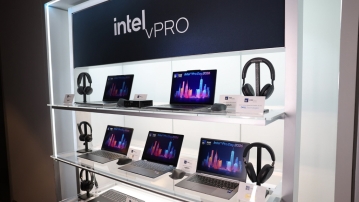
Intel Unveils Next-Generation 'Core Ultra Series 3' and vPro Platform for Enterprise PCs
Intel has officially unveiled the "Intel Core Ultra Series 3" for next-generation enterprise PCs and the latest vPro platform, addressing a wide range of demands from enterprise notebooks to high-performance workstations.
2026.03.26by 배종인 기자
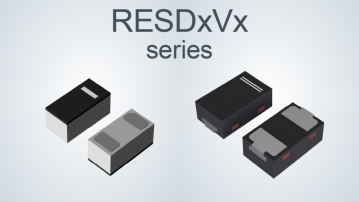
ROHM Launches ESD Protection Diode Compatible with High-Speed Interfaces of 10Gbps or Higher
반도체 전문 기업 로옴(ROHM)이 10Gbps를 넘어서는 차세대 고속 데이터 통신 환경에 대응할 수 있는 ESD(정전기 방전) 보호 다이오드 ‘RESDxVx 시리즈’를 개발하며, 고속 인터페이스에서 요구되는 신호 품질 유지와 IC 보호 성능을 동시에 끌어올렸다.
2026.03.26by 배종인 기자
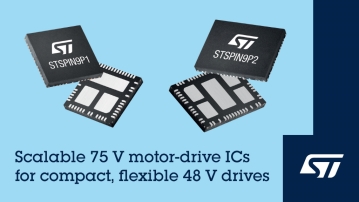
ST Launches 75V Drive IC Targeting 48V Industrial Motor Driving
ST마이크로일렉트로닉스가 48V급 산업용 구동 시스템 설계에 맞춘 75V 모터 드라이브 IC ‘STSPIN9P’ 시리즈를 공개했다. 새 제품군은 하프 브리지와 풀 브리지 구조로 구성돼 모터 종류와 출력 조건에 따라 설계를 확장할 수 있도록 한 것이 특징이다. 전원 회로와 보호 기능, 전류 감지 회로를 칩에 통합해 시스템 구성을 단순화했으며, 최대 500W급 애플리케이션까지 대응하도록 설계됐다. 회사는 레퍼런스 디자인과 데모 보드도 함께 제공해 산업 자동화, 로보틱스, 펌프, 팬, 조명, 섬유 기계 등에서 개발과 평가를 지원할 계획이다.
2026.03.26by 배종인 기자

Nordic supports security updates for the entire lifecycle of IoT devices at a single fixed cost
Nordic Semiconductor, a global leader in low-power wireless connectivity solutions, has unveiled a single fixed-cost licensing model that delivers FOTA (Firmware Over-the-Air) and device management capabilities throughout the device lifecycle via nRF Cloud, and introduced a new firmware update solution to prepare for the enforcement of the European Union's Cyber Resilience Act (CRA).
2026.03.26by 배종인 기자
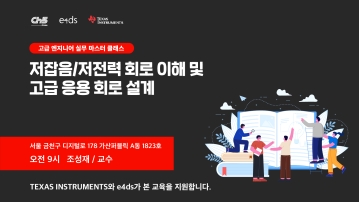
Practical Training in Low-Noise, Low-Power Circuit Design All in One Place… Training Fee Support
고감도 아날로그 회로와 센서 기반 시스템 설계 역량을 강화할 수 있는 ‘2026 고급 엔지니어 실무 마스터 클래스’가 오는 4월16일 서울 가산동 e4ds 컨퍼런스 센터에서 열린다. 이번 과정은 온라인이 아닌 오프라인 유료 실습 교육으로 진행되며, 현장 중심의 심화 학습을 원하는 엔지니어를 대상으로 한다. 이번 교육은 텍사스 인스트루먼트(Texas Instruments)가 교육비를 지원해 정가 25만원에서 10만원 할인 된 15만원에 참가할 수 있다.
2026.03.26by 배종인 기자











