



IBM Unveils Weather Signal, an AI-Based Weather Forecasting Solution
 Published2019.06.05 09:01
| Leverage data through universal platforms such as Tableau
| Agricultural Weather Decision Platform Released Together
Weather data analyzed by AI is expected to be widely utilized in business.

IBM and its subsidiary, The Weather Company, unveiled 'IBM Weather Signals,' an AI-based solution that can predict business performance in response to weather changes, on May 30.
IBM Weather Signals enables companies to proactively adjust their supply chains based on weather data, determine inventory levels and the appropriate staff to manage inventory, and launch promotions tailored to specific weather conditions.
Weather Signal, powered by IBM Watson AI, analyzes a company's operational data and weather data together.
This allows companies to create models that show the correlation between weather conditions such as temperature changes, perceived temperature, and humidity in a specific area and business performance such as sales of individual products.
This information can be widely applied to business operations, including supply chains.
For example, if the clothing industry predicts that the heat will arrive earlier than usual, it may bring forward the release and promotion of new summer products. Tourist attractions and amusement parks can adjust the number of staff or plan promotions such as admission discounts by predicting the number of tourists based on perceived temperature and humidity.
IBM Weather Signal data can be leveraged through general-purpose platforms such as Tableau.
Businesses can easily integrate weather data into their business planning processes without having to build complex analytics solutions.
You can also create models that measure the correlation between weather and business performance within the context of your overall business forecasting plan, all within an intuitively structured dashboard environment.
IBM Weather Signals has applications across a wide range of industries, but is particularly valuable in weather-sensitive industries such as retail, consumer goods, services, entertainment, travel, and transportation.
Along with this, IBM also unveiled the 'Weather Decision Platform for Agriculture'.
The platform leverages AI, local weather data, and IoT data to provide farmers with information on sowing, plowing, planting, pesticide spraying, and crop harvesting times.
Since acquiring The Weather Company in 2016, IBM has been helping companies in various industries, including travel, transportation, and logistics, reduce weather-related costs.
Innovative services like Weather Signals and Agricultural Decision Platforms enable businesses to leverage weather data for predictive business considerations.
“Most companies know that weather affects their business, but they rely solely on general past weather data to predict the future,” said Kim Jong-hoon, executive vice president and general manager of IBM Korea’s Cloud and Cognitive Software business."All of them," he said.
He continued, “Weather Signal can provide months in advance information on how real-time weather changes in a specific area will impact businesses, and companies can reap economic benefits worth billions of won through this weather forecast information.”
관련뉴스
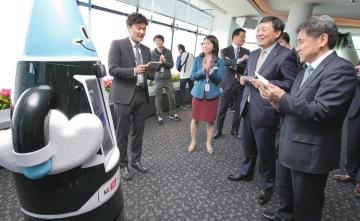
KT, Lotte World Tower Observatory and Robot Partnership Business Agreement
KT announced that it has signed an agreement for robot partnership at Seoul Sky, the observation deck of Lotte World Tower, and Seoul Sky at the Second Lotte World in Songpa-gu, Seoul. Through this business agreement, the two companies plan to operate robots using 5G robots as a medium to provide ▲observation deck viewing guidance (weather, floor-by-floor information) ▲multilingual guidance ▲voice recognition conversation ▲autonomous driving, enabling visitors to receive information in a new way and experience 5G technology. The 5G robot operated at Seoul Sky in Lotte World Tower was modeled after 'Rota,' the signature character of Seoul Sky, based on KT's 5G network operation expertise and autonomous driving demonstrated for the first time at the PyeongChang Olympics, as well as AI robot technology from KT's Convergence Technology Institute.
2018.04.25by 김지혜 기자

IBM Blockchain World Wire… Real-time global financial payment network expands to over 50 countries worldwide
IBM announced on the 19th the expansion of IBM Blockchain World Wire, a real-time global financial settlement network for financial institutions. World Wire was developed to accelerate and optimize foreign exchange transactions and cross-border payment and remittance speeds. Additionally, it integrates payment message transmission, clearing, and settlement procedures into a single network while supporting network participants in selecting various types of digital assets for settlement. Starting from the 19th, the payment service area will be expanded to 72 countries, including 47 global currencies and 44 financial endpoints. Busan Bank became the first domestic bank to join World Wire.
2019.03.19by 이수민 기자
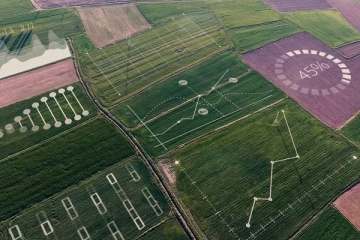
Yara and IBM are building a digital farm platform to apply AI, blockchain, and other technologies to farms.
야라가 IBM과 협력하여 디지털팜 플랫폼을 구축하고 폭넓은 농학 지식에 기반을 둔 디지털 서비스 및 영농 자문을 제공할 계획이라고 밝혔다. 야라와 IBM 서비스는 양사의 상호 보완적인 역량을 바탕으로 세계 식량 생산을 증가시키는 데 도움이 되는 디지털팜 솔루션 개발 및 상용화에 협력한다. 양사 공동의 글로벌 디지털팜 플랫폼은 AI, 머신러닝, 현장 데이터를 적용하여 농부들에게 새로운 통찰력을 제공한다. 전 세계에 보급되는 이 플랫폼은 약 1억 헥타르의 농지에 적용 가능하며, 이는 스페인의 2배 규모이자, 전 세계 수백만 곳의 소규모 농가를 포함한 전체 농경지의 7%에 가까운 규모다.
2019.05.02by 이수민 기자
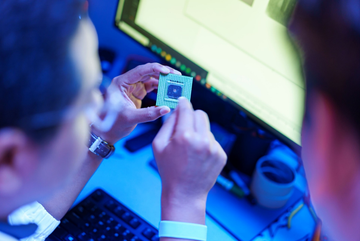
ST Microelectronics and NUS Establish Joint Research Center 'HELIX' for Edge AI
ST Microelectronics and the National University of Singapore have established the 'HELIX' joint research center aimed at implementing embedded AI in edge environments. Over a four-year period, the center will conduct research across the entire technology stack from algorithms to silicon, focusing on memory-centric architecture leveraging ST's 18nm FD-SOI technology and embedded PCM. The core objective is to implement intelligence directly in physical devices such as robots and drones while minimizing energy consumption.
2026.08.28by 배종인 기자

ams, 디지털 포토닉스로 휴머노이드 로봇 감각·소통 기능 지원
ams OSRAM이 디지털 포토닉스 기술을 활용해 휴머노이드 로봇의 감각·소통 기능을 강화하는 솔루션을 공개했다. dToF 센서, 광학식 힘 센서, 구조광 이미터 등으로 주변 환경 인식과 정밀 조작을 구현하며, EVIYOS·ALIYOS 플랫폼으로 LED 기반 비언어 소통을 지원한다. 시장조사에 따르면 휴머노이드 로봇 시장은 2025년 6억 달러에서 2035년 510억 달러로 성장할 전망이며, 로봇의 감각 능력 향상이 핵심 성장 동인으로 작용할 것으로 예상된다.
2026.08.27by 배종인 기자











