



Seoul National University Professor Han Seung-yong's research team successfully develops MRI magnet technology capable of imaging brain microvessels
 Published2019.06.16 07:01
Expected to have ripple effects on the medical, power generation, energy, and environmental industries.
High-temperature superconducting magnet technology expected to be a catalyst for commercialization
A research team led by Professor Han Seung-yong of the School of Electrical and Information Engineering at Seoul National University, in collaboration with the National High Magnetic Field Laboratory in the United States, achieved the world record for a DC magnetic field using a 'no-insulation high-temperature superconductor magnet'.
Through this study, Professor Han Seung-yong's research team recorded a DC magnetic field of 45.5 Tesla, breaking the world record of 44.8 Tesla, which had not been surpassed for the past 20 years.
The results of this study were published in the international journal Nature on June 13.
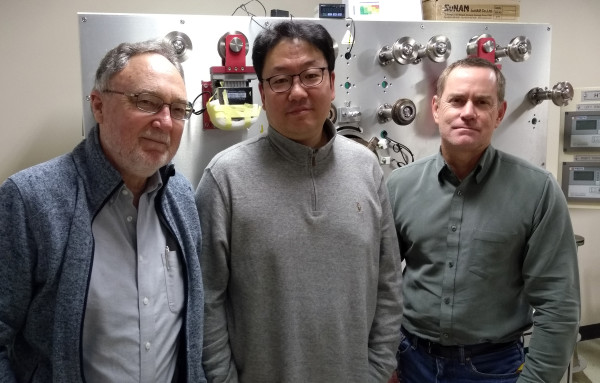
"Professor Han Seung-yong explained, 'The results of this study demonstrate that through new uninsulated high-temperature superconducting magnet technology, it is possible to generate ultra-high magnetic fields that surpass existing limitations more safely, while also achieving miniaturization to a level previously unimaginable.'"
He added, "If the results of this study are utilized, future medical fields such as MRI for cancer diagnosis and analytical equipment for new drug development, wind power generation, "It will have a significant ripple effect across the entire industry, including the energy sector such as energy storage devices, the environment sector such as wastewater treatment, the transportation sector such as electric propulsion, and high-efficiency industrial equipment," they stated.
In the case of MRI for cancer diagnosis, the magnetic field of the equipment currently used for clinical purposes is at the 3 Tesla level, and equipment with a magnetic field of 10 Tesla is under research. Based on the results of this study, if a clinical MRI of 45 Tesla or higher is developed, it is expected to be highly effective in diagnosing early-stage cancer or vascular brain diseases such as dementia, as it will be possible to obtain diagnostic images with a resolution more than 100 times higher than existing ones.
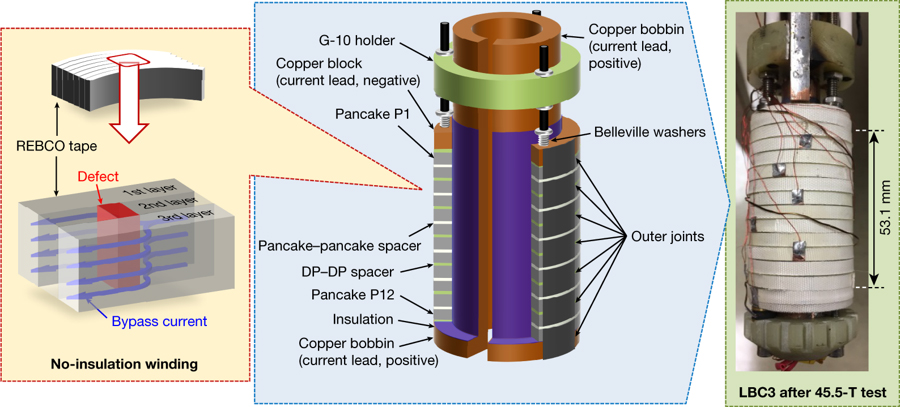
Non-insulated high-temperature superconducting magnet structure
Professor Han Seung-yong's research team is being recognized for changing the paradigm of superconducting magnet fabrication methods by proposing, for the first time in the world, an insulation-free high-temperature superconducting magnet structure that intentionally eliminates the electrical insulation previously considered essential in conventional superconducting magnets.
The research team developed an 'insulated high-temperature superconducting insert coil' designed with a diameter of 34 mm and a height of 53 mm, which has an energy density more than 50 times higher than existing superconducting magnets.
The results of this study are expected to pave the way for the commercialization of high-temperature superconducting magnet technology.
In the early stages of the research, there was difficulty in identifying the cause of the unique mechanical deformation that occurs when an insulated high-temperature superconducting magnet is driven in an ultra-high magnetic field of 45.5 Tesla. However, through research support from Samsung Electronics’ Future Technology Development Center, a new technique was developed to interpret the nonlinear current characteristics occurring in the insulated high-temperature superconducting magnet, and the principle of the mechanical deformation was identified.
Comments
Related news
The KRnet Conference 2019, which explores the future of internet technology in the era of the Fourth Industrial Revolution, will be held.
The KRnet Conference 2019, hosted by the Ministry of Science and ICT and jointly organized by nine related organizations including the Korea Internet & Security Agency, will be held for two days from the 24th to the 25th at the InterContinental Seoul COEX Hotel in Samseong-dong, Seoul. KRnet 2019, organized to introduce the latest technology trends related to the Internet both domestically and internationally and to explore the future technological development direction of the Internet, has been held annually since July 1993, beginning with the first Korean Academic Computer Network Workshop. Marking its 27th edition this year, KRnet 2019, under the theme "Creating Better for the Future," is expected to feature approximately 70 technical sessions, lectures, and discussions related to future technology trends and collaborative development directions, covering 5G, AI and big data, security, autonomous vehicles, humanities convergence, IoT, cloud and edge computing, immersive content, blockchain, open source, and more.
2019.06.05by 이수민 기자
Samsung Electronics Presents 8K Roadmap at 8K Display Summit
Samsung Electronics held an 8K Display Summit in Manhattan, New York, and moved forward with establishing 8K as the mainstream trend. At this event, Samsung Electronics presented the latest technology trends and roadmap for 8K. The event, co-hosted by Samsung Electronics and Insight Media, a U.S. research specialist, was attended by approximately 100 industry experts including display equipment-related companies, video production companies, and tech specialized media. The event was organized into three major sessions: 8K technology and market status, 8K content ecosystem, and advanced 8K technology. Experts from across all sectors of the 8K ecosystem shared the latest technology status related to 8K from multiple perspectives and discussed future outlook.
2019.06.12by 이수민 기자
Mouser Hosts Seminar on "Noise Reduction and Power-Efficient Power Supply Design for the 5G Era"
Mouser Electronics will hold the 2019 Mouser Power Design Seminar on the 21st at Conference Room 327, COEX, Samseong-dong, Seoul. At this seminar, Mouser will introduce the latest power management solutions along with products and components for power supply design in collaboration with Analog Devices, Vicor, and TE Connectivity. The seminar will also explain the latest market and technology trends, product selection guidelines, development tool utilization methods, and design techniques. This year's seminar theme is "Power Supply Design Seminar for Efficient Noise Reduction and Power Consumption," and will feature the latest techniques for designing new products that meet future trends and requirements, along with analysis of future prospects for 5G technology.
2019.06.14by 이수민 기자
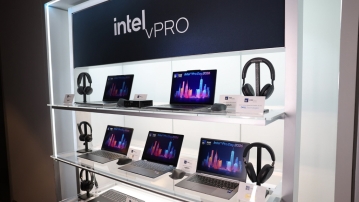
Intel Unveils Next-Generation 'Core Ultra Series 3' and vPro Platform for Enterprise PCs
Intel has officially unveiled the "Intel Core Ultra Series 3" for next-generation enterprise PCs and the latest vPro platform, addressing a wide range of demands from enterprise notebooks to high-performance workstations.
2026.03.26by 배종인 기자
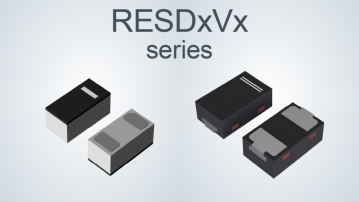
ROHM Launches ESD Protection Diode Compatible with High-Speed Interfaces of 10Gbps or Higher
Semiconductor specialist ROHM has developed the 'RESDxVx series' of ESD (electrostatic discharge) protection diodes capable of responding to next-generation high-speed data communication environments exceeding 10Gbps, simultaneously enhancing both signal quality maintenance required in high-speed interfaces and IC protection performance.
2026.03.26by 배종인 기자











