


Expanding Industry-Leading Capacity/Speed Serial SRAM Portfolio
 Published2012.08.07 09:29
- World's first implementation of 1 Mbit density and 80Mbps speed at 5V operating voltage
- Serial SRAM with non-volatile, battery-backed specifications offered in 8-pin package at significantly lower price compared to existing non-volatile SRAM, FRAM, and parallel SRAM
Microchip Technology, a global leader in microcontroller, analog and flash IP solutions (Korea Representative: Han Byung-don), today announced the expansion of its serial SRAM (serial SRAM) portfolio by introducing four new devices with industry-leading density and speed. These new devices are the industry's first serial SRAM products to support the 5V operating voltage range commonly used in automotive and industrial applications. These 512 Kb and 1Mb SPI devices maintain the product family's hallmark low power consumption and compact 8-pin package, while offering competitive pricing at 10,000-unit volumes. Achieving speeds up to 80Mbps through Quad-SPI or SQI™ protocol, they provide immediate data movement characteristics required for graphics offloading, data buffering, data input, display, computation, audio, video, and other data-intensive functions, thereby achieving zero write-cycle times.
Two additional products, 23LCV512 and 23LCV1024, provide battery backup options for the industry's most cost-effective non-volatile and unlimited-endurance RAM. In fact, fast dual-SPI (SDI) throughput of this product family reaching 40Mbps and low-level active/sleep current enable all price-point products of this serial NVSRAM device to operate at high speed without requiring as many pins as parallel NVSRAM, while reducing power consumption comparable to FRAM. These characteristics make them ideal for applications such as meters, black boxes, and data loggers that require non-volatile storage along with unlimited endurance or immediate data input capabilities.
Randy Drwinga, Vice President of Microchip's Memory Components Business Unit, stated, "Most embedded applications require significant RAM during the design process. Microchip's new 1 Mbit SRAM allows designers to meet those requirements cost-effectively without moving to larger microcontrollers or processors, while delivering the same functionality with lower power consumption, fewer pins, and lower cost than parallel SRAM." He added, "For applications requiring non-volatile RAM, Microchip has developed two products that provide battery-backed functionality at significantly lower cost than any other non-volatile RAM product."
Drwinga further stated, "Due to the high cost, large board area, and power consumption of parallel devices, the EEPROM market has completely migrated to serial interfaces, and the flash market is rapidly transitioning to serial interfaces as well. The SRAM market is expected to follow this trend, and Microchip's serial SRAM portfolio provides customers with competitive options for the embedded market."
Development Support
PICtail™ daughter board will be available in February 2013 and can be used with Microchip's modular PIC® microcontroller development board Explorer Series and XLP 16-bit development board. This daughter board will support designers in quickly evaluating devices by demonstrating the characteristics of both volatile and non-volatile devices within Microchip's new serial SRAM product family.
Availability
All six devices in the new serial SRAM product family are currently available in 8-pin SOIC, TSSOP, and PDIP packages. Two storage density options—512 Kbits and 1 Mbit—are offered. Of the two volatile devices, 23A1024 and 23LC1024 are available for sampling and production at 10,000-unit quantities. 23A512 and 23LC512 are available for sampling and production starting in October. The two non-volatile devices—23LCV512 and 23LCV1024—are also expected to be available for sampling and production starting in October at 10,000-unit quantities. For more information, contact a Microchip sales representative or an authorized distributor worldwide, or visit the Microchip website (http://www.microchip.com/get/PT2P). To purchase products mentioned in this press release, visit microchipDIRECT or contact one of Microchip's authorized distribution partners.

Related news

Intel Unveils Next-Generation 'Core Ultra Series 3' and vPro Platform for Enterprise PCs
Intel has officially unveiled the "Intel Core Ultra Series 3" for next-generation enterprise PCs and the latest vPro platform, addressing a wide range of demands from enterprise notebooks to high-performance workstations.
2026.03.26by 배종인 기자
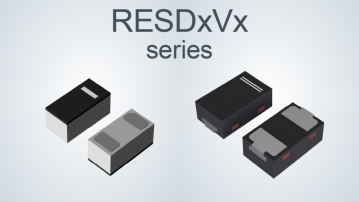
ROHM Launches ESD Protection Diode Compatible with High-Speed Interfaces of 10Gbps or Higher
Semiconductor specialist ROHM has developed the 'RESDxVx series' of ESD (electrostatic discharge) protection diodes capable of responding to next-generation high-speed data communication environments exceeding 10Gbps, simultaneously enhancing both signal quality maintenance required in high-speed interfaces and IC protection performance.
2026.03.26by 배종인 기자
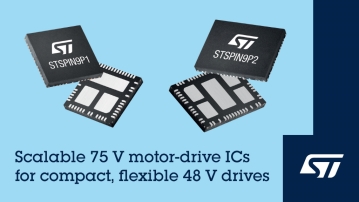
ST Launches 75V Drive IC Targeting 48V Industrial Motor Driving
ST Microelectronics has unveiled the 'STSPIN9P' series of 75V motor drive ICs tailored for 48V-class industrial drive system design. The new product family is characterized by half-bridge and full-bridge configurations that enable design scalability according to motor type and output conditions. Power supply circuits, protection functions, and current sensing circuits are integrated on-chip to simplify system configuration, and the devices are designed to support applications up to 500W maximum. The company plans to provide reference designs and demo boards to support development and evaluation in industrial automation, robotics, pumps, fans, lighting, and textile machinery.
2026.03.26by 배종인 기자

Nordic supports security updates for the entire lifecycle of IoT devices at a single fixed cost
Nordic Semiconductor, a global leader in low-power wireless connectivity solutions, has unveiled a single fixed-cost licensing model that delivers FOTA (Firmware Over-the-Air) and device management capabilities throughout the device lifecycle via nRF Cloud, and introduced a new firmware update solution to prepare for the enforcement of the European Union's Cyber Resilience Act (CRA).
2026.03.26by 배종인 기자

Practical Training in Low-Noise, Low-Power Circuit Design All in One Place… Training Fee Support
The "2026 Advanced Engineer Practical Masterclass" to strengthen competencies in high-sensitivity analog circuit and sensor-based system design will be held on April 16 at the e4ds Conference Center in Gasan-dong, Seoul. This program will be conducted as an offline paid hands-on training session, not online, and is targeted at engineers seeking on-site intensive learning. Texas Instruments will provide educational support for this training, allowing participation at 150,000 won, a 100,000 won discount from the original price of 250,000 won.
2026.03.26by 배종인 기자











