


IDT Launches World's First Enterprise-Class Flash Controller
 Published2012.08.09 16:26
World's First NVMe Enterprise Flash Controllers Announced
IDT, a global specialist in oscillator manufacturing, announced today at its Korean branch, through Senior Marketing Director KAM Eshghi, that it has launched the world's first enterprise-grade Flash controller.
The newly announced Non-Volatile Memory (NVM) Express enterprise flash controller is being handled by IDT's Computing Business Unit and is reportedly targeting PCI Express, which is currently used in server-class computers. In particular, to establish a standard suitable for PCI Express, industry standards were created in collaboration with the relevant sector, with leading companies such as EMC, NEDEC, Samsung, and IDT participating in the current working group.
The market for these PCIe Enterprise SSDs has been growing at a rate of more than tenfold since 2011, and it is projected to reach approximately 3,497,000 by 2015. It was stated that this growth would gain further momentum with the establishment of the NVM standard. Here, IDT currently holds a market share of % .
Based on market size, the client SSD market appears larger than the enterprise SSD market, but in terms of actual monetary value, they are nearly identical. Currently, IDT is used exclusively for enterprise projects.
Although these SSDs were not widely used in the market due to previous price resistance, prices have now dropped significantly, giving them a competitive edge. Furthermore, unlike in the past, computing usage generates a large amount of DB traffic, requiring the functionality of SSDs that allow for easy data transfer and rewriting. Therefore, in enterprise-level systems, SSDs are placed at the front in PCIe, while less frequently used components are placed in hard storage.
In addition, regarding IDT's enterprise flash controller, it was announced that the product was commercialized by incorporating IDT's flash controller into a chip made by Micron in a server card made by Gen2 EMC2.
In addition, Dell also used IDT's Gen2 controller for server storage.
While IDT has commercialized products starting from PCIG1 up to 2, the announcement being made this time can be considered Gen3. SATA 6G currently sold on the market is Gen3, achieving a maximum speed of 600 Mbyte/sec. In contrast, PCIe 4G3 Gen 3 delivers speeds of approximately 4 Gbytes, which is six times higher.
Currently, a 2.5" small form factor driver is 27mm * 27mm with 16 channels, and a PCIe card form factor that offers a slightly larger size is 40mm * 40mm with 32 channels.
Currently, IDT supplies its products to memory manufacturers such as Samsung, Hynix, Micron, and Toshiba, and the product announced today is currently in the design phase. Most notably, this product is the industry's first non-volatile memory controller.
In addition, this product is programmable, allowing engineers to program it using firmware.
Firmware capable of optimizing the characteristics of NAND is created and used by each company. This is because, unlike DRAM, which is currently standardized and optimized for specialization, NAND flash memory is not standardized; since standards vary by company, the people who truly understand the internal workings of that NAND are the employees of each individual company. Therefore, applying such controllers requires programming via firmware, and IDT's latest product is ideal for this purpose as it allows for effective use with programmable specifications. (This is particularly true when matching numerical values for wearable labels.)
There is source code embedded inside the chip. Therefore, it is suitable for creating new programs using that source code and the firmware. This source code contains the following:
The current client is a company that sells to SSD manufacturers, and it manufactures PCIe based on NVM to sell to storage OEMs, who then sell the storage to data center companies.
They also sell to intermediate storage companies. Here, they also create products directly by programming firmware using the provided controllers.
We also sell to clients like Google and DC.
In the currently available models, IDT first provides hardware, embeds firmware into that hardware, and the client further develops the embedding. IDT also provides standard software drivers.
I am using the by8 host controller.
PCI e ecosystem.
IDT's PCIe holds a significantly advantageous technical position. However, it has not established itself until now due to the lack of market standards and criteria. These have recently been newly created, namely: 1. Standards for form factors. The company that will establish these form factor standards is Dell.........., and key country boot companies include IDT, etc. Currently, it is based on Gen2 standards , and as for Gen3............
It is also an NVM standard. Additionally, IDT... established the standard Linux criteria, and the source code is currently provided through the Open Alliance. Therefore, it appears that if OEMs proceed with qualification through this alliance, they will comply with the two points mentioned above, making the qualification process easier.
In addition, since MVNe measuring instruments and the like are already being formed, the ecosystem is also growing together.
IDT is now able to announce the first flash controller that meets NVM.
This is the first to qualify for the form factor and NVM standards as a single-chip enterprise chip released in August, and as mentioned, it can be applied as optimized for clients through firmware programming.
IDT believes that through these NVM and FormTector standards, it is possible to make it easy to follow without incurring significant existing costs. By reducing latency throughput, it enables closer access to quality.

관련뉴스

Intel Unveils Next-Generation 'Core Ultra Series 3' and vPro Platform for Enterprise PCs
Intel has officially unveiled the "Intel Core Ultra Series 3" for next-generation enterprise PCs and the latest vPro platform, addressing a wide range of demands from enterprise notebooks to high-performance workstations.
2026.03.26by 배종인 기자
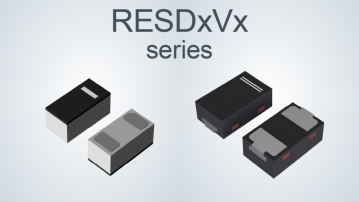
ROHM Launches ESD Protection Diode Compatible with High-Speed Interfaces of 10Gbps or Higher
반도체 전문 기업 로옴(ROHM)이 10Gbps를 넘어서는 차세대 고속 데이터 통신 환경에 대응할 수 있는 ESD(정전기 방전) 보호 다이오드 ‘RESDxVx 시리즈’를 개발하며, 고속 인터페이스에서 요구되는 신호 품질 유지와 IC 보호 성능을 동시에 끌어올렸다.
2026.03.26by 배종인 기자
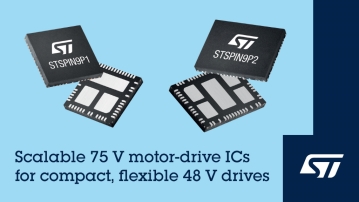
ST Launches 75V Drive IC Targeting 48V Industrial Motor Driving
ST마이크로일렉트로닉스가 48V급 산업용 구동 시스템 설계에 맞춘 75V 모터 드라이브 IC ‘STSPIN9P’ 시리즈를 공개했다. 새 제품군은 하프 브리지와 풀 브리지 구조로 구성돼 모터 종류와 출력 조건에 따라 설계를 확장할 수 있도록 한 것이 특징이다. 전원 회로와 보호 기능, 전류 감지 회로를 칩에 통합해 시스템 구성을 단순화했으며, 최대 500W급 애플리케이션까지 대응하도록 설계됐다. 회사는 레퍼런스 디자인과 데모 보드도 함께 제공해 산업 자동화, 로보틱스, 펌프, 팬, 조명, 섬유 기계 등에서 개발과 평가를 지원할 계획이다.
2026.03.26by 배종인 기자

Nordic supports security updates for the entire lifecycle of IoT devices at a single fixed cost
Nordic Semiconductor, a global leader in low-power wireless connectivity solutions, has unveiled a single fixed-cost licensing model that delivers FOTA (Firmware Over-the-Air) and device management capabilities throughout the device lifecycle via nRF Cloud, and introduced a new firmware update solution to prepare for the enforcement of the European Union's Cyber Resilience Act (CRA).
2026.03.26by 배종인 기자
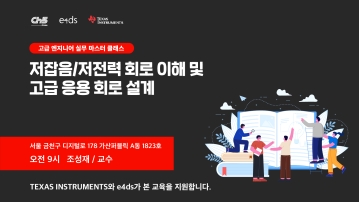
Practical Training in Low-Noise, Low-Power Circuit Design All in One Place… Training Fee Support
고감도 아날로그 회로와 센서 기반 시스템 설계 역량을 강화할 수 있는 ‘2026 고급 엔지니어 실무 마스터 클래스’가 오는 4월16일 서울 가산동 e4ds 컨퍼런스 센터에서 열린다. 이번 과정은 온라인이 아닌 오프라인 유료 실습 교육으로 진행되며, 현장 중심의 심화 학습을 원하는 엔지니어를 대상으로 한다. 이번 교육은 텍사스 인스트루먼트(Texas Instruments)가 교육비를 지원해 정가 25만원에서 10만원 할인 된 15만원에 참가할 수 있다.
2026.03.26by 배종인 기자











