


Expanding the M2M market base through strengthened comprehensive consulting
 Published2012.08.27 19:33
 Target of 30% domestic sales growth compared to 2011
Actively expanding the market base by discovering and commercializing potential applications across various industries through the strengthening of m2m consulting businesses and product contests.
Seoul, August 24, 2012 - Telit Wireless Solutions (CEO Jong-Gap Yoon, www.Telit.com , hereinafter Telit), a specialized company providing M2M (Machine-to-machine) modules and consulting services, announced today that as a leading M2M company, it is focusing on expanding its user base by strengthening its consulting capabilities and actively developing applications for general consumers as well as B2B solutions to drive market growth in the Asia-Pacific region.
At the '2012 Telit Media Day' held to unveil its business strategy for the year, Telit announced that, as a leading global M2M operator, it would actively expand its market base by strengthening its M2M consulting business and discovering and commercializing applicable cases across various industries through product contests, in order to achieve a 30% growth in domestic sales compared to 2011.
Along with this, an overview of M2M technology and market trends, Telit’s advanced technology in the M2M market, and recent application examples were presented, along with a big picture for targeting the domestic M2M market.
At the event, Telit shared its vision for targeting the domestic M2M market in 2012.
2012 Business Goals – Telit is the only M2M company globally to have maintained an annual growth rate of over 20% for the past two years, with a significant increase in module sales. Last year, the revenue of the Korean subsidiary was 29 billion won. Telit aims for 25% growth globally this year compared to 2010, and 30% growth for its Korean subsidiary.
Business Strategy – We plan to actively participate in various government initiatives aimed at revitalizing the M2M market and collaborate with major telecommunications operators to develop new business models in five key sectors: Energy & Smart Grid, Automotive & Transportation, Security & Surveillance, Medical & Health, and Consumer Electronics. Through this, we are focusing on increasing the utilization of M2M in diverse fields, including not only existing core markets such as telematics and logistics, but also remote medical services, smart grids utilizing meter reading data from smart meters, security, and smart cities (efficient operation of public services, transportation, and urban traffic through the IT integration of urban infrastructure).
Supporting M2M Commercialization through Comprehensive Consulting Services – Telit has established the 'm2mAIR' business unit to provide comprehensive services ranging from product development to management, utilizing its wireless technologies and modules. Through this, customers can reduce their Total Cost of Ownership (TCO) and easily develop and manage M2M applications. Notably, Telit recently formed a strategic partnership with the global telecommunications company Telefónica. This enables the development of new modules and the management of the entire cycle using a Software as a Service (SaaS) approach, which offers optimal services at a reasonable cost. M2M operators using Telit's services can leverage the latest wireless data communication technologies to develop, register, and manage the entire operation cycle of new modules. More details can be found at www.m2mair.com , Telit's dedicated web portal for the m2mAIR business.
Global M2M Solution Development Contest 'M2M Challenge' – Telit announced that M2MApps ( www.M2Mapps.com ), a global network M2M communication portal site sponsored by the company, is holding the 'M2M Challenge,' a solution development contest for M2M industry professionals worldwide. Any M2M developer or corporate official from around the world can participate, and proposals for M2M solution development must be submitted to the official M2M Challenge website, www.M2M-challenge.com , by December 31st.
Solidifying the Foundation for Growth Through Expanded Long-Term R&D Investment – Given the nature of modular products, which cannot stand as finished goods in themselves, Telit plans to focus on enhancing customer satisfaction through continuous technology development and close customer support via its R&D centers. Telit Korea serves as a forward base covering not only Korea but the entire APAC region; it is actively targeting the M2M market in APAC by currently operating offices in Taipei, Taiwan; Shenzhen and Shanghai, China; and New Delhi, India. The company has 260 R&D personnel across regional centers, including Seoul, Trieste and Sardinia in Italy, and Sophia Antipolis in France, bringing the total global R&D workforce to 350. Telit is currently involved in the design process of over 2,000 new products based on M2M technology.
Derick Tsang, President of Telit’s Asia-Pacific region, stated, “Recently, M2M technology is no longer limited to the B2B market but is increasingly being used for remote monitoring and control of general consumer applications.” He added, “Telit plans to engage in continuous product development and technical support through its R&D center, and will focus on growing the domestic M2M market while meeting the diverse needs of the market and customers through cooperation with domestic partners.”
Latest products
Commercialization of various popular M2M products incorporating the latest technology
Telit plans to commercialize and supply a variety of M2M products that are receiving great acclaim worldwide for use in the domestic market. The recently launched new products are as follows.
Launch of Jupiter SL869, a High-Performance Module for Navigation Equipment Supporting Both GPS and GLONASS: A new dual GPS/GLONASS module has been released that dramatically improves navigation performance by providing combined support for Russia's proprietary GLONASS positioning system and the US GPS. Telit's new positioning solution, the Jupiter® SL869, can communicate with up to 22 satellites, offering approximately three times the satellite visibility compared to standard GPS, which communicates with 6 to 8 satellites. In particular, this product is characterized by its ability to support optimal performance for all types of navigation applications, ranging from personal equipment and asset tracking to automotive solutions. Navigation systems equipped with the Jupiter SL869 can verify location information within seconds, a process that previously took over a minute after launch. Furthermore, it minimizes satellite coverage loss rates by utilizing additional satellite fixes to reduce blind spots, even in densely populated urban areas with high-rise buildings. By securing more accurate location information through this, it becomes possible to display the actual locations of people, vehicles, and objects on a digital map.
Launch of the xE910 Family Supporting All Global Cellular Platform Standards: We have launched the xE910 family of wireless data communication modules, capable of communicating with all types of cellular networks worldwide to provide cost-effective coverage for M2M applications and various consumer electronics. Composed of a small single LGA form factor, this family measures 28.2 x 28.2 x 2.2 mm and has a footprint of only 795 mm². Since all models within the family are designed identically, customers can utilize global communication standards or select and apply cellular networks suitable for their respective countries, taking into account target regions, data transmission volume, and module costs. Supporting GSM/GPRS, UMTS/HSPA+, and CDMA/EV-DO cellular technologies facilitates easy application upgrades; notably, it is characterized by the ability to maintain core designs throughout the product lifecycle of applications and equipment, particularly during migration from 2G to 3.5G.
Mini-PCIe Adapter Card with M2M Module 'HE910' Announced: A PCIe (PCI Express) adapter card equipped with the 'HE910' embedded M2M module has been announced. The Mini-PCIe adapter card equipped with Telit's HE910 can be used in embedded PCs to manage all kinds of applications requiring constant wireless data connectivity, monitoring, and control, such as digital signage like ATMs, kiosks, and digital billboards, surveillance devices, and vehicle management equipment. In addition, secure wireless data, voice, and video communication is possible on 3G networks.
Recent Use Cases
[Domestic-General] Telit Supplies Data Communication Module 'UC864-K' to Seongju-gun’s 'Smart Farm System Construction Project' for Korean Melon Cultivation System Automation: Telit supplied its WCDMA (HSDPA) wireless data communication module 'UC864-K' to the 'Smart Farm System Construction Project,' which supports facility cultivation farms in Seongju-gun in automatically managing facilities according to weather conditions using real-time data communication. With this, farmers can check various weather information (solar energy, temperature, humidity, rainfall) or surveillance cameras anytime and anywhere using smartphones, tablets, or PCs. The confirmed data is transmitted to an integrated server system for cultivation site management using 3G/4G communication networks, enabling remote control such as automatically opening and closing cultivation facilities (vinyl greenhouses) according to pre-set cultivation environment standards.
[Medical & Health] Telit Data Communication Module Integrated with CardioNet Mobile Medical Diagnostic Device to Provide Remote Medical Data Services: Telit’s wireless data communication module, CC864-DUAL, is integrated with MCOT™ (Mobile Cardiac Outpatient Telemetry), an outpatient mobile medical diagnostic device from CardioNet ( www.cadionet.com ), a global wireless medical technology company specializing in cardiac arrhythmia diagnosis and monitoring, to provide remote medical data services. By combining the cellular capabilities of the Telit module with CardioNet MCOT, heart rate-related data can be collected and transmitted while the patient is in motion. In particular, it monitors and analyzes heartbeat-by-heartbeat electrocardiograms (ECGs) without location restrictions to provide diagnostic information, and allows doctors to continuously access patient medical information in real time while the patient goes about their daily life outside the hospital.
[Medical & Health] Telit Establishes M2M System to Prevent Newborn HIV Infection in Africa: Telit announced the establishment of an M2M telemedicine system in Africa to save the lives of newborns infected with HIV from their mothers. Through this system, mothers who test positive for HIV can be prescribed antiviral AIDS medication early in pregnancy, thereby lowering the newborn infection rate from the existing 40% range to the 1% range. Currently, in Mozambique, a republic in southeastern Africa, approximately 50% of newborns die from HIV within two years of birth.
[Automotive & Transport] Telit's 'GE863-GPS' Data Communication Module Used for London City Transport Bus Operation Information and Component Performance Analysis: The wireless data communication module 'GE863-GPS' is being utilized to analyze driver behavior and automotive component performance in public transport buses manufactured by Alexander Dennis (ADL), the UK's largest bus manufacturer. The Traphilog M2M solution is equipped with Telit's state-of-the-art wireless data communication module, which transmits driver and component performance analysis data to a vehicle management center in real time and enables remote vehicle control when necessary. This supports passengers in using the buses safely.
[Energy & Smart Grid] Telit Supplies M2M Solution to Manage German IPM System's Solar Power System: IPM SYSTEM International GmbH, a German government-affiliated company specializing in the development and supply of solar renewable energy, operates a solar power system by adopting its wireless data communication module, the 'GE865'. IPM Systems International applies Telit's M2M technology to monitor the operational status of solar power generation systems in real time, and can control system failures as well as predict and control energy yield status. In particular, solar power generation systems can be integrated with advanced technologies such as smart grids, SIM cards from Telekom Deutschland (Germany's leading mobile carrier), and Telit's wireless data modules to comprehensively manage and control the production and supply of solar energy.
M2M Market Trends
Over the past few years, M2M has continued to grow rapidly and has become a market of global attention. According to the "The Global Wireless M2M Market - 4th Edition" report recently published by Berg Insight AB, the number of mobile network lines used for M2M (Machine-to-Machine) communication increased by 37% worldwide in 2011, reaching 108 million lines.
In particular, the Asia-Pacific region is the world's largest market, with the number of M2M subscribers increasing by 64% year-on-year to reach 34.5 million lines by the end of 2011. The number of subscribers in Europe and North America increased by approximately 27% year-on-year, reaching 32.3 million and 29.3 million lines, respectively. Over the next five years, global wireless M2M subscribers are expected to grow at a compound annual growth rate (CAGR) of 27.2%, reaching 359.3 million lines by 2016.
Meanwhile, ABI Research projected that the number of M2M terminal connections through global mobile networks would surge from approximately 57 million in 2009 to over 200 million in 2015, and analyzed that the scale of connections for telematics and remote metering was the largest by service. The proportion of connections to the two markets out of the total number of connections was expected to steadily increase from 73% in 2009 to 77% in 2015.
Furthermore, the KT Economic and Management Research Institute forecasts that the domestic M2M market will reach a massive 26 trillion won by 2020. The government and telecommunications operators anticipate that the M2M market will begin in earnest next year and are accelerating research and development (R&D) and the identification of related business models. China, anticipating that the M2M sector will form a domestic market worth 500 trillion won by the same period, is providing active government support.

관련뉴스

Intel Unveils Next-Generation 'Core Ultra Series 3' and vPro Platform for Enterprise PCs
Intel has officially unveiled the "Intel Core Ultra Series 3" for next-generation enterprise PCs and the latest vPro platform, addressing a wide range of demands from enterprise notebooks to high-performance workstations.
2026.03.26by 배종인 기자

ROHM Launches ESD Protection Diode Compatible with High-Speed Interfaces of 10Gbps or Higher
Semiconductor specialist ROHM has developed the 'RESDxVx series' of ESD (electrostatic discharge) protection diodes capable of responding to next-generation high-speed data communication environments exceeding 10Gbps, simultaneously enhancing both signal quality maintenance required in high-speed interfaces and IC protection performance.
2026.03.26by 배종인 기자
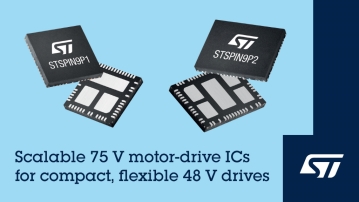
ST Launches 75V Drive IC Targeting 48V Industrial Motor Driving
ST Microelectronics has unveiled the 'STSPIN9P' series of 75V motor drive ICs tailored for 48V-class industrial drive system design. The new product family is characterized by half-bridge and full-bridge configurations that enable design scalability according to motor type and output conditions. Power supply circuits, protection functions, and current sensing circuits are integrated on-chip to simplify system configuration, and the devices are designed to support applications up to 500W maximum. The company plans to provide reference designs and demo boards to support development and evaluation in industrial automation, robotics, pumps, fans, lighting, and textile machinery.
2026.03.26by 배종인 기자

Nordic supports security updates for the entire lifecycle of IoT devices at a single fixed cost
Nordic Semiconductor, a global leader in low-power wireless connectivity solutions, has unveiled a single fixed-cost licensing model that delivers FOTA (Firmware Over-the-Air) and device management capabilities throughout the device lifecycle via nRF Cloud, and introduced a new firmware update solution to prepare for the enforcement of the European Union's Cyber Resilience Act (CRA).
2026.03.26by 배종인 기자
Practical Training in Low-Noise, Low-Power Circuit Design All in One Place… Training Fee Support
The "2026 Advanced Engineer Practical Masterclass" to strengthen competencies in high-sensitivity analog circuit and sensor-based system design will be held on April 16 at the e4ds Conference Center in Gasan-dong, Seoul. This program will be conducted as an offline paid hands-on training session, not online, and is targeted at engineers seeking on-site intensive learning. Texas Instruments will provide educational support for this training, allowing participation at 150,000 won, a 100,000 won discount from the original price of 250,000 won.
2026.03.26by 배종인 기자











