



What are the year-end shopping sales predicted by AI?
 Published2019.11.29 14:35
IBM has used AI to forecast year-end shopping sales. The forecast is drawing attention as it matches the results predicted by the National Retail Federation.
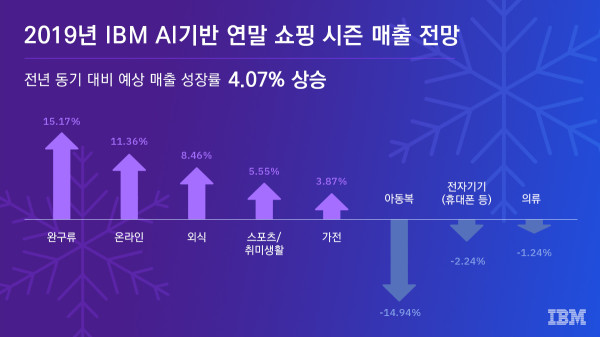
▲ 2019 Year-End Shopping Season Sales Forecast Analyzed by IBM Using AI <Source: IBM>
IBM predicted that sales during the U.S. year-end shopping season, spanning from Thanksgiving through Black Friday, Cyber Monday, and Christmas, would increase by 4% compared to last year. This aligns with the results of a survey conducted by the National Retail Association in October involving 7,782 U.S. consumers.
This report, derived from AI analysis of demographic data and various factors across more than 25 retail sectors, predicts that retail sales in December will surge at the end of the season, deviating from the previous trend of skyrocketing at the beginning of the Christmas season. According to the report, this is attributed to the increase in U.S. consumers' disposable income during the holiday season.
IBM predicted, based on AI-powered analysis, that toy sales would increase by 15.17% compared to last year, showing the largest growth among products. It was predicted that overall online sales would increase by 11.3%, while the food service industry would rise by 8.46%, sports and leisure by 5.55%, and household goods by 3.87%, whereas the children's clothing sector would decrease by 14.94%, home appliances by 2.24%, and clothing by 1.24% compared to last year.
Meanwhile, in addition to this outlook report, IBM is providing various AI-based solutions for businesses, including marketers, retailers, and supply chain managers, in time for the shopping season. Best Western, a world-renowned hotel chain, launched AI-powered digital advertisements for the year-end season. Utilizing IBM’s AI Watson, which has learned about customers, services, and travel destinations, they produced advertisements that engage in one-on-one conversations with customers to offer personalized travel packages and tips. As a result, the time spent conversing with customers through digital advertisements increased by more than 2.2 times, and the number of new customers rose by 48.6%.
관련뉴스

IBM Unveils Weather Signal, an AI-Based Weather Forecasting Solution
IBM과 IBM의 자회사인 웨더 컴퍼니는 AI 기반으로 기상 변화에 따른 비즈니스 실적을 미리 예측할 수 있는 솔루션 IBM 웨더 시그널을 선보였다. 기업들은 IBM 웨더 시그널이 제공하는 기상 데이터의 결과에 따라 공급망을 선제적으로 조정하고, 재고 수량과 재고 관리에 필요한 적정 인원을 파악하며, 특정 지역의 기상 조건에 적합한 프로모션을 진행할 수 있다.
2019.06.05by 이수민 기자

What is the future of the semiconductor industry amidst the 5G and AI competition?
5G, AI, IoT, 로봇, 자율주행차량 등의 영역에서 반도체 수요가 급증하고 있다. 화웨이를 위시한 중국이 빠르게 성장하고 있다. 미국이 중국을 전방위적으로 압박하고 있으나 중국의 반도체 산업은 성장을 지속하고 있다. 삼성전자는 2030년까지 비메모리 반도체 1위 기업 도약을 위해 파운드리와 시스템 LSI 시장점유율 확대에 나서고 있다.
2019.11.19by 최인영 기자

Appier Accelerates AI Innovation for Data-Driven Decision Making
Appier has successfully secured Series D funding, accelerating its global market expansion, talent acquisition, digital marketing domain expansion, and AI innovation for industrial applications. The company plans to support businesses in leveraging data for decision-making through its AI-powered marketing platform, and further develop technology that can automate decision-making across the entire consumer lifecycle.
2019.11.26by 최인영 기자
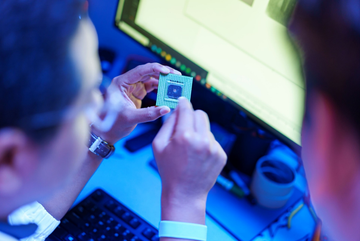
ST Microelectronics and NUS Establish Joint Research Center 'HELIX' for Edge AI
ST Microelectronics and the National University of Singapore have established the 'HELIX' joint research center aimed at implementing embedded AI in edge environments. Over a four-year period, the center will conduct research across the entire technology stack from algorithms to silicon, focusing on memory-centric architecture leveraging ST's 18nm FD-SOI technology and embedded PCM. The core objective is to implement intelligence directly in physical devices such as robots and drones while minimizing energy consumption.
2026.08.28by 배종인 기자

ams, 디지털 포토닉스로 휴머노이드 로봇 감각·소통 기능 지원
ams OSRAM이 디지털 포토닉스 기술을 활용해 휴머노이드 로봇의 감각·소통 기능을 강화하는 솔루션을 공개했다. dToF 센서, 광학식 힘 센서, 구조광 이미터 등으로 주변 환경 인식과 정밀 조작을 구현하며, EVIYOS·ALIYOS 플랫폼으로 LED 기반 비언어 소통을 지원한다. 시장조사에 따르면 휴머노이드 로봇 시장은 2025년 6억 달러에서 2035년 510억 달러로 성장할 전망이며, 로봇의 감각 능력 향상이 핵심 성장 동인으로 작용할 것으로 예상된다.
2026.08.27by 배종인 기자











