



Required Technologies, Applications, and Market Outlook for PCRAM
 Published2019.12.04 15:50
- 요구되는 기술 -
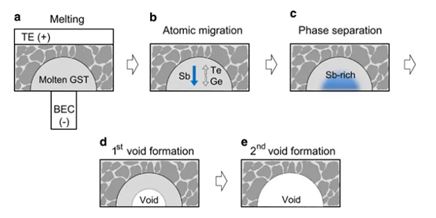
PCRAM 설계 및 생산에 있어서 주요 이슈들은 다음과 같다.
- GST를 구성하는 소재들의 Etch Rate의 차이로 인해 Sidewall이 데미지를
입거나 Bowing(안쪽으로 휘는) 현상 발생
않으므로 전체 면적 대비 손상 비율은 증가

Void(빈 공간)가 생기는 현상
DRAM과 생산 과정이 유사할지라도 위와 같은 문제점을 내포한 상태로는 여전히 일정 수준 이하로의 집적화는 쉽지 않다. 현재도 해당 이슈에 대해서 각 기업 및 정부들은 꾸준히 연구 개발을 통해서 극복하고자 하는 의지를 보이고 있다. 하지만 아직 양산화까지는 좀 더 시간이 필요하다.
- 적용분야 -
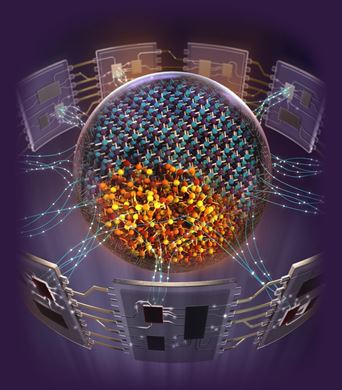
PCRAM은 웨어러블 기기, 모바일, AI, IoT 등 다양한 용도로 사용될 예정이다. 고온의 환경에서도 동작할 수 있다는 장점 때문에 Embedded 메모리로서 ePCM은 차량의 MCU(Micro Controller Unit)로도 적극적으로 활용될 예정이다.
또한, ReRAM과 함께, 서버용 DRAM과 저장장치(SSD/HDD)에 사용되는 플래시 메모리의 일부를 대체하여 동작 속도와 전력 소모를 모두 개선할 SCM(Storage Class Memory)로 사용될 것이다.
더불어 빅 데이터와 같은 고성능 처리 지원이 필요한 인메모리(In-memory) 컴퓨팅 기술의 핵심으로 주목 받고 있다.
- 시장 전망 -
PCRAM 시장은 단독(Stand-alone) 메모리로서 강세를 보일 것으로 예상된다. 단독 메모리는 임베디드 방식처럼 CPU와 결합되는 것이 아니라, 오로지 메모리를 위해서 설계 및 제작되는 방식을 말한다. 특히, 30nm 이하 수준의 사이즈가 양산이 가능한 시점부터 PCRAM 시장은 급상승을 이어나갈 것으로 전망되고 있다.
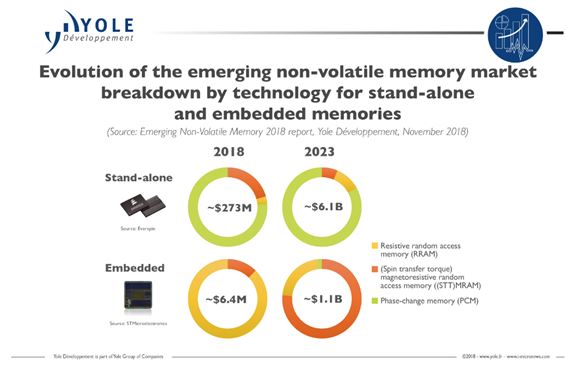
▲ 차세대 메모리 시장 동향(자료=Yole Développement)
프랑스의 마켓 리서치 회사인 욜 디벨롭먼트(Yole Développement)는 2023년엔 2018년의 약 20배 수준의 메모리 시장 성장을 예상하고 있다.
Comments
Related news
SK Hynix Develops Third-Generation 10nm DDR4 DRAM, Produced Without EUV Process
SK Hynix announced the development of 16Gbit DDR4 DRAM using third-generation 10-nanometer-class (1z) advanced process technology. The third-generation product achieved approximately 27% improvement in productivity compared to the second-generation (1y) product, and enhanced cost competitiveness by enabling production without EUV lithography processes. The company applied new materials not used in previous generation production processes to increase capacitance, and introduced new design techniques to enhance operational stability. SK Hynix plans to expand the application of third-generation 10-nanometer-class advanced process technology across various applications including LPDDR5 and HBM3.
2019.10.22by 이수민 기자
MRAM, which companies and countries are focusing on development and investment?
MRAM (Magnetic Random Access Memory) is a memory technology capable of high speed, large capacity, and high integration. Companies worldwide are accelerating MRAM development, and commercialization is already underway. Furthermore, government-level investments are being actively pursued.
2019.11.26by 김동욱 연구원
Microchip Expands EERAM Memory Solution Capable of Preserving Data Even When Power Is Cut Off
Manufacturing production lines and similar applications requiring repetitive data logging must be able to automatically restore content if power is interrupted during processing. Microchip has newly announced a Serial Peripheral Interface EEPROM memory product family that allows system developers to achieve up to 25% cost savings compared to conventional serial nonvolatile RAM.
2019.12.03by 이수민 기자

Intel Unveils Next-Generation 'Core Ultra Series 3' and vPro Platform for Enterprise PCs
Intel has officially unveiled the "Intel Core Ultra Series 3" for next-generation enterprise PCs and the latest vPro platform, addressing a wide range of demands from enterprise notebooks to high-performance workstations.
2026.03.26by 배종인 기자
ROHM Launches ESD Protection Diode Compatible with High-Speed Interfaces of 10Gbps or Higher
Semiconductor specialist ROHM has developed the 'RESDxVx series' of ESD (electrostatic discharge) protection diodes capable of responding to next-generation high-speed data communication environments exceeding 10Gbps, simultaneously enhancing both signal quality maintenance required in high-speed interfaces and IC protection performance.
2026.03.26by 배종인 기자











