



High-performance converter, supports high-resolution Mars exploration photography
 Published2012.09.11 15:49
September 11, 2012 – Analog Devices ( www.analog.com , NASDAQ: ADI), a global leader in high-performance signal processing technology and data converters, announced that its high-performance data converter AD6645 was used in the HiRISE (High Resolution Imaging Science Experiment) camera at Ball Aerospace, a company that designs, develops, and manufactures innovative aerospace systems, enabling scientists to capture the highest resolution images of Mars. The HiRISE camera is the largest and highest-resolution camera ever sent beyond Earth's orbit and was launched into space in August 2005 aboard NASA's Mars Reconnaissance Orbiter (MRO) to search for traces of life on Mars.
The Hi-Rise camera is capable of capturing an area of approximately 4 x 7 miles of the Martian surface at a resolution of about 800 megapixels. This provides the highest resolution images showing Mars' geological topography and climatic processes, revealing details ranging from small, table-sized objects to surface features. Thanks to this exceptional performance, the Hi-Rise camera is capable of photographing the Martian surface at a resolution approximately five times that of previously used cameras, providing images of 20,000 x 40,000 pixels. To date, this camera has taken more than 21,000 photos of Mars.
<Mounting the HiRISE camera on NASA's MRO> <Martian sedimentary rocks captured by HiRISE>
In the image processing and memory module of the HiRise camera, 28 of ADI's high-performance 14-bit AD6645 AD converters are used for 14 charge-coupled devices (CCDs). The CCDs capture light reflected from the surface of Mars and convert it into electrical signals. These electrical signals are then rapidly converted into digital data by the AD6645 and transmitted from the spacecraft to Earth via the Deep Space Network (DSN). This radiation-corrected data, processed through the DSN, is processed into a mosaic image composed of 14 CCD image strips and then adjusted to represent the distance and position between the spacecraft and Mars. This image is finally displayed aligned with the coordinates representing the planet.
Doug Bartow, Marketing Manager at Analog Devices, said, “We are proud that ADI’s high-performance data converters, as a core technology for the HiRISE camera, have contributed to expanding our holistic understanding of Mars. Originally, the scientific exploration mission of this orbiter was scheduled to last for about two years.” "However, the fact that the Hi-Rise camera and the Mars Orbiter continue to provide valuable images of Mars even now, long after their original mission duration has passed, clearly demonstrates the reliability of the components used in these systems," he said.
Thomas Ebben, Project Manager for HiRise at Ball Aerospace, said, “Analog Devices’ data converters have delivered performance that exceeded our company’s technical requirements and are contributing to the execution of HiRise’s historic mission by capturing remarkably clear photos of Mars.”
Supporting sampling frequencies of up to 105 MSPS (million samples per second) and providing excellent noise performance, the AD6645 meets Ball Aerospace's demanding performance and signal-to-noise ratio (SNR) requirements. In addition, through Ball Aerospace's rigorous temperature and vibration testing, the AD6645 has been proven to be highly suitable for the extreme environmental conditions during spacecraft launches.
Analog Devices' AD6645 remains in high demand to this day and is actively adopted in various types of applications, including satellites. In August 2012, a recent photo of Mars taken by the MRO orbiter can be viewed in detail via the URL below.
http://www.youtube.com/UAHiRISE

관련뉴스

Intel Unveils Next-Generation 'Core Ultra Series 3' and vPro Platform for Enterprise PCs
Intel has officially unveiled the "Intel Core Ultra Series 3" for next-generation enterprise PCs and the latest vPro platform, addressing a wide range of demands from enterprise notebooks to high-performance workstations.
2026.03.26by 배종인 기자

ROHM Launches ESD Protection Diode Compatible with High-Speed Interfaces of 10Gbps or Higher
반도체 전문 기업 로옴(ROHM)이 10Gbps를 넘어서는 차세대 고속 데이터 통신 환경에 대응할 수 있는 ESD(정전기 방전) 보호 다이오드 ‘RESDxVx 시리즈’를 개발하며, 고속 인터페이스에서 요구되는 신호 품질 유지와 IC 보호 성능을 동시에 끌어올렸다.
2026.03.26by 배종인 기자
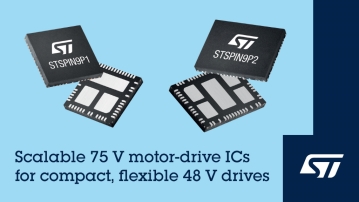
ST Launches 75V Drive IC Targeting 48V Industrial Motor Driving
ST마이크로일렉트로닉스가 48V급 산업용 구동 시스템 설계에 맞춘 75V 모터 드라이브 IC ‘STSPIN9P’ 시리즈를 공개했다. 새 제품군은 하프 브리지와 풀 브리지 구조로 구성돼 모터 종류와 출력 조건에 따라 설계를 확장할 수 있도록 한 것이 특징이다. 전원 회로와 보호 기능, 전류 감지 회로를 칩에 통합해 시스템 구성을 단순화했으며, 최대 500W급 애플리케이션까지 대응하도록 설계됐다. 회사는 레퍼런스 디자인과 데모 보드도 함께 제공해 산업 자동화, 로보틱스, 펌프, 팬, 조명, 섬유 기계 등에서 개발과 평가를 지원할 계획이다.
2026.03.26by 배종인 기자

Nordic supports security updates for the entire lifecycle of IoT devices at a single fixed cost
Nordic Semiconductor, a global leader in low-power wireless connectivity solutions, has unveiled a single fixed-cost licensing model that delivers FOTA (Firmware Over-the-Air) and device management capabilities throughout the device lifecycle via nRF Cloud, and introduced a new firmware update solution to prepare for the enforcement of the European Union's Cyber Resilience Act (CRA).
2026.03.26by 배종인 기자

Practical Training in Low-Noise, Low-Power Circuit Design All in One Place… Training Fee Support
고감도 아날로그 회로와 센서 기반 시스템 설계 역량을 강화할 수 있는 ‘2026 고급 엔지니어 실무 마스터 클래스’가 오는 4월16일 서울 가산동 e4ds 컨퍼런스 센터에서 열린다. 이번 과정은 온라인이 아닌 오프라인 유료 실습 교육으로 진행되며, 현장 중심의 심화 학습을 원하는 엔지니어를 대상으로 한다. 이번 교육은 텍사스 인스트루먼트(Texas Instruments)가 교육비를 지원해 정가 25만원에서 10만원 할인 된 15만원에 참가할 수 있다.
2026.03.26by 배종인 기자











