



Future Automotive Expertise Comes from Freescale
 Published2012.09.18 17:44
 - In the car semiconductor specific gravity rapidly It gets higher
- The size of a fingernail semiconductor1 item automobile The future ont-family: Arial; mso-hansi-font-family: Arial; mso-bidi-font-family: Arial">Run .
September 18, 2012, Seoul, Korea – Freescale (NYSE: FSL, www.freescale.com ), a global automotive semiconductor supplier, held a press conference on the morning of September 18 at the Volvo showroom in Daechi-dong, Gangnam-gu, Seoul, to look ahead to the smart car life of the near future enabled by Freescale’s semiconductor technology.
By exhibiting models wearing outfits shaped like semiconductor chips using cutting-edge electronic technology alongside automobiles, the exhibition allowed visitors to see the present and future of cars evolving from mechatronics to electronics at a glance.
On this day, Freescale held a technical briefing on related products, stating that four key trends—"Mobility for everyone," "Cleaner world for everyone," "Safety for everyone," and "Always connected for personalized driver information"—will be the driving forces of the future automotive industry.
Considering the reality that 'safety' is emerging as a core element of automotive development as the electrification of vehicles accelerates, cost-effective passive safety systems such as airbags, ABS, and TPMS for emerging industrial nations, and active safety systems such as surround view ADAS (Advanced Driver Assistance Systems), 77 GHz radar technology, vision, and Ethernet AVB for developed nations.Freescale unveiled its differentiated solutions tailored to specific markets. In particular, Freescale emphasized its position as a leading provider of safety solutions by describing the Qorivva MPC5643L, a 32-bit automotive MCU that was the world's first to obtain ISO 26262 (International Standard for Automotive Functional Safety) ASIL-D certification.
In 'Mobility for All,' the 1-cylinder engine management single-chip MM912xx812 and the highly integrated single-chip S12 MagniV solution were highlighted as key elements for developing the latest vehicles at reasonable prices, with a single-chip solution that reduces size and significantly lowers price.
In addition, it introduced a diverse portfolio for fuel efficiency improvement, including the industry's highest-performance engine control MCU, MPC5676R, which offers four times better performance than existing products and enables eco-friendly engine control in response to increasingly stringent international exhaust gas regulations.
In addition, introducing the i.MX 6 series, a single, dual, and quad-core high-performance processor that implements driver information systems such as infotainment, graphic instrument panels, and telematics, it was announced that five of the top 10 automotive OEMs plan to mass-produce infotainment devices based on Freescale i.MX6. Freescale’s telematics technology has already been adopted and applied to Ford SYNC, GM OnStar, and Hyundai-Kia’s BlueLink and UVO, which are commercialized in North America.
"The core of automotive electronic components is the ECU (Electronic Control Unit), and we are proud that Freescale possesses technological capabilities in this field that no semiconductor company can match," said Hwang Yeon-ho, President of Freescale Korea. "With the opening of a convergence era where IT (Information Technology) is rapidly integrating into the automotive industry, the market for new types of automotive electronic components is growing explosively, and Freescale will lead the market in this field with its unrivaled technological prowess."
Today, a single car is equipped with approximately 250 to 400 semiconductors, and automotive electronic components, which accounted for less than 1% of the total vehicle price as recently as the 1980s, now represent about 20 to 30% of the total vehicle price. McKinsey, a renowned U.S. consulting firm, forecasts that the automotive electronics market will reach $200 billion (approximately 230 trillion won) by 2015, predicting that the proportion of electronic components in the manufacturing cost of automobiles will rise to around 40% by 2015, and reach 70% in the case of electric vehicles that eliminate the engine.
It has been well known over the past few years that innovation in the automotive sector has become increasingly dependent on electronic components and software, and Freescale is a proven company that has supplied over 750 million ICs to automotive customers worldwide through its extensive portfolio of microcontrollers, processors, analog components, sensors, and specialized software.

관련뉴스

Intel Unveils Next-Generation 'Core Ultra Series 3' and vPro Platform for Enterprise PCs
인텔이 차세대 기업용 PC를 위한 ‘인텔 코어 Ultra 시리즈 3’와 최신 vPro 플랫폼을 공식 발표하며, 기업용 노트북부터 고성능 워크스테이션까지 폭넓은 수요 충족에 나섰다.
2026.03.26by 배종인 기자

ROHM Launches ESD Protection Diode Compatible with High-Speed Interfaces of 10Gbps or Higher
반도체 전문 기업 로옴(ROHM)이 10Gbps를 넘어서는 차세대 고속 데이터 통신 환경에 대응할 수 있는 ESD(정전기 방전) 보호 다이오드 ‘RESDxVx 시리즈’를 개발하며, 고속 인터페이스에서 요구되는 신호 품질 유지와 IC 보호 성능을 동시에 끌어올렸다.
2026.03.26by 배종인 기자
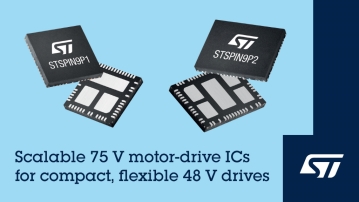
ST Launches 75V Drive IC Targeting 48V Industrial Motor Driving
ST마이크로일렉트로닉스가 48V급 산업용 구동 시스템 설계에 맞춘 75V 모터 드라이브 IC ‘STSPIN9P’ 시리즈를 공개했다. 새 제품군은 하프 브리지와 풀 브리지 구조로 구성돼 모터 종류와 출력 조건에 따라 설계를 확장할 수 있도록 한 것이 특징이다. 전원 회로와 보호 기능, 전류 감지 회로를 칩에 통합해 시스템 구성을 단순화했으며, 최대 500W급 애플리케이션까지 대응하도록 설계됐다. 회사는 레퍼런스 디자인과 데모 보드도 함께 제공해 산업 자동화, 로보틱스, 펌프, 팬, 조명, 섬유 기계 등에서 개발과 평가를 지원할 계획이다.
2026.03.26by 배종인 기자

Nordic supports security updates for the entire lifecycle of IoT devices at a single fixed cost
Nordic Semiconductor, a global leader in low-power wireless connectivity solutions, has unveiled a single fixed-cost licensing model that delivers FOTA (Firmware Over-the-Air) and device management capabilities throughout the device lifecycle via nRF Cloud, and introduced a new firmware update solution to prepare for the enforcement of the European Union's Cyber Resilience Act (CRA).
2026.03.26by 배종인 기자
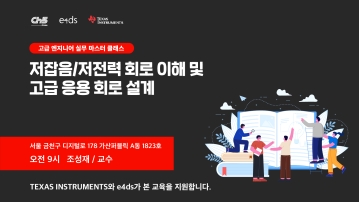
Practical Training in Low-Noise, Low-Power Circuit Design All in One Place… Training Fee Support
고감도 아날로그 회로와 센서 기반 시스템 설계 역량을 강화할 수 있는 ‘2026 고급 엔지니어 실무 마스터 클래스’가 오는 4월16일 서울 가산동 e4ds 컨퍼런스 센터에서 열린다. 이번 과정은 온라인이 아닌 오프라인 유료 실습 교육으로 진행되며, 현장 중심의 심화 학습을 원하는 엔지니어를 대상으로 한다. 이번 교육은 텍사스 인스트루먼트(Texas Instruments)가 교육비를 지원해 정가 25만원에서 10만원 할인 된 15만원에 참가할 수 있다.
2026.03.26by 배종인 기자











