

.png)

Linear, Industry-Leading Low-Power WirelessHART and Internet Protocol
 Published2012.10.17 13:23
October 17, 2012 – Linear Technology Korea (CEO Hong Sa-gwak) announced that the Dust Networks® product division of Linear Technology is launching industry-leading low-power wireless sensor networking products compliant with IEEE 802.15.4E specification (product name: SmartMesh™ LTC5800 (System-on-Chip) & LTP5900 (module)). The SmartMesh IC products and modules support design to enable small sensor "motes" to operate with battery life exceeding 10 years, and enable the realization of wireless sensor networks (WSN) development that requires very high robustness and security along with network managers.
SmartMesh networks utilize a "triple play" wireless mesh technology of time diversity, frequency diversity, and physical diversity to ensure reliability, resiliency, scalability, power source flexibility, and ease of use. The core of this technology is an intelligent mesh network equipped with advanced algorithms and power-saving techniques. Through these technologies, it realizes powerful capabilities unavailable from other WSN vendors, including decisive power management and optimization, auto-forming, and self-healing mesh technology, zero-collision low-power packet switching, and large-scale high-density network scalability.
The SmartMesh IP™ version complies with the 6LoWPAN standard and provides native IPv6 addressability for all nodes. The new SmartMesh WirelessHART IEC62591 standard-compliant products extend battery life by 2x compared to previously announced products.
The SmartMesh product family consists of multiple products that can simplify system development. The LTC5800 System-on-Chip includes robust sensor networking software in an easy-to-integrate 72-pin 10mm x 10mm QFN package. The LTC5800 integrates all wireless circuit components including an onboard power amplifier and ARM Cortex M3 32-bit microprocessor, requiring only power, ground, and an antenna for robust wireless connectivity. The LTP5901/LTP5902 mote modules provide easy-to-integrate surface-mount PCBs that have passed FCC, CE, and IC modular wireless certification. The LTP5901 module includes an onboard chip antenna while the LTP5902 module includes an MMCX antenna connector.
Joy Weiss, President of Linear Technology's Dust Networks product division, stated "The primary objective is to enable customers to confidently deploy sensors wherever they need to obtain data. The launch of the SmartMesh WirelessHART system and the addition of wireless sensor networks for IP implementation represent Linear Technology's ongoing efforts that reflect this objective."
Bob Karschnia, Vice President and Business Unit Leader of the Smart Wireless Product Line at Emerson Process Management, said "Dust Networks is the only company focused on simultaneously realizing ultra-low-power and high-reliability wireless networks. By leveraging Dust Networks' SmartMesh WirelessHART components, we have realized Emerson's Smart Wireless instrumentation in the field through over 1 billion hours of operation. Accordingly, we highly value the potential of the LTC5800 and expect that the 2x extension of battery life will enable new applications in the industrial process market."
Mark Housley, CEO of Vigilent, stated "The RF environment within data centers is extremely harsh. Therefore, customers require that energy management and data center analytics systems be deployed while minimizing their impact on the data center. Wireless sensors based on Dust Networks ensure that Vigilent technology can provide solutions for mission-critical facilities without impacting data center operations."
SmartMesh WirelessHART was built to meet ultra-low-power and reliability requirements for the industrial process control market. These characteristics satisfy the demands of numerous diverse applications, while SmartMesh IP maintains comparable performance while following the 6LoWPAN standard.
Professor Steven Glaser of UC Berkeley oversees the SierraNet program (http://systems.berkeley.edu/wsn/). This program can measure temperature, humidity, snow depth, soil moisture, and solar radiation levels in remote environments using sensors with SmartMesh implementation. Professor Steven Glaser stated "Our objective is to accurately monitor remote environments to track California's water supply status. Because SmartMesh IP IPv6 routing nodes can operate with average power consumption of less than 50μA, SmartMesh IP presents a new paradigm in sensor networking. Additionally, it combines convenient web programming with the long lifetime and reliability of Dust Networks' industrial products."
All SmartMesh networks are centrally managed and provide comprehensive security and network management capabilities. The SmartMesh WirelessHART Manager (LTP5903) can support up to 500 nodes per network. The SmartMesh IP Manager can support up to 100 nodes per network. Multiple instances of SmartMesh subnets can be deployed side-by-side to design large-scale networks.
All detailed information on SmartMesh WirelessHART and SmartMesh IP products, including Mote-on-Chip™, PCB motes, and network managers, is available at www.linear.com/products/wireless_sensor_networks.
Photo caption: LTC5800 QFN & LTP5902 PCB module with selectable chip antenna, FCC, CE & IC modular wireless certification
Product Features: LTC5800 & LTP5900 Product Family
• Time-synchronized channel-hopping network realizing ultra-low-power and high-reliability in harsh environments
• Self-forming, self-healing mesh network
• Rx current: 4.5 mA
• Tx current @ 0 dBm: 5.4 mA
• Tx current @ +8 dBm: 9.7 mA
• IEEE 802.15.4, 2.4 GHz (2400-2483.5 MHz), direct sequence spread spectrum
• AES-128-bit encryption
• Built-in over-the-air software update capability
• Sub-millisecond accurate time stamp available to all nodes in the network
• Complete on-chip RF integration including PA (Power Amplifier), balun & antenna matching circuits
• ARM Cortex M3 32-bit processor
• 72-pin 10mm x 10mm QFN package (LTC5800)
• 42 mm x 24 mm PCBA module with onboard chip antenna (LTP5901)
• 37.5 mm x 24 mm PCBA module with MMCX antenna connector (LTP5902)
• LTP5903 WirelessHART Network Manager, 102.9mm x 55.6 mm PCBA module with antenna connector. Requires 150mA @ average 5V

Related news

Intel Unveils Next-Generation 'Core Ultra Series 3' and vPro Platform for Enterprise PCs
Intel has officially unveiled the "Intel Core Ultra Series 3" for next-generation enterprise PCs and the latest vPro platform, addressing a wide range of demands from enterprise notebooks to high-performance workstations.
2026.03.26by 배종인 기자

ROHM Launches ESD Protection Diode Compatible with High-Speed Interfaces of 10Gbps or Higher
Semiconductor specialist ROHM has developed the 'RESDxVx series' of ESD (electrostatic discharge) protection diodes capable of responding to next-generation high-speed data communication environments exceeding 10Gbps, simultaneously enhancing both signal quality maintenance required in high-speed interfaces and IC protection performance.
2026.03.26by 배종인 기자
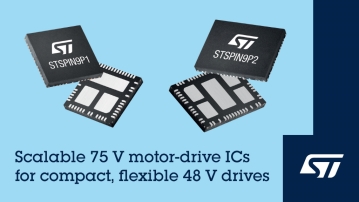
ST Launches 75V Drive IC Targeting 48V Industrial Motor Driving
ST Microelectronics has unveiled the 'STSPIN9P' series of 75V motor drive ICs tailored for 48V-class industrial drive system design. The new product family is characterized by half-bridge and full-bridge configurations that enable design scalability according to motor type and output conditions. Power supply circuits, protection functions, and current sensing circuits are integrated on-chip to simplify system configuration, and the devices are designed to support applications up to 500W maximum. The company plans to provide reference designs and demo boards to support development and evaluation in industrial automation, robotics, pumps, fans, lighting, and textile machinery.
2026.03.26by 배종인 기자

Nordic supports security updates for the entire lifecycle of IoT devices at a single fixed cost
Nordic Semiconductor, a global leader in low-power wireless connectivity solutions, has unveiled a single fixed-cost licensing model that delivers FOTA (Firmware Over-the-Air) and device management capabilities throughout the device lifecycle via nRF Cloud, and introduced a new firmware update solution to prepare for the enforcement of the European Union's Cyber Resilience Act (CRA).
2026.03.26by 배종인 기자

Practical Training in Low-Noise, Low-Power Circuit Design All in One Place… Training Fee Support
The "2026 Advanced Engineer Practical Masterclass" to strengthen competencies in high-sensitivity analog circuit and sensor-based system design will be held on April 16 at the e4ds Conference Center in Gasan-dong, Seoul. This program will be conducted as an offline paid hands-on training session, not online, and is targeted at engineers seeking on-site intensive learning. Texas Instruments will provide educational support for this training, allowing participation at 150,000 won, a 100,000 won discount from the original price of 250,000 won.
2026.03.26by 배종인 기자











