

.png)

Xilinx Unveils Zynq™-7000 All-Programmable SoC Platform Based on Automotive ARM® Processors at SAE Convergence 2012
 Published2012.10.22 15:35
Xilinx Korea (Country Manager Ahn Heung-sik) October 22, 2012 – Xilinx has set the stage to accelerate the development and adoption of next-generation automotive driver assistance systems (ADAS). At SAE (Society Automotive Engineers) Convergence 2012 (Booth 909), held on the 16th, Xilinx unveiled the Zynq™-7000 All Programmable SoC platform based on automotive ARM® processors. The newly unveiled platform meets the sophisticated technical requirements of systems, such as image vision demanding high reliability and in-vehicle networking functions. Furthermore, it enables the integration of programmable systems at a low cost, thereby reducing the cost and development time of driver assistance solutions.
Nick DiFiore, Director of Automotive at Xilinx, stated, “As the ADAS sector evolves rapidly, Xilinx’s automotive-grade Zynq-7000 All Programmable SoC is recognized in the industry as an innovative product that accelerates the adoption of ADAS technology.” He added, “With the Zynq-7000 family, ADAS developers can not only implement existing software-based systems but also process images with tightly coupled, optimized hardware accelerators, providing low power consumption performance that was impossible with conventional multi-chip approaches.”
In addition, Difior stated that ADAS vendors are seeking to differentiate themselves in the market by combining standardized IP and algorithms with existing IP from the Xilinx ecosystem using Zynq-7000, which is not an ASSP. This benefits both ADAS vendors and IP vendors in such a highly competitive market because it does not require the massive costs and time that make ASIC development inefficient.
Currently, automotive manufacturers are providing additional ADAS applications that guarantee various safety features to drivers at a low cost. These include blind spot monitoring systems, lane departure warning systems, automatic parking assistance systems, collision avoidance systems, and pedestrian and driver drowsiness detection systems. A commonality between current and future ADAS applications is the use of multiple cameras and ultrasonic sensors combined with specialized real-time processing systems. A prime example is image vision functionality; currently, this system utilizes multiple chips for necessary processing, resulting in high BOM costs and limited flexibility for scaling across vehicle platforms. This is an area where Xilinx places the greatest emphasis.
In addition, the Xilinx Automotive (XA) Zynq-7000 All Programmable SoC meets the stringent temperature, quality, and reliability requirements for automotive applications, making it ideal for ADAS applications.
Mark Fitzgerald, a global automotive strategy analyst, analyzed, “Demand for driver assistance applications is very high and continuously increasing, but it is constrained by high production and development costs. To overcome this, priority must be given to optimizing the size of key components through continuous integration and creating a common platform ideal for various ADAS applications. This will enable reduction of device costs, increased economies of scale, and shortened development cycles.” In addition, it was predicted that “through customized solutions that increase integration scale while reducing the number of chips, we will be able to address the requirements of automotive manufacturers seeking to develop next-generation ADAS applications applicable to various vehicles.”
While current ADAS solutions typically utilize multiple chips, Xilinx is overcoming this limitation with the Zynq-7000 family, the industry's first SoC family. The Zynq-7000 family integrates an ARM dual-core Cortex™-A9 MPCore™ processing system with programmable logic tightly coupled on a single die. This combination significantly improves performance for processing-intensive real-time ADAS and enables superior system integration capable of supporting multiple applications while reducing the Bill of Materials (BOM).
Xilinx provides relevant videos to enhance customer understanding of its products. Through Xilinx’s automotive videos, you can discover the secret behind how the Zynq-7000 All Programmable SoC eliminates the need for multi-chip architecture and delivers superior system integration capabilities, as well as how to leverage optimal hardware resources and the scalability of advanced ADAS.
Davor Kovacec, Founder and CEO of Xylon, highly praised Xilinx’s Zynq-7000 All Programmable SoC, stating, “The Zynq-7000 is the best programmable platform for next-generation automotive driver assistance applications that require advanced real-time video processing, simultaneous execution of multiple advanced algorithms, and diverse interfaces with sensors and the vehicle communication backbone.” He added, “The superior performance and reprogrammability of the Zynq-7000 device enabled Xylon to design SoCs that are superior to competitor solutions.” "In addition, we have been able to design an SoC capable of realizing a new level of differentiation through the combination of hardware-accelerated video inputs from multiple camera inputs and the ability to rapidly adapt to continuously changing sensor configurations and interfaces," he said.
Supply timing
The optimized XA Zynq-7000 is scheduled for release in the second quarter of 2013. Developers can begin designing using current commercial devices. More details can be found in the Xilinx Automotive Zynq-7000 SoC. Zylon's LogiADAK Zynq-7000 SoC Automotive Driver Assistance Kit is scheduled for release in December 2012. Further information about this kit can be found on the Zylon website.

관련뉴스

Intel Unveils Next-Generation 'Core Ultra Series 3' and vPro Platform for Enterprise PCs
Intel has officially unveiled the "Intel Core Ultra Series 3" for next-generation enterprise PCs and the latest vPro platform, addressing a wide range of demands from enterprise notebooks to high-performance workstations.
2026.03.26by 배종인 기자

ROHM Launches ESD Protection Diode Compatible with High-Speed Interfaces of 10Gbps or Higher
반도체 전문 기업 로옴(ROHM)이 10Gbps를 넘어서는 차세대 고속 데이터 통신 환경에 대응할 수 있는 ESD(정전기 방전) 보호 다이오드 ‘RESDxVx 시리즈’를 개발하며, 고속 인터페이스에서 요구되는 신호 품질 유지와 IC 보호 성능을 동시에 끌어올렸다.
2026.03.26by 배종인 기자
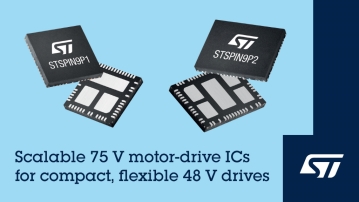
ST Launches 75V Drive IC Targeting 48V Industrial Motor Driving
ST Microelectronics has unveiled the 'STSPIN9P' series of 75V motor drive ICs tailored for 48V-class industrial drive system design. The new product family is characterized by half-bridge and full-bridge configurations that enable design scalability according to motor type and output conditions. Power supply circuits, protection functions, and current sensing circuits are integrated on-chip to simplify system configuration, and the devices are designed to support applications up to 500W maximum. The company plans to provide reference designs and demo boards to support development and evaluation in industrial automation, robotics, pumps, fans, lighting, and textile machinery.
2026.03.26by 배종인 기자

Nordic supports security updates for the entire lifecycle of IoT devices at a single fixed cost
Nordic Semiconductor, a global leader in low-power wireless connectivity solutions, has unveiled a single fixed-cost licensing model that delivers FOTA (Firmware Over-the-Air) and device management capabilities throughout the device lifecycle via nRF Cloud, and introduced a new firmware update solution to prepare for the enforcement of the European Union's Cyber Resilience Act (CRA).
2026.03.26by 배종인 기자

Practical Training in Low-Noise, Low-Power Circuit Design All in One Place… Training Fee Support
The "2026 Advanced Engineer Practical Masterclass" to strengthen competencies in high-sensitivity analog circuit and sensor-based system design will be held on April 16 at the e4ds Conference Center in Gasan-dong, Seoul. This program will be conducted as an offline paid hands-on training session, not online, and is targeted at engineers seeking on-site intensive learning. Texas Instruments will provide educational support for this training, allowing participation at 150,000 won, a 100,000 won discount from the original price of 250,000 won.
2026.03.26by 배종인 기자











