



Market through Mega Zoom and Segment Memory
 Published2012.11.09 11:17
InfiniiVision 4000X Series Lee Sun-woo, Director
In a presentation explaining the InfiniiVision 4000X Series, which embodies Agilent's philosophy, Director Lee Sun-woo mentioned that based on research firm data, Agilent currently holds a 13.50% market share in the oscilloscope market. Agilent's current product portfolio is prepared to cover from handheld benchtop products, real-time oscilloscopes to sampling oscilloscopes, ranging from 53 to 64GHz.
Director Lee Sun-woo, explaining by comparing to food, stated that Agilent's strategy focuses on differentiation based on technological superiority. He mentioned that this has been the reason consumers have used Agilent's products over the past 10 years.
He stated that the core of the announced InfiniiVision is the ASIC called Mega Zoom.
Additionally, InfiniiVision incorporates responses to user dissatisfaction and improvement requests.
First, oscilloscopes display signals, but users wanted stronger analytical capability. In the OS field, both embedded operating environments and Windows OS were required. In the case of embedded systems, they are fast and good, but there are compatibility issues. This is where Windows OS differs.
And users requested easier triggering.
Moreover, all oscilloscopes have limitations, and that is memory. There were requests for more efficient memory usage.
As customer requests frequently emerge along with new technologies, there were concerns about whether the oscilloscope would meet development requirements 5 and 10 years in the future.
Director Lee Sun-woo stated that in response to this need, the InfiniiVision 4000 Series was introduced.
Video Proposal
1. They wanted to redefine the user experience. Through the convenience of products like the iPhone, mouse, and vehicle navigation systems, they sought to provide a new user-centric experience through environmental redefinition.
He first mentioned the speed aspect. An oscilloscope must perform two functions to display the desired signal on screen: it must break down incoming signals into short segments and store them, and then plot or draw them on screen. It must be able to display incoming real-time signals quickly.
2. Ease of use. The trigger aspect—one must be able to trigger signals in the desired state.
3. Integration. Agilent considers this as a combined product of five independent products: oscilloscope, function generator, voltmeter, logic analyzer, and protocol analyzer.
An oscilloscope must be able to sample, plot, and analyze.
Conventional Agilent oscilloscopes typically sample through an ADC and plot, with the CPU performing averaging, histogramming, digital channel and analog plotting functions.
These oscilloscopes, which typically perform hundreds of billions of samples per second, were questioned on how well they draw waveforms millions or tens of millions of times per second, and it was stated that they are currently not performing adequately in this regard.
The Mega Zoom technology announced this time is a chip that makes the CPU speed even faster. Previously, two CPUs were used, but this product optimizes the chip using ASIC.
In other words, the CPU only handles measurement and measuring, while the ASIC handles the rest.
Competitor T company currently operates through 7 chips, but Agilent resolves everything with a single chip, thereby achieving signal integrity, reducing processing time, and enabling repairs by replacing just one chip. See photo.
As shown in the photo below, when the oscilloscope's sampling rate is slow, signals are not captured and information is not conveyed to engineers. However, when creating signals at a million times, the probability of catching unexpected bursts that customers did not anticipate increases significantly.
In the case of 4000X's 1 million sampling rate compared to T company's 55,000 sampling rate, the difference shown below occurs. This is the advantage of Mega Zoom. And although 55,000 is mentioned, when digital is activated, it becomes even slower.
Additionally, in the memory aspect, it enables capturing only the signal portions that customers desire. This is called 100 segments.
Currently in vehicles, bursts and commands are sent through CAN, and frame-by-frame communication occurs, with which engineers capture bursts. However, by using the segment function, signals close to 101 seconds can be captured using segment memory.
The command given to capture the signal at the point the engineer desires—this is triggering. This aspect is not easy. Previously, engineers had to analyze signals individually through direct commands, but now, through touch screen functionality, they can capture the desired portion and display the waveform at a rate of 1 million times per second, which is what Agilent calls redefining the user experience. By forming a box through touch and immediately appearing triggering conditions through screen clicking, users can view them simply and easily. And this design also enables measurement and analysis through internet connection from external sources.
According to records, function generators and multimeters are used together with oscilloscopes. So this product includes a protocol analyzer, analog channel, digital channel, and dual-channel waveform generator.
The reasons why these five functions are needed are as follows:
Users view voltage with a voltmeter, view waveforms with an oscilloscope, analyze communication protocols, confirm analog analysis through MSO channels, then complete the signal and input it into the function generator to create a golden signal—a completed signal. And this is what makes everything possible in one product at one location.
Regarding the positioning of the 4000 Series, it is described as high-end in the mid-to-lower price range. Previously it was 1GHz, but now it has been raised to 1.5GHz and sampling up to 5GHz is possible, with 4MB of memory and a large 12.1" display.
And a capacitive touch UI has been applied. Through capacitive touch, the inconvenience of previous pressure-based operation has been eliminated.
It is prepared to cover most applications and currently serves as a replacement product for the existing 7000 Series.

Related news
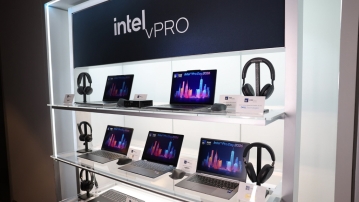
Intel Unveils Next-Generation 'Core Ultra Series 3' and vPro Platform for Enterprise PCs
Intel has officially unveiled the "Intel Core Ultra Series 3" for next-generation enterprise PCs and the latest vPro platform, addressing a wide range of demands from enterprise notebooks to high-performance workstations.
2026.03.26by 배종인 기자
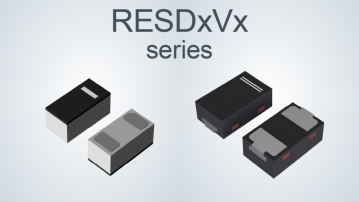
ROHM Launches ESD Protection Diode Compatible with High-Speed Interfaces of 10Gbps or Higher
Semiconductor specialist ROHM has developed the 'RESDxVx series' of ESD (electrostatic discharge) protection diodes capable of responding to next-generation high-speed data communication environments exceeding 10Gbps, simultaneously enhancing both signal quality maintenance required in high-speed interfaces and IC protection performance.
2026.03.26by 배종인 기자
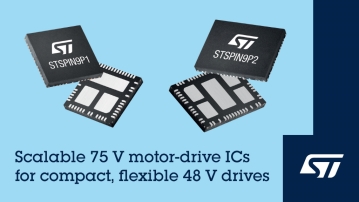
ST Launches 75V Drive IC Targeting 48V Industrial Motor Driving
ST Microelectronics has unveiled the 'STSPIN9P' series of 75V motor drive ICs tailored for 48V-class industrial drive system design. The new product family is characterized by half-bridge and full-bridge configurations that enable design scalability according to motor type and output conditions. Power supply circuits, protection functions, and current sensing circuits are integrated on-chip to simplify system configuration, and the devices are designed to support applications up to 500W maximum. The company plans to provide reference designs and demo boards to support development and evaluation in industrial automation, robotics, pumps, fans, lighting, and textile machinery.
2026.03.26by 배종인 기자

Nordic supports security updates for the entire lifecycle of IoT devices at a single fixed cost
Nordic Semiconductor, a global leader in low-power wireless connectivity solutions, has unveiled a single fixed-cost licensing model that delivers FOTA (Firmware Over-the-Air) and device management capabilities throughout the device lifecycle via nRF Cloud, and introduced a new firmware update solution to prepare for the enforcement of the European Union's Cyber Resilience Act (CRA).
2026.03.26by 배종인 기자
Practical Training in Low-Noise, Low-Power Circuit Design All in One Place… Training Fee Support
The "2026 Advanced Engineer Practical Masterclass" to strengthen competencies in high-sensitivity analog circuit and sensor-based system design will be held on April 16 at the e4ds Conference Center in Gasan-dong, Seoul. This program will be conducted as an offline paid hands-on training session, not online, and is targeted at engineers seeking on-site intensive learning. Texas Instruments will provide educational support for this training, allowing participation at 150,000 won, a 100,000 won discount from the original price of 250,000 won.
2026.03.26by 배종인 기자











