



Veredus Institute Launches Lab-on-Chip for Diagnosing Multidrug-Resistant Tuberculosis!
 Published2012.11.27 15:27
Multidrug-resistant tuberculosis is a major headache for the global medical community. For effective tuberculosis treatment, rapid and accurate diagnosis, along with taking the correct medication, is crucial. The downside of this treatment method is that tuberculosis infections can mutate to become resistant to drugs, making treatment very difficult and costly. Existing methods for accurately identifying tuberculosis infections took up to eight weeks. However, VereMTB does not require the culture step that takes the longest time, allowing it to diagnose from natural samples [2] within three hours and identify specific acid-fast bacilli that cause infection and resistance. Additionally, because the chip is small, the system can be deployed appropriately for the required time and environment.
Dr. Rosemary Tan, CEO of Veredus Institute, stated, “In 2011, 8.7 million people were diagnosed with tuberculosis, and 1.4 million died. According to the World Health Organization, tuberculosis is the second leading cause of death from a single infectious disease worldwide. For such a highly contagious disease, rapid diagnosis and the use of appropriate treatments are crucial. Veredus Institute is confident that VereMTB can meet this need by rapidly diagnosing tuberculosis and multidrug resistance, and furthermore, help provide appropriate treatment.”
The VereMTB multimolecular diagnostic lab-on-chip was designed and tested through the TM-REST program[3] as part of the 7th EU Framework for the Development of New Diagnostics to Combat Tuberculosis and Malaria.
Benedetto Vigna, General Manager of ST’s Analog, MEMS, and Sensors business unit and Group Senior Vice President, stated, “We are at the forefront of developing silicon technology for healthcare applications. ST’s sensor and power technologies have driven numerous innovations in the healthcare sector, ranging from personal and portable to ultra-small and minimally invasive medical devices. VereMTB, utilizing ST’s lab-on-chip technology, is a prime example of ST’s ability to leverage its technology portfolio to provide strategic solutions for global healthcare challenges.”
The VereMTB chip is based on ST's industry-recognized lab-on-chip technology and is currently being evaluated by the Chinese Center for Disease Control and Prevention in Beijing as part of a new technology evaluation program for tuberculosis diagnosis. According to a 2012 WHO report on tuberculosis, India and China combined account for 40% of the world's tuberculosis infections, and in 2011, nearly 60% of multidrug-resistant tuberculosis patients were located in India, China, and the Russian Federation.
Professor Zhao Yanlin, Director of the National Tuberculosis Standard Research Institute of China and Deputy Director of the National Tuberculosis Control and Prevention Center under the Chinese Center for Disease Control and Prevention, stated, “The National Tuberculosis Standard Research Institute of the Chinese Center for Disease Control and Prevention in Beijing has been evaluating VereMTB using samples collected from across China, focusing on whether it can identify multidrug-resistant variants that are difficult to distinguish by other methods.” “The speed, accuracy, and comprehensiveness of the experimental results are very satisfactory. We would like to continue collaborating with Veredus to create a new breakthrough in tuberculosis diagnosis,” he said.
VereMTB was demonstrated at the 43rd Union World Conference in Kuala Lumpur, Malaysia, held from November 13-17. Veredus Lab is a Singapore-based subsidiary of STMicroelectronics, a global semiconductor leader in sensor technology, including biosensors such as lab-on-chip.

관련뉴스

Intel Unveils Next-Generation 'Core Ultra Series 3' and vPro Platform for Enterprise PCs
Intel has officially unveiled the "Intel Core Ultra Series 3" for next-generation enterprise PCs and the latest vPro platform, addressing a wide range of demands from enterprise notebooks to high-performance workstations.
2026.03.26by 배종인 기자

ROHM Launches ESD Protection Diode Compatible with High-Speed Interfaces of 10Gbps or Higher
반도체 전문 기업 로옴(ROHM)이 10Gbps를 넘어서는 차세대 고속 데이터 통신 환경에 대응할 수 있는 ESD(정전기 방전) 보호 다이오드 ‘RESDxVx 시리즈’를 개발하며, 고속 인터페이스에서 요구되는 신호 품질 유지와 IC 보호 성능을 동시에 끌어올렸다.
2026.03.26by 배종인 기자

ST Launches 75V Drive IC Targeting 48V Industrial Motor Driving
ST Microelectronics has unveiled the 'STSPIN9P' series of 75V motor drive ICs tailored for 48V-class industrial drive system design. The new product family is characterized by half-bridge and full-bridge configurations that enable design scalability according to motor type and output conditions. Power supply circuits, protection functions, and current sensing circuits are integrated on-chip to simplify system configuration, and the devices are designed to support applications up to 500W maximum. The company plans to provide reference designs and demo boards to support development and evaluation in industrial automation, robotics, pumps, fans, lighting, and textile machinery.
2026.03.26by 배종인 기자

Nordic supports security updates for the entire lifecycle of IoT devices at a single fixed cost
Nordic Semiconductor, a global leader in low-power wireless connectivity solutions, has unveiled a single fixed-cost licensing model that delivers FOTA (Firmware Over-the-Air) and device management capabilities throughout the device lifecycle via nRF Cloud, and introduced a new firmware update solution to prepare for the enforcement of the European Union's Cyber Resilience Act (CRA).
2026.03.26by 배종인 기자
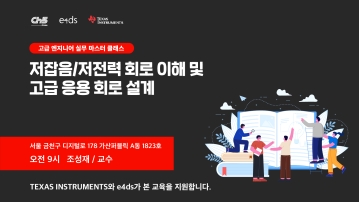
Practical Training in Low-Noise, Low-Power Circuit Design All in One Place… Training Fee Support
The "2026 Advanced Engineer Practical Masterclass" to strengthen competencies in high-sensitivity analog circuit and sensor-based system design will be held on April 16 at the e4ds Conference Center in Gasan-dong, Seoul. This program will be conducted as an offline paid hands-on training session, not online, and is targeted at engineers seeking on-site intensive learning. Texas Instruments will provide educational support for this training, allowing participation at 150,000 won, a 100,000 won discount from the original price of 250,000 won.
2026.03.26by 배종인 기자











