


STMicroelectronics Launches Smaller, Smarter Intelligent High-Side Switch
 Published2013.01.28 11:34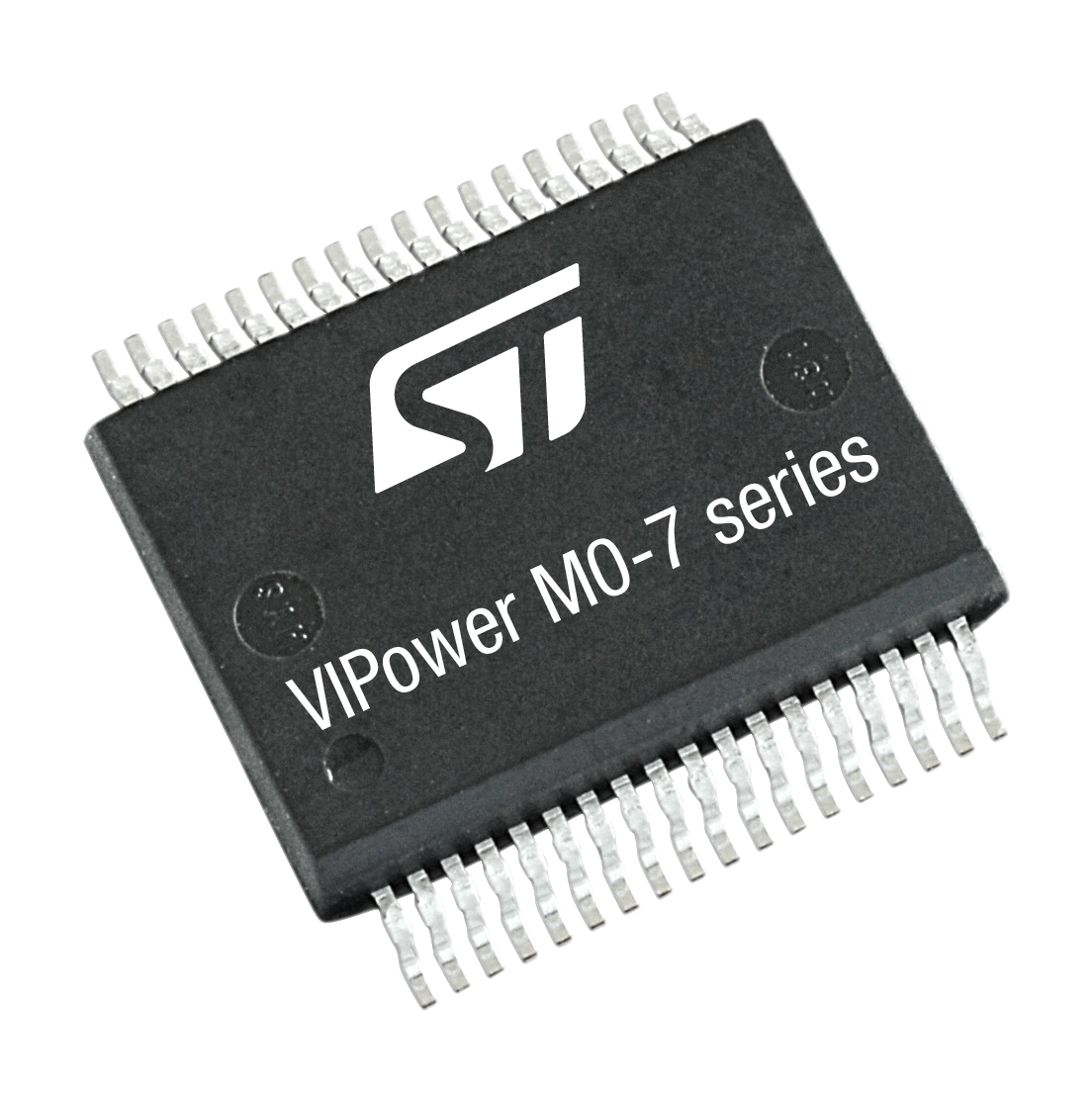
January 22, 2013, Seoul — STMicroelectronics (ST), a global semiconductor company providing a wide range of electronic applications and the No. 1 supplier of automotive semiconductors, has introduced the new M0-7 series of switch ICs. These new products are automotive electronic components suitable for lighting and body modules. In addition to providing enhanced intelligent functions and increased protection and reliability, they are up to 40% smaller than competing products.
The intelligent high-side switches pioneered by ST will serve as a more reliable and efficient alternative to conventional relays. Over the years, ST's VIPower product family has provided benefits such as a common package for a wide range of devices within relevant categories. This has enabled major suppliers to manufacture various modular variants using the same underlying hardware and software. Consequently, automotive companies can meet the diverse requirements of the international market and cost-effectively offer various model specifications and options. The common package approach is being widely adopted among high-side switch vendors.
75% of ST’s 7th generation VIPower product family, the M0-7 series, is supplied in a 5x4mm package, which is 40% smaller than the smallest competing devices. This allows automotive electronics design engineers to reduce PC board space and target smaller module sizes. Furthermore, various changes in the internal design increase precision, improve diagnostic feedback, and enhance reliability. Specific examples of performance improvements include more reliable prevention of short circuits, more accurate voltage and temperature feedback, improved current sensing precision, and best-in-class electromagnetic interference (EMI) performance.
Samples of all products in this product family are currently available. The first device to enter production is the dual-channel VND7020AJ-E, scheduled for the second quarter of 2013, priced starting at $1.10 per unit for orders of 1,000. Available package types in this new product family include the PowerSSO-16, PowerSSO-36, Octapak, and SO-8.
Key Features of the M0-7 Series:
• Precise load—current, voltage, and temperature—monitor feedback
• Integrated sense multiplexer
• Power limit and over-temperature latch off
• Bulb/LED Mode (Quad Channel)
• Flexible fault-reset management
• Reverse polarity prevention
• Pull-on and pull-off state detection capability
• Ultra-low standby current
Background explanation on automotive high-side switches
Intelligent high-side switches play a crucial role in the development of advanced automotive electronics. This switch product integrates a power MOSFET, serving as the main electronic control switch, along with logic, control, and sensing circuits, into a single package. Connected between a microprocessor and loads such as lighting, motors, heaters, or valves, it enables the microprocessor to control the loads in response to inputs like dashboard switches or sensors, as well as information from the high-side switch's intelligent circuitry. The sensor may be an ambient light sensor, a rain sensor, an indoor temperature sensor, a wheel speed sensor, or other sensors depending on the type of subsystem.
By integrating sensing, control, and logic circuits, intelligent high-side switches can operate reliably with various types of loads, such as inductive loads like motors or resistive loads like heaters. Furthermore, because these intelligent features enable the switch to perform many functions without microprocessor intervention, engineers can simplify software and utilize processor resources efficiently. Built-in protection against situations such as overvoltage, overtemperature, and open or short circuits prevents damage to subsystems, modules, or wires, and allows the switch to resume operation once it is safe.
Because it is specifically designed to operate under high-side loads by connecting directly to the battery voltage, the high-side switch connects the load's negative terminal directly to the vehicle chassis. This approach results in significant cost savings and vehicle weight reduction by minimizing wiring and connection devices.

관련뉴스

Intel Unveils Next-Generation 'Core Ultra Series 3' and vPro Platform for Enterprise PCs
Intel has officially unveiled the "Intel Core Ultra Series 3" for next-generation enterprise PCs and the latest vPro platform, addressing a wide range of demands from enterprise notebooks to high-performance workstations.
2026.03.26by 배종인 기자

ROHM Launches ESD Protection Diode Compatible with High-Speed Interfaces of 10Gbps or Higher
Semiconductor specialist ROHM has developed the 'RESDxVx series' of ESD (electrostatic discharge) protection diodes capable of responding to next-generation high-speed data communication environments exceeding 10Gbps, simultaneously enhancing both signal quality maintenance required in high-speed interfaces and IC protection performance.
2026.03.26by 배종인 기자
ST Launches 75V Drive IC Targeting 48V Industrial Motor Driving
ST Microelectronics has unveiled the 'STSPIN9P' series of 75V motor drive ICs tailored for 48V-class industrial drive system design. The new product family is characterized by half-bridge and full-bridge configurations that enable design scalability according to motor type and output conditions. Power supply circuits, protection functions, and current sensing circuits are integrated on-chip to simplify system configuration, and the devices are designed to support applications up to 500W maximum. The company plans to provide reference designs and demo boards to support development and evaluation in industrial automation, robotics, pumps, fans, lighting, and textile machinery.
2026.03.26by 배종인 기자

Nordic supports security updates for the entire lifecycle of IoT devices at a single fixed cost
Nordic Semiconductor, a global leader in low-power wireless connectivity solutions, has unveiled a single fixed-cost licensing model that delivers FOTA (Firmware Over-the-Air) and device management capabilities throughout the device lifecycle via nRF Cloud, and introduced a new firmware update solution to prepare for the enforcement of the European Union's Cyber Resilience Act (CRA).
2026.03.26by 배종인 기자

Practical Training in Low-Noise, Low-Power Circuit Design All in One Place… Training Fee Support
The "2026 Advanced Engineer Practical Masterclass" to strengthen competencies in high-sensitivity analog circuit and sensor-based system design will be held on April 16 at the e4ds Conference Center in Gasan-dong, Seoul. This program will be conducted as an offline paid hands-on training session, not online, and is targeted at engineers seeking on-site intensive learning. Texas Instruments will provide educational support for this training, allowing participation at 150,000 won, a 100,000 won discount from the original price of 250,000 won.
2026.03.26by 배종인 기자











