



DMC Convergence Research Group Localizes GaN-Based AESA Radar PA
 Published2021.07.28 10:20
Development of two types of AESA gallium nitride power amplifier chips
Equivalent in performance to commercial products from the US and EU, but smaller in volume.
Domestic researchers have succeeded in localizing key components for radar.
The National Research Council of Science and Technology (NST) DMC Convergence Research Group announced on the 28th that it has developed gallium nitride (GaN) semiconductor power amplifier integrated circuit (MMIC) technology, a core component of AESA radar.
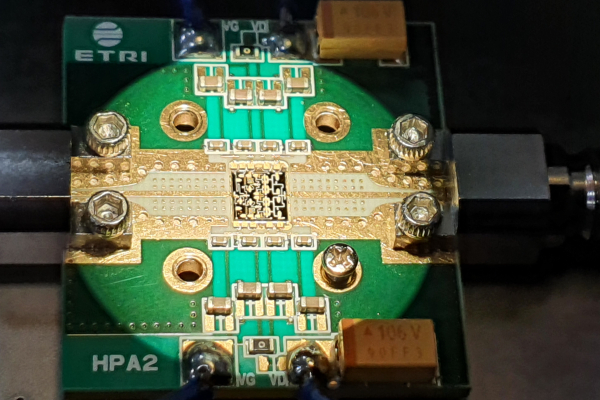
Applied to a measuring jig [Photo = ETRI]
The AESA (Active Electronically Scanned Array) radar, which is installed on the latest fighter jets, can quickly and accurately detect the distance, location, and shape of a target thanks to thousands of transmitting and receiving modules attached to the front of the radar.
The transmit/receive module integrates switches, power amplifiers (PAs), and low-noise amplifiers (LNAs). Last year, the research team developed switch MMIC technology for transmitters and receivers, and this year, they successfully developed PA MMIC technology for X-band (8-12 GHz) and Ku-band (12-18 GHz) radar transmitters and receivers.
PA is a device that amplifies the transmission signal to enable smooth signal processing and target detection and tracking. As radars are changing from vacuum tube amplifier (TWTA) type to semiconductor PA (SSPA) type, PA MMIC has emerged as an essential technology for domestic production of semiconductor PA.
This development is expected to contribute to the development of the domestic defense industry by enabling the domestic production and performance improvement of AESA radar and seeker in preparation for export restrictions on military semiconductors.
The X-band PA can deliver 25W of output power, a bandwidth of 2GHz, and a maximum efficiency of 40%, while the Ku-band PA can deliver 20W of output power, a bandwidth of 2GHz, and a maximum efficiency of 30%. By using GaN GaAs (gallium arsenide), which is suitable for high-power PA components, it secures an output power that is more than 10 times higher than conventional GaAs materials and excellent signal conversion efficiency. Since the signal can be amplified significantly with fewer components, it enables not only a lighter radar but also more accurate target detection.
The PA chip developed by the research team has similar performance to commercial products in the US and Europe, but is smaller, making it advantageous for commercialization. The X-band chip volume is 3.5×3.6×0.1mm, which is 60% of the European product. The Ku-band chip size is 3.1×3.6×0.1mm, which is approximately 23% smaller than the US product.
“For the first time in Korea, we have secured high-power PA and switch MMIC technology with our own design and process technology,” said Lim Jong-won, a senior researcher at ETRI and head of the DMC Convergence Research Group. “This technology will help expand our country’s defense technology and respond to small, medium, and large-scale issues.”
In the future, the DMC Convergence Research Group plans to transfer technology to related industries and support commercialization, while also conducting reliability tests to meet military component performance requirements. In addition, by 2022, we plan to conduct follow-up research on a single-chip MMIC for transmitting and receiving that integrates switches, PAs, and LNA MMICs for C-/X-/Ku-bands into a single chip based on this technology.
Comments
Related news
Successful domestic production of GaN transceiver switch for AESA radar
The DMC Convergence Research Group has domestically developed for the first time GaN switch integrated circuit technology for radar semiconductor transceivers applicable in the C-band and X-band. The GaN switch developed by the research team measures 1.3×1.55×0.1mm in size, offering a volume 450 times smaller than the circulator of conventional commercial products, and weighing at least 10% less.
2020.11.25by 이수민 기자

Continental Unveils Two Long-Range Radars to Accelerate Autonomous Driving
Continental announced that it will showcase a sixth-generation long-range radar and surround radar at the Shanghai Motor Show in China. The two radars share software and hardware platforms, reducing complexity and associated costs. They also reduce the testing and development work required of customers. Performance has been improved compared to the fifth-generation radar.
2021.04.17by 명세환 기자

ETRI-RFHIC to Localize GaN MMICs for Military Radars
ETRI announced that it is launching a collaborative project to support RFHIC, the only domestic manufacturer producing gallium nitride material-based products, in mass production of gallium nitride MMIC for radar applications, with support from the Ministry of Trade, Industry and Energy and the Ministry of Defense. The two organizations held a joint research laboratory plaque ceremony on the 22nd and signed a memorandum of understanding on business cooperation.
2021.07.22by 이수민 기자

Intel Unveils Next-Generation 'Core Ultra Series 3' and vPro Platform for Enterprise PCs
Intel has officially unveiled the "Intel Core Ultra Series 3" for next-generation enterprise PCs and the latest vPro platform, addressing a wide range of demands from enterprise notebooks to high-performance workstations.
2026.03.26by 배종인 기자

ROHM Launches ESD Protection Diode Compatible with High-Speed Interfaces of 10Gbps or Higher
Semiconductor specialist ROHM has developed the 'RESDxVx series' of ESD (electrostatic discharge) protection diodes capable of responding to next-generation high-speed data communication environments exceeding 10Gbps, simultaneously enhancing both signal quality maintenance required in high-speed interfaces and IC protection performance.
2026.03.26by 배종인 기자











