



Extended fast charging through battery auto-analysis now possible. "TI MaxLife Unveiled"
 Published2013.06.03 15:01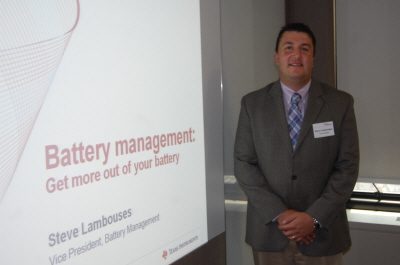
On June 3, 2013, TI Korea (Distribution Director Kent Chon) announced MaxLife (power management applying fast charging algorithms) and wireless charging technology as solutions to reduce battery degradation, presented by Steve Lambouse, who oversees the Battery Management Solution Analog Business Unit at the company headquarters, at the R&D Center in Yangjae.
On this occasion, Steve cited four key trends in current battery management:
-Faster, Cooler Charging
-More Accurate Capacity measurement
-Newer, Higher Capacity batteries
-Smaller form factors
-Wireless power
Among the various trends, the core focus of this presentation was MaxLife, a solution addressing how to reduce degradation that occurs during charging.
Battery life remains a persistent challenge for batteries, and it is one of the issues facing all current portable devices. Steve emphasized that degradation represents the largest factor reducing battery lifespan.
A system that enables rapid charging delivers high power in a short timeframe, and with such high power input in a short duration, corresponding degradation inevitably occurs. Moreover, most existing portable devices (notebooks, mobile phones, etc.) employ rechargeable batteries, and the problem is particularly severe in mobile devices that consume significant power and experience frequent on-off cycles.
MaxLife addresses this issue by reducing the degradation that occurs during rapid charging, reportedly extending battery life by approximately 30% compared to current solutions.
This is achieved through the Fuel Gauge storing battery specifications and component data, so that when degradation occurs during charging, systematic control mitigates the degradation. Even in the mobile sector alone, batteries used in various portable devices have slightly different chemical compositions depending on the manufacturer. These chemical characteristics are profiled in advance in the charger IC to accurately monitor battery status and minimize potential battery damage during fast charging. Additionally, state changes in the battery over its service life are monitored as well. These results are communicated to the Battery Charger IC, which receives recommendations for the method that best minimizes battery damage during charging, thereby extending battery lifespan.
Wireless Charging
Currently, TI is a member of WPC, PMA, and A4WP, the international wireless charging organizations, and contributes to establishing wireless charging standards. TI has distributed Qi-Compliant System WPC1.0 and WPC1.1 in cooperation with these organizations.
To facilitate the adoption of TI's wireless charging solution technology, TI provides reference designs, technical support, and hardware design training courses conducted at the U.S. headquarters for requesting engineers.
Certification: Since wireless charging must comply with international standards, TI also provides certification support for required products. Contact: ...
To date, the mobile sector is the primary field utilizing TI's solutions, with approximately 30 types of mobile devices adopted and in use in connection with U.S. Verizon and others.
TI's wireless charging solution chipset allocates significant R&D resources to support continuous evolution. The differences between current specifications and the following specifications not yet released can be easily understood through comparison.
What's Next sectors

Related news

Intel Unveils Next-Generation 'Core Ultra Series 3' and vPro Platform for Enterprise PCs
Intel has officially unveiled the "Intel Core Ultra Series 3" for next-generation enterprise PCs and the latest vPro platform, addressing a wide range of demands from enterprise notebooks to high-performance workstations.
2026.03.26by 배종인 기자
ROHM Launches ESD Protection Diode Compatible with High-Speed Interfaces of 10Gbps or Higher
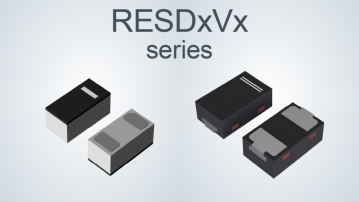
Semiconductor specialist ROHM has developed the 'RESDxVx series' of ESD (electrostatic discharge) protection diodes capable of responding to next-generation high-speed data communication environments exceeding 10Gbps, simultaneously enhancing both signal quality maintenance required in high-speed interfaces and IC protection performance.
2026.03.26by 배종인 기자
ST Launches 75V Drive IC Targeting 48V Industrial Motor Driving
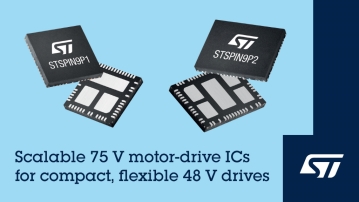
ST Microelectronics has unveiled the 'STSPIN9P' series of 75V motor drive ICs tailored for 48V-class industrial drive system design. The new product family is characterized by half-bridge and full-bridge configurations that enable design scalability according to motor type and output conditions. Power supply circuits, protection functions, and current sensing circuits are integrated on-chip to simplify system configuration, and the devices are designed to support applications up to 500W maximum. The company plans to provide reference designs and demo boards to support development and evaluation in industrial automation, robotics, pumps, fans, lighting, and textile machinery.
2026.03.26by 배종인 기자
Nordic supports security updates for the entire lifecycle of IoT devices at a single fixed cost
Nordic Semiconductor, a global leader in low-power wireless connectivity solutions, has unveiled a single fixed-cost licensing model that delivers FOTA (Firmware Over-the-Air) and device management capabilities throughout the device lifecycle via nRF Cloud, and introduced a new firmware update solution to prepare for the enforcement of the European Union's Cyber Resilience Act (CRA).
2026.03.26by 배종인 기자
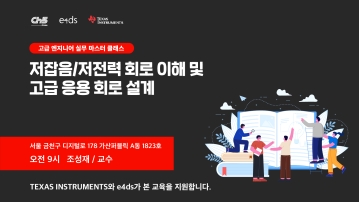
Practical Training in Low-Noise, Low-Power Circuit Design All in One Place… Training Fee Support
The "2026 Advanced Engineer Practical Masterclass" to strengthen competencies in high-sensitivity analog circuit and sensor-based system design will be held on April 16 at the e4ds Conference Center in Gasan-dong, Seoul. This program will be conducted as an offline paid hands-on training session, not online, and is targeted at engineers seeking on-site intensive learning. Texas Instruments will provide educational support for this training, allowing participation at 150,000 won, a 100,000 won discount from the original price of 250,000 won.
2026.03.26by 배종인 기자











