



Broadcom Announces Server-Class ARMv8-A Multicore Processor Architecture
 Published2013.11.04 14:12
- Optimized for next-generation networking and communication applications to achieve industry-leading performance
- 64-bit ARMv8-A core with quad-issue and quad-threading, providing ideal server-class performance with superscalar out-of-order execution capabilities
- Goal to establish and develop an ISA-independent open NFV software environment through a partnership with ARM
October 29, 2013 – Broadcom, a global wired and wireless semiconductor company, today announced the architecture for its next-generation multicore processor line featuring the industry's highest-performing 64-bit ARM cores. Using a license for the ARMv8-A architecture, Broadcom is developing new CPU cores that provide true server-class performance for networking, big data, communications, storage, and security applications, as well as for top-tier virtual accelerators and Network Function Virtualization (NFV) implementations.
Due to the exponential increase in global network traffic stemming from device-to-device connectivity and cloud services, service providers are adopting cloud-based networks that support increasingly fluid services and tasks. Broadcom plans to introduce a new line of processors to meet these next-generation virtualization trends. This new line of processors provides superior computational performance for control and data plane processing and is optimized to deliver the maximum throughput required by networking functions such as security and packet processing.
Ron Jankov, Senior Vice President of Processors and Wireless Infrastructure at Broadcom, stated, “Broadcom will maintain its position as a leader in multicore processing, which it has held for generations, through the design of industry-leading ARM-based multicore processors,” adding, “Broadcom’s innovations in CPU cores and comprehensive virtualization, along with the introduction of 16-nm FINFET technology, will further differentiate Broadcom from its competitors.”
Furthermore, Broadcom is collaborating with ARM to establish and develop an open standards-based NFV software environment for the ARM ecosystem. As members of the Linaro Networking Group and the European Telecommunications Standards Institute (ETSI), as well as leading service providers, Broadcom and ARM are working together to standardize programming models, toolchains, application programming interfaces, and detailed networking libraries for the NFV environment. Equipment manufacturers designing NFV solutions to meet next-generation carrier-grade requirements are expected to reap significant benefits, as enabling the software environment to be easily moved across various platforms and instruction sets improves code portability and reduces development time.
Tom Cronk, Senior Vice President of ARM’s Processor Business Unit, stated, “ARM and Broadcom have consistently maintained a close relationship,” adding, “ARM is very pleased that Broadcom has actively leveraged ARMv8-A designs to introduce high-performance processing solutions to the telecommunications market. Broadcom is actively cooperating to help ARM build an open standards-based NFV software environment.” “In today’s world, where everything is connected and requires vast amounts of data, this environment enables the development of intelligent and highly efficient technologies needed by businesses and consumers,” he stated.
Broadcom customers can easily migrate existing products based on the market-leading XLP II multi-core processors to the new ARMv8-A processor architecture without new software investment through an interoperable open software environment. The XLP980, the latest model in the XLP II family, delivers top-tier performance, including 160 Gbps of information throughput, comprehensive end-to-end virtualization of the CPU, accelerators, and I/O, and secure acceleration capabilities of up to 100 Gbps.
Linley Gwennap, Senior Analyst at Linley Group, stated, “As network bandwidth continues to increase and various services are launched, network managers are seeking to improve the efficiency and scalability of their networks through virtualization capabilities.” He added, “Broadcom’s design, featuring out-of-order instruction processing, quad-threading, and quad-issue, enables a new level of performance through the ARM architecture, giving it a competitive edge over other multi-core manufacturers. We expect this design, derived from 16-nm process and design innovations, to deliver top-tier performance in both single and multi-threaded workloads.”

관련뉴스

Intel Unveils Next-Generation 'Core Ultra Series 3' and vPro Platform for Enterprise PCs
인텔이 차세대 기업용 PC를 위한 ‘인텔 코어 Ultra 시리즈 3’와 최신 vPro 플랫폼을 공식 발표하며, 기업용 노트북부터 고성능 워크스테이션까지 폭넓은 수요 충족에 나섰다.
2026.03.26by 배종인 기자

ROHM Launches ESD Protection Diode Compatible with High-Speed Interfaces of 10Gbps or Higher
반도체 전문 기업 로옴(ROHM)이 10Gbps를 넘어서는 차세대 고속 데이터 통신 환경에 대응할 수 있는 ESD(정전기 방전) 보호 다이오드 ‘RESDxVx 시리즈’를 개발하며, 고속 인터페이스에서 요구되는 신호 품질 유지와 IC 보호 성능을 동시에 끌어올렸다.
2026.03.26by 배종인 기자
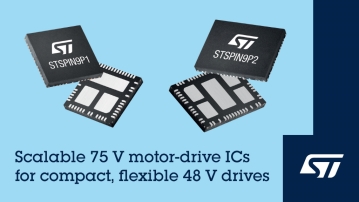
ST Launches 75V Drive IC Targeting 48V Industrial Motor Driving
ST마이크로일렉트로닉스가 48V급 산업용 구동 시스템 설계에 맞춘 75V 모터 드라이브 IC ‘STSPIN9P’ 시리즈를 공개했다. 새 제품군은 하프 브리지와 풀 브리지 구조로 구성돼 모터 종류와 출력 조건에 따라 설계를 확장할 수 있도록 한 것이 특징이다. 전원 회로와 보호 기능, 전류 감지 회로를 칩에 통합해 시스템 구성을 단순화했으며, 최대 500W급 애플리케이션까지 대응하도록 설계됐다. 회사는 레퍼런스 디자인과 데모 보드도 함께 제공해 산업 자동화, 로보틱스, 펌프, 팬, 조명, 섬유 기계 등에서 개발과 평가를 지원할 계획이다.
2026.03.26by 배종인 기자

Nordic supports security updates for the entire lifecycle of IoT devices at a single fixed cost
Nordic Semiconductor, a global leader in low-power wireless connectivity solutions, has unveiled a single fixed-cost licensing model that delivers FOTA (Firmware Over-the-Air) and device management capabilities throughout the device lifecycle via nRF Cloud, and introduced a new firmware update solution to prepare for the enforcement of the European Union's Cyber Resilience Act (CRA).
2026.03.26by 배종인 기자
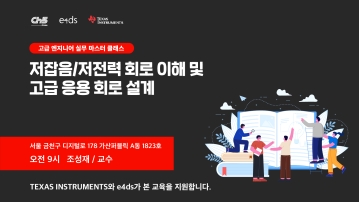
Practical Training in Low-Noise, Low-Power Circuit Design All in One Place… Training Fee Support
고감도 아날로그 회로와 센서 기반 시스템 설계 역량을 강화할 수 있는 ‘2026 고급 엔지니어 실무 마스터 클래스’가 오는 4월16일 서울 가산동 e4ds 컨퍼런스 센터에서 열린다. 이번 과정은 온라인이 아닌 오프라인 유료 실습 교육으로 진행되며, 현장 중심의 심화 학습을 원하는 엔지니어를 대상으로 한다. 이번 교육은 텍사스 인스트루먼트(Texas Instruments)가 교육비를 지원해 정가 25만원에서 10만원 할인 된 15만원에 참가할 수 있다.
2026.03.26by 배종인 기자











