


Altera Provides Quad-Core 64-Bit ARM Cortex-A53 with Stratix 10 SoC
 Published2013.11.04 14:24
Hong Kong, October 30, 2013 — Altera (NASDAQ: ALTR) announced that it is providing a high-performance quad-core 64-bit ARM Cortex™-A53 processor system with its Stratix 10 SoC device, manufactured using Intel's 14nm Tri-Gate process. This complements the device's floating-point digital signal processing (DSP) blocks with a high-performance FPGA fabric. Combined with Altera's advanced system-level design tools, including OpenCL, this versatile heterogeneous computing platform delivers excellent adaptability, performance, power efficiency, and design productivity for a wide range of applications, such as data center computing acceleration, radar systems, and communications infrastructure.
The ARM Cortex-A53 processor is the first 64-bit processor used in SoC FPGAs and is an ideal solution for the Stratix 10 SoC by providing outstanding performance, power efficiency, data throughput, and enhanced features. The Cortex-A53 is among the most power-efficient of ARM's application-class processors and is expected to achieve more than six times the data throughput compared to today's highest-performance SoC FPGAs when delivered using the 14nm Tri-Gate process. The Cortex-A53 also provides important features such as virtualization support, 256TB of memory capacity, and error correction code (ECC) for L1 and L2 caches. In addition, the Cortex-A53 core can run in 32-bit mode, allowing it to run without changing the Cortex-A9 operating system and code, thus providing a seamless upgrade path from Altera's 28nm and 20nm SoC FPGAs.
Tom Cronk, Executive Vice President and General Manager of Processors at ARM, said, “We are pleased that Altera has adopted our ultra-low-power 64-bit architecture as the ideal solution for building cutting-edge heterogeneous computing platforms that complement DSP and FPGA processing. The Cortex-A53 processor delivers the industry’s most advanced power efficiency and outstanding performance levels, enabling it to leverage the ARM ecosystem and its innovative software community.”
The Altera Stratix 10 SoC, adopting Intel's 14nm Tri-Gate process and an enhanced high-performance architecture, provides programmable logic performance of over 1GHz, thereby delivering twice the performance of current high-end 28nm FPGA cores.
Linley Gwennap, Senior Analyst at The Linley Group, an embedded market research firm, said, “High-end networking and communications infrastructure is rapidly shifting to heterogeneous computing architectures to achieve maximum system performance and power efficiency. With the Stratix 10 SoC, Altera stands at the cutting edge of the industry in both silicon convergence and support for high-level design tools, providing a heterogeneous computing platform and positioning itself optimally to realize countless possibilities.”
Altera enables software compatibility and allows the use of a common ARM ecosystem for tool and operating system support by unifying its portfolio across three generations of SoCs with ARM processors. Embedded developers can reduce debugging time by using Altera’s SoC Embedded Design Suite (EDS), which includes the ARM Development Studio 5 (DS-5™) Altera® Edition toolkit, the industry’s only FPGA adaptive debug tool, and also implement heterogeneous systems using the OpenCL high-level design language by using Altera’s Software Development Kit (SDK) for OpenCL.
Danny Biran, Senior Vice President of Business Strategy and Marketing at Altera, said, “By using the Stratix 10 SoC, designers can utilize a powerful, versatile heterogeneous computing platform, enabling them to innovate products and further accelerate time-to-market. Silicon convergence will continue to be the most suitable solution for enabling complex, high-performance applications.”

관련뉴스

Intel Unveils Next-Generation 'Core Ultra Series 3' and vPro Platform for Enterprise PCs
Intel has officially unveiled the "Intel Core Ultra Series 3" for next-generation enterprise PCs and the latest vPro platform, addressing a wide range of demands from enterprise notebooks to high-performance workstations.
2026.03.26by 배종인 기자

ROHM Launches ESD Protection Diode Compatible with High-Speed Interfaces of 10Gbps or Higher
Semiconductor specialist ROHM has developed the 'RESDxVx series' of ESD (electrostatic discharge) protection diodes capable of responding to next-generation high-speed data communication environments exceeding 10Gbps, simultaneously enhancing both signal quality maintenance required in high-speed interfaces and IC protection performance.
2026.03.26by 배종인 기자
ST Launches 75V Drive IC Targeting 48V Industrial Motor Driving
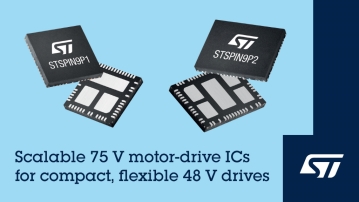
ST Microelectronics has unveiled the 'STSPIN9P' series of 75V motor drive ICs tailored for 48V-class industrial drive system design. The new product family is characterized by half-bridge and full-bridge configurations that enable design scalability according to motor type and output conditions. Power supply circuits, protection functions, and current sensing circuits are integrated on-chip to simplify system configuration, and the devices are designed to support applications up to 500W maximum. The company plans to provide reference designs and demo boards to support development and evaluation in industrial automation, robotics, pumps, fans, lighting, and textile machinery.
2026.03.26by 배종인 기자

Nordic supports security updates for the entire lifecycle of IoT devices at a single fixed cost
Nordic Semiconductor, a global leader in low-power wireless connectivity solutions, has unveiled a single fixed-cost licensing model that delivers FOTA (Firmware Over-the-Air) and device management capabilities throughout the device lifecycle via nRF Cloud, and introduced a new firmware update solution to prepare for the enforcement of the European Union's Cyber Resilience Act (CRA).
2026.03.26by 배종인 기자

Practical Training in Low-Noise, Low-Power Circuit Design All in One Place… Training Fee Support
The "2026 Advanced Engineer Practical Masterclass" to strengthen competencies in high-sensitivity analog circuit and sensor-based system design will be held on April 16 at the e4ds Conference Center in Gasan-dong, Seoul. This program will be conducted as an offline paid hands-on training session, not online, and is targeted at engineers seeking on-site intensive learning. Texas Instruments will provide educational support for this training, allowing participation at 150,000 won, a 100,000 won discount from the original price of 250,000 won.
2026.03.26by 배종인 기자











