


TI Launches Revolutionary New Floating Switch Architecture for Offline LED Design
 Published2013.11.13 14:09
TI Korea (CEO Kent Chon, www.ti.com/ww/kr) November 8, 2013 – TI (CEO Kent Chon) announced that it is providing the industry's first floating switch architecture that simplifies LED offline linear drive for lamps, downlights, and fixtures. The AC conversion matrix technique, a key feature of TI's TPS92411 floating MOSFET switch, is an innovative technique that generates low-ripple LED drive current without magnetic components. This architecture demonstrates excellent compatibility with conventional wall dimmers and achieves high power factor and low total harmonic distortion (THD). (For more detailed product information and information on ordering samples and evaluation modules, refer to http://www.ti.com/tps92411-pr-kr)
Flyback, buck, and boost converters are SMPS (switch-mode power supply) topologies commonly used in today's LED lamps. These circuits operate at high frequency and require inductive components to convert the main AC current to the DC constant current necessary for LED driving. The task of selecting inductors and transformers for power transfer is very complex and in most cases involves expensive custom components. Furthermore, to prevent the SMPS circuit from interfering with other electronic equipment, an EMI (electromagnetic interference) filter consisting of 4 to 10 passive components is required. Additionally, when phase dimming is required, the design may need to be iterated multiple times to optimize dimmer compatibility and prevent LED flicker.
The floating switch architecture provided by TI's TPS92411 solves these problems. Since inductive components for power transfer are not required, cost and size can be reduced while simplifying the design. (View related video)
The TPS92411 is a new product being added to TI's diverse LED driver product portfolio, which includes the TPS92075, LM3447, and LM3445.

Related news

Intel Unveils Next-Generation 'Core Ultra Series 3' and vPro Platform for Enterprise PCs
Intel has officially unveiled the "Intel Core Ultra Series 3" for next-generation enterprise PCs and the latest vPro platform, addressing a wide range of demands from enterprise notebooks to high-performance workstations.
2026.03.26by 배종인 기자

ROHM Launches ESD Protection Diode Compatible with High-Speed Interfaces of 10Gbps or Higher
Semiconductor specialist ROHM has developed the 'RESDxVx series' of ESD (electrostatic discharge) protection diodes capable of responding to next-generation high-speed data communication environments exceeding 10Gbps, simultaneously enhancing both signal quality maintenance required in high-speed interfaces and IC protection performance.
2026.03.26by 배종인 기자
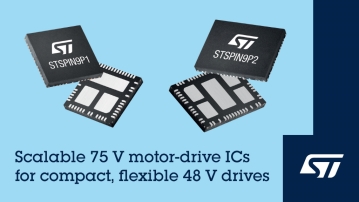
ST Launches 75V Drive IC Targeting 48V Industrial Motor Driving
ST Microelectronics has unveiled the 'STSPIN9P' series of 75V motor drive ICs tailored for 48V-class industrial drive system design. The new product family is characterized by half-bridge and full-bridge configurations that enable design scalability according to motor type and output conditions. Power supply circuits, protection functions, and current sensing circuits are integrated on-chip to simplify system configuration, and the devices are designed to support applications up to 500W maximum. The company plans to provide reference designs and demo boards to support development and evaluation in industrial automation, robotics, pumps, fans, lighting, and textile machinery.
2026.03.26by 배종인 기자

Nordic supports security updates for the entire lifecycle of IoT devices at a single fixed cost
Nordic Semiconductor, a global leader in low-power wireless connectivity solutions, has unveiled a single fixed-cost licensing model that delivers FOTA (Firmware Over-the-Air) and device management capabilities throughout the device lifecycle via nRF Cloud, and introduced a new firmware update solution to prepare for the enforcement of the European Union's Cyber Resilience Act (CRA).
2026.03.26by 배종인 기자

Practical Training in Low-Noise, Low-Power Circuit Design All in One Place… Training Fee Support
The "2026 Advanced Engineer Practical Masterclass" to strengthen competencies in high-sensitivity analog circuit and sensor-based system design will be held on April 16 at the e4ds Conference Center in Gasan-dong, Seoul. This program will be conducted as an offline paid hands-on training session, not online, and is targeted at engineers seeking on-site intensive learning. Texas Instruments will provide educational support for this training, allowing participation at 150,000 won, a 100,000 won discount from the original price of 250,000 won.
2026.03.26by 배종인 기자











