


Intel Unveils Max Series for HPC and AI
 Published2022.11.11 08:45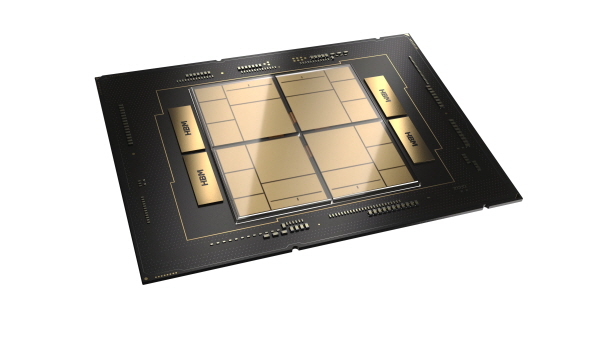
Latest 2023 oneAPI·AI tools provided, advanced features implemented
Intel has announced the Intel Max Series family of products for supercomputing (HPC) and AI workloads, featuring over 100 billion transistors in a 47-tile package with 128GB of high-bandwidth memory to provide up to 4.8 times better performance than competing products, and is expected to play a key role in solving difficult problems in science and society.
Intel unveiled new Intel® MAX Series products on the 10th, including the Intel® Xeon® CPU MAX Series (codename Sapphire Rapids HBM) for supercomputing (HPC) and artificial intelligence (AI) workloads and the Intel® Data Center GPU MAX Series (codename Ponte Vecchio).
In addition, Intel announced that its new products will be installed on the Aurora supercomputer at the U.S. Argonne National Laboratory.
Intel® Xeon® CPU Max Series products are the first and only x86-based processors with high-bandwidth memory that can quickly handle many supercomputing workloads without changing code.
The Intel® Data Center GPU Max Series is the most densely integrated processor among Intel products, featuring over 100 billion transistors in a 47-tile package with up to 128GB of high-bandwidth memory.
In addition, the oneAPI open software ecosystemThe system provides a single programming environment for new processors.
Intel plans to provide the latest 2023 oneAPI and AI tools to enable advanced features of the new Intel Max Series products.
Jeff McVeigh, Executive Vice President and General Manager of Intel’s Supercomputing Group, said, “To handle all supercomputing workloads, solutions are needed that can maximize bandwidth, computing power, developer productivity, and ultimately, impact. The Intel® Max Series family of products, along with oneAPI, will provide high-bandwidth memory to a wider market, enabling easy code sharing between CPUs and GPUs and helping to solve global challenges faster.”
Meanwhile, Intel® Xeon® CPU Max provides up to 56 performance cores composed of four tiles connected using Intel’s Embedded Multi-Die Interconnect Bridge (EMIB) technology, with a 350W envelope.
It also includes 64GB high-bandwidth in-package memory, PCIe 5.0, and CXL 1.1 I/O.
In addition, it provides high-bandwidth memory capacity of over 1GB per core and is suitable for most common supercomputing workloads. When processing actual supercomputing workloads, Intel® Xeon® CPU Max provides up to 4.8 times better performance than competitors.
It provides the same HPCG performance with 68% lower power consumption compared to AMD Milan-X cluster products, significantly improves AI performance with AMX extensions, and offers 8 times higher throughput compared to AVX-512 for INT8 which accumulates with INT32.
It provides flexibility to operate in various high-bandwidth memory (HBM) and DDR memory configurations.
Looking at workload benchmarks, it provides 2.4 times faster speeds in MPAS-A workloads utilizing only high-bandwidth memory compared to AMD Milan-X in climate modeling, and 2.8 times higher performance in DeePMD workloads compared to competitor products using DDR memory in molecular dynamics.
Intel® Max Series GPUs provide up to 128 Xe-HPC cores based on a new architecture for the most demanding computing workloads.
It supports industry-leading 408MB L2 cache and 64MB L1 cache to increase performance and throughput, and is designed to speed up scientific visualization and animation as the only HPC/AI GPU with native ray tracing acceleration.
Looking at the workload benchmarks, in finance, it provided 2.4x improved performance compared to the NVIDIA A100 in Riskfuel credit option pricing, and in physics, it provided 1.5x improved performance compared to the A100 in NerkRS virtual reactor simulation.
Intel® Max Series GPUs will be available in various form factors to meet diverse customer requirements.

Comments
Related news
Intel Accelerates Open Ecosystem for Developers
Amid fierce competition in the IT industry, Intel demonstrated its willingness to energize the developer community through an open platform and provide solutions tailored to developers.
2022.09.29by 명세환 기자

Intel, 13th Gen Intel CPU 'Overwhelming Performance'... Launching on October 20
Intel showcased its 13th generation Core processor lineup, equipped with the highest speeds to date, demonstrating remarkable advancements in gaming performance and creator workflow performance, asserting overwhelming performance superiority in the high-performance CPU market.
2022.10.05by 배종인 기자
Intel Announces Next-Generation Thunderbolt Products
Intel has unveiled a next-generation Thunderbolt prototype aligned with the USB4 v2 specification, delivering the ultimate display experience for content creators and gamers.
2022.10.21by 배종인 기자

Intel Unveils Next-Generation 'Core Ultra Series 3' and vPro Platform for Enterprise PCs
Intel has officially unveiled the "Intel Core Ultra Series 3" for next-generation enterprise PCs and the latest vPro platform, addressing a wide range of demands from enterprise notebooks to high-performance workstations.
2026.03.26by 배종인 기자

ROHM Launches ESD Protection Diode Compatible with High-Speed Interfaces of 10Gbps or Higher
Semiconductor specialist ROHM has developed the 'RESDxVx series' of ESD (electrostatic discharge) protection diodes capable of responding to next-generation high-speed data communication environments exceeding 10Gbps, simultaneously enhancing both signal quality maintenance required in high-speed interfaces and IC protection performance.
2026.03.26by 배종인 기자











