


Development of an Optimal Hydrogen Compressor for Urban Hydrogen Charging
 Published2022.11.17 16:39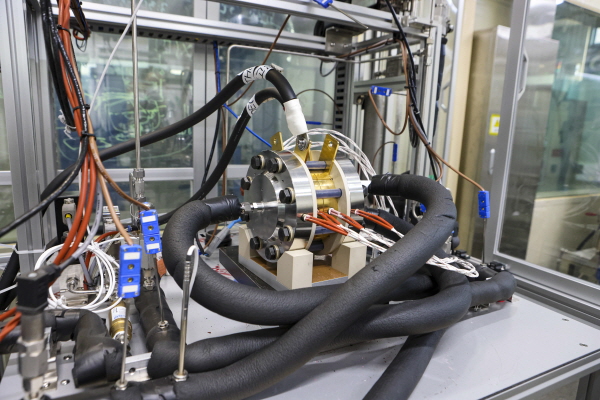
▲Hydrogen compressor using electrochemical reaction developed by the Korea Institute of Machinery and Materials
A compressor that uses electrochemical reactions to compress hydrogen quietly and efficiently has been developed. Suitable for urban hydrogen refueling, it is expected to expand in urban areas in the future.
The Korea Institute of Machinery and Materials (President Park Sang-jin), under the Ministry of Science and ICT, has successfully developed an electrochemical hydrogen compressor that compresses hydrogen using electrochemical reactions, through joint research with Chung-Ang University (President Park Sang-gyu). This innovative technology is expected to contribute to the revitalization of a hydrogen society.
A joint research team led by Research Director Seok-ho Yoon of the Thermal Energy Solutions Laboratory at the Carbon Neutral Machine Research Institute of the Korea Institute of Machinery and Materials, and Professors Min-seong Kim and Dong-gyu Kim of Chung-Ang University, successfully developed a hydrogen compressor by applying current to the separator used in the fuel cell to extract only hydrogen by utilizing the characteristics of fuel cells that generate electricity from hydrogen.
As hydrogen passes through the device through an electrochemical reaction, compression occurs as hydrogen accumulates at the rear end of the device. The research team designed the internal structure of the device to withstand high pressures during hydrogen compression, and maximized compression efficiency by preventing energy loss through internal surface treatment.
To store hydrogen in hydrogen vehicles, it must be compressed to 700 atmospheres. Therefore, hydrogen charging stations must be compressed to even higher pressures before supplying it. Charging hydrogen causes the pressure in the charging station's storage tank to drop, requiring a waiting period to build up the pressure. Fast and efficient hydrogen compression technology can reduce this waiting time, making it essential for building a hydrogen supply chain.
Existing mechanical compressors, utilizing various physical methods including pistons, suffer from unreliable durability and low efficiency. Furthermore, the compression process can contaminate the hydrogen, as lubricants used in the process can mix with it, and generate significant noise, necessitating improvement.
Conversely, electrochemical compressors, which simultaneously perform hydrogen purification and compression, can extract 99.99% hydrogen without contamination and compress it to high pressure. Furthermore, the compressors can be scaled to extract and compress hydrogen at any desired volume.
This compressor's compact size allows it to be used even in confined spaces. Recent attempts to install hydrogen charging stations alongside LPG charging stations have been hampered by the size limitations of high-pressure compressors. The use of electrochemical compressors is expected to alleviate this space constraint.
In addition to spatial advantages, it also offers quietness, making it very advantageous for installing hydrogen charging stations in urban areas. Even if it is not a hydrogen charging station, a small-scale compression system can be built anywhere hydrogen compression is needed, and it can also be applied to urban zero-energy houses that have recently been attracting attention.
Seok-ho Yoon, head of the Thermal Energy Solutions Lab at the Korea Institute of Machinery and Materials, said, “The electrochemical hydrogen compressor has the great advantage of being more space-efficient and quieter than existing mechanical compressors,” and added, “We will improve the performance of the compressor so that the technology can be commercialized, contributing to the revitalization of a hydrogen society beyond the spread of hydrogen charging stations in urban areas.”
Meanwhile, this research was conducted with the support of the Ministry of Trade, Industry and Energy's Alchemist Project, 'Development of a chemical absorption heat pump using an electrochemical compressor.'

관련뉴스
A robotic hand with an elephant trunk that can even grasp micro-needles.
An elephant trunk-inspired gripper robot has been developed that can grasp everything from very thin objects like acupuncture needles to large objects like boxes, and is expected to be applicable to various fields including effective material handling.
2022.10.21by 배종인 기자
KIMM Develops Self-Repairing Valve for Damaged Pipes
A smart valve that automatically repairs damaged piping in the event of accidents has been developed for the first time in Korea, and it is drawing expectations that it will quickly restore damaged piping within the golden time window during future piping failure incidents, thereby preventing major accidents.
2022.10.28by 배종인 기자
.jpg)
KIMM Develops Underwater Cutting Simulator for Reactor Decommissioning
A remote virtual simulator for worker training in underwater laser and plasma cutting of reactor internal structures (RVI) required for nuclear power plant decommissioning has been developed for the first time in Korea.
2022.11.11by 배종인 기자
A single misaligned light means 'defect'… Vehicle interior lighting now guarded by semiconductors and software
Automotive interior lighting is moving beyond its role as 'auxiliary lighting.' As it becomes a core element of user experience (UX) that expresses brand identity through color and animation while reflecting driver preferences, the LED interior ambient lighting market is growing rapidly. In connection with this, we met in advance with Choi Young-jae, Research Director at Dabo Corporation, who will present a technical webinar session on "Intelligent LED Interior Lighting Solutions Illuminating Future Vehicles," to hear about market trends and changes in design requirements.
2026.08.28by 명세환 기자
TI, HEV·EV 트랙션 인버터용 다축 코어리스 전류 센서 TMCS2100-Q1 공개
Texas Instruments가 HEV·EV 트랙션 인버터용 다축 코어리스 홀 효과 전류 센서 TMCS2100-Q1을 공개했다. 수평·수직 자기장을 동시에 측정하는 다축 센싱 기술로 기존 단일 축 센서 대비 최대 20배 높은 정확도를 달성하며, 버스바 무개조 설계로 기계 설계 유연성을 확보했다. 800V 아키텍처 확산에 따른 고정확도 요구 충족과 소형화를 동시에 구현한다.
2026.08.27by 배종인 기자











