


Samsung Electronics Secures Stable Industrial Water Supply Through Wastewater Reuse
 Published2022.11.30 10:55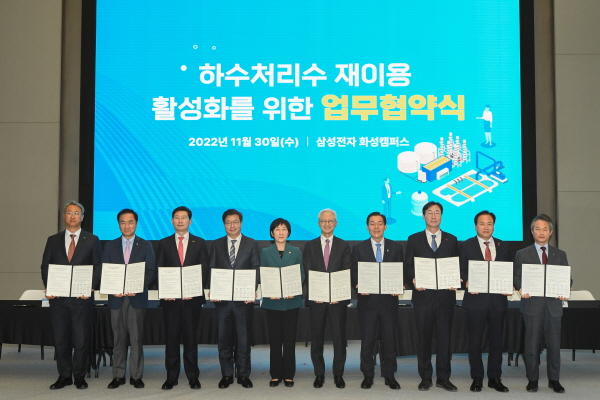
Samsung Electronics will stably secure industrial water through the reuse of effluent from public wastewater treatment plants.
On the 30th, Samsung Electronics signed a business agreement with the Ministry of Environment, Gyeonggi Province and five cities (Suwon, Yongin, Hwaseong, Pyeongtaek, and Osan), Korea Water Resources Corporation, and Korea Environment Institute to activate wastewater reuse.
The signing ceremony was held at Samsung Electronics' semiconductor Hwaseong campus with attendance by Environment Minister Han Hwa-jin, Gyeonggi Province Vice Governor for Economy Yeom Tae-young, Suwon Mayor Lee Jae-jun, Yongin Mayor Lee Sang-il, Hwaseong Mayor Jeong Myeong-geun, Pyeongtaek Mayor Jeong Jang-seon, Osan Mayor Lee Gwon-jae, Korea Water Resources Corporation President Park Jae-hyun, Korea Environment Institute Chairman Ahn Byung-ok, and Samsung Electronics CEO and President Kyung Kyeun-hyun.
With the expansion of semiconductor production lines, the industrial water required at Samsung Electronics' semiconductor business sites is projected to more than double by 2030 compared to current levels.
Through the 'New Environmental Management Strategy' announced last September, Samsung Electronics announced the goal of achieving 'zero growth in water intake at domestic semiconductor business sites by 2030,' and has been reviewing various measures to stably secure industrial water without increasing water intake.
In accordance with this agreement, effluent from public wastewater treatment plants in Suwon, Yongin, Hwaseong, and Osan will be treated to the level of industrial water required at semiconductor business sites and will be supplied to Samsung Electronics' Giheung, Hwaseong, and Pyeongtaek business sites.
The effluent supplied to each business site will be processed into ultra-pure water through additional processes and is scheduled to be used in semiconductor manufacturing.
Through this agreement, the volume of water Samsung Electronics can be supplied is expected to reach approximately 474,000 tons per day and 173 million tons annually.
By expanding semiconductor production lines while reusing effluent from public wastewater treatment plants without additionally withdrawing industrial water from nature, it is expected to contribute to addressing the nation's water shortage problem.
Additionally, Samsung Electronics semiconductor will continue to pursue various efforts including optimization of water usage through replacement of aging equipment, improvement of manufacturing processes, and development of new technologies, as well as diverse initiatives to reduce water intake to suppress growth in water withdrawal.
Kyung Kyeun-hyun, CEO and Representative of Samsung Electronics' DS Division, stated, "Using reclaimed wastewater in the semiconductor industry, which requires ultra-pure water, represents a significant paradigm shift," and added, "We will develop innovative water reuse technologies and work together with the government and local governments to conserve water resources."

Related news
Full-scale domestic production of ultra-pure semiconductor water
The government will invest 48 billion won by 2025 to accelerate the full-scale localization of ultra-pure water for semiconductors, a key technology currently monopolized by the United States, France, and Japan.
2021.07.30by 배종인 기자
Fast pace toward ultra-pure water localization
Water is essential in semiconductor manufacturing processes and is used in excess of 20 million tons annually by major domestic semiconductor factories alone. However, the domestic industry faces high overseas dependency in ultra-pure water, which is high-purity industrial water, and the necessity for localization has been consistently raised.
2022.09.21by 명세환 기자
Vertiv Leads the Way in Achieving Net Zero in Data Centers
Vertiv, a leading provider of critical digital infrastructure and continuity solutions, has launched a comprehensive initiative to support the data center industry in reducing carbon emissions and water consumption.
2022.11.07by 배종인 기자
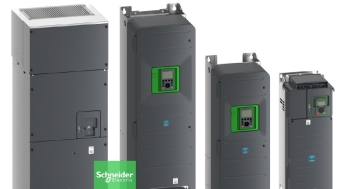
Schneider Aims for Building Energy Savings and Operational Stability with Next-Generation HVAC Drives
Schneider Electric has unveiled its next-generation HVAC drive product line 'Altivar HVAC'. The new product line's key features center on enhanced energy savings, system operational stability, and building management system integration. The products are divided into 'ATH200' for OEM and small equipment applications, and 'ATH600' for environments requiring continuous operation and advanced control. The company plans to expand the application scope from commercial buildings to facilities where HVAC system stability is critical, such as hospitals, airports, and data centers. The announcement includes over 30% energy savings, operation from -10°C to +60°C, Modbus and BACnet support, and compatibility with low global warming potential refrigerants.
2026.03.26by 명세환 기자
Ecolab Expands AI Data Center Cooling Business Through Acquisition of CoolIT
Ecolab has agreed to acquire CoolIT Systems, a liquid cooling company for AI data centers, for approximately $4.75 billion. The transaction is expected to close by Q3 2026, subject to regulatory approvals. CoolIT has been supplying direct-to-chip cooling-based coolant distribution units, cold plates, and manifolds, serving hyperscale data centers and colocation operators as customers. This acquisition is a measure to address the high-heat and high-density server environments created by AI proliferation. Ecolab plans to combine its water management and digital monitoring capabilities with CoolIT's hardware technology to expand its data center cooling business.
2026.03.26by 명세환 기자











