


Telit Partners with Parsec to Launch Industry's Smallest 'Integrated GPS Receiver and Antenna' Offering Highest Level of Sensitivity
 Published2014.01.28 11:33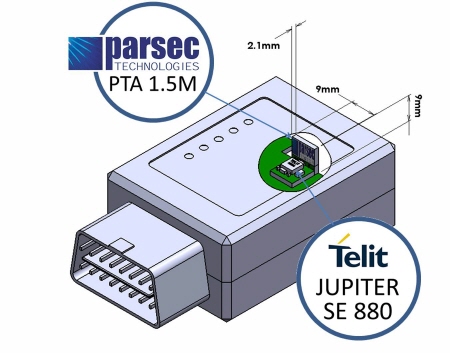
Seoul, January 27, 2014 Telit Wireless Solutions (CEO Derek Sang, www.telit.com , hereinafter Telit), a specialist in M2M (machine-to-machine) modules and consulting services, announced today that it has launched the industry's smallest ultra-compact GPS receiver and antenna package solution in collaboration with Parsec Technologies, Incorporated, a global supplier of intelligent amplifier products and services for telecommunications.
Parsec’s package solution, which integrates an antenna and the industry’s smallest GPS receiver, can be utilized in various fields, including wearable devices, devices related to usage-based insurance, and adapters for mobile computing.
The newly released GPS solution can be applied as a discrete assembly component measuring 6x16xmm for host devices requiring high symmetry, or as an ultra-thin component measuring 6x16x2.4mm when applied as a flat component. Featuring industry-leading miniaturization technology, this new product provides excellent path loss of 10dB or equivalent along the GPS signal path, guaranteeing maximum performance for devices based on traditional designs. In other words, it can maximize the performance of devices such as OBD (On-Board Diagnostics) log collection devices installed in harsh environments, such as inside a vehicle dashboard, to enable Usage-Based Insurance (UBI).
The PTA1.5M active antenna, equipped with the ultra-sensitive micro receiver 'Jupiter SE880', provides performance enhancement of more than 15dB within the operating frequency band. Through a close partnership, Parsec and Telit are collaborating to produce complete application notes that enable system integrators to implement them with minimal engineering work.
The Jupiter SE880 receiver module utilizes a 4.7x4.7mm SiRFstarIV™-based LGA package and delivers peak performance for GPS applications with standard or size constraints through heterogeneous 3D integration technology. Additionally, it supports an RF front-end featuring a waveguide-quality path with spatially scaled 3D grids within the architecture, significantly reducing parasitic impedance* associated with traditional 2D RF designs. The internal multi-filter system incorporates a 2.4 GHz notch filter alongside the SAW filters typically used in GPS receiver designs to block interference from high-power frequency devices such as Wi-Fi hotspots, Bluetooth systems, and cordless phones. This enables the reception of even faint satellite signals in environments where frequency reception is challenging. (Impedance: The ratio of voltage to current in an AC circuit)
The 15dB PTA1.5M and 30dB PTA1.5Mx2M feature the industry's smallest GNSS active antenna modules, ensuring a signal strength of -192 dBm in the 1575.42 (±1.023) MHz center frequency band, and both models provide over 60% efficiency when equipped with the Jupiter SE880 receiver. Parsec's PT1233D LNA supports the best IP3 rating in low-voltage environments to prevent radio interference. Both products can be optionally equipped with SAW filters and cascadable PT1233D LNAs, allowing for easy integration with 10x16 mm single-sided PCBAs featuring a copper-clad ground plane on the back. The height can be adjusted for various types of applications, including Intel's M.2 Next Generation Form Factor (NGFF) modules.
Michael A. Neenan, CEO and founder of Parsec Technologies, said, “The combination of the Parsec PTA/PT product family and Telit’s Jupiter SE880 ensures cost savings and design flexibility while being easy to deploy, delivering a unique user experience for products where location-based services play a critical role. In particular, the combination of industry-leading technologies provides stable RF reception performance, allowing relevant regulations to be met without additional testing prior to the final product launch.”
"Kim Ho-sang, Senior Vice President overseeing Telit's domestic sales, said, 'Miniaturization technology offers various possibilities for location information products and M2M applications. The combination of Parsec's antenna and the industry's smallest receiver can be utilized in a wide range of fields, including wearable devices, various usage-based insurance (UBI) devices, and adapters for mobile computing.'"

관련뉴스

Intel Unveils Next-Generation 'Core Ultra Series 3' and vPro Platform for Enterprise PCs
인텔이 차세대 기업용 PC를 위한 ‘인텔 코어 Ultra 시리즈 3’와 최신 vPro 플랫폼을 공식 발표하며, 기업용 노트북부터 고성능 워크스테이션까지 폭넓은 수요 충족에 나섰다.
2026.03.26by 배종인 기자

ROHM Launches ESD Protection Diode Compatible with High-Speed Interfaces of 10Gbps or Higher
반도체 전문 기업 로옴(ROHM)이 10Gbps를 넘어서는 차세대 고속 데이터 통신 환경에 대응할 수 있는 ESD(정전기 방전) 보호 다이오드 ‘RESDxVx 시리즈’를 개발하며, 고속 인터페이스에서 요구되는 신호 품질 유지와 IC 보호 성능을 동시에 끌어올렸다.
2026.03.26by 배종인 기자

ST Launches 75V Drive IC Targeting 48V Industrial Motor Driving
ST마이크로일렉트로닉스가 48V급 산업용 구동 시스템 설계에 맞춘 75V 모터 드라이브 IC ‘STSPIN9P’ 시리즈를 공개했다. 새 제품군은 하프 브리지와 풀 브리지 구조로 구성돼 모터 종류와 출력 조건에 따라 설계를 확장할 수 있도록 한 것이 특징이다. 전원 회로와 보호 기능, 전류 감지 회로를 칩에 통합해 시스템 구성을 단순화했으며, 최대 500W급 애플리케이션까지 대응하도록 설계됐다. 회사는 레퍼런스 디자인과 데모 보드도 함께 제공해 산업 자동화, 로보틱스, 펌프, 팬, 조명, 섬유 기계 등에서 개발과 평가를 지원할 계획이다.
2026.03.26by 배종인 기자

Nordic supports security updates for the entire lifecycle of IoT devices at a single fixed cost
Nordic Semiconductor, a global leader in low-power wireless connectivity solutions, has unveiled a single fixed-cost licensing model that delivers FOTA (Firmware Over-the-Air) and device management capabilities throughout the device lifecycle via nRF Cloud, and introduced a new firmware update solution to prepare for the enforcement of the European Union's Cyber Resilience Act (CRA).
2026.03.26by 배종인 기자

Practical Training in Low-Noise, Low-Power Circuit Design All in One Place… Training Fee Support
고감도 아날로그 회로와 센서 기반 시스템 설계 역량을 강화할 수 있는 ‘2026 고급 엔지니어 실무 마스터 클래스’가 오는 4월16일 서울 가산동 e4ds 컨퍼런스 센터에서 열린다. 이번 과정은 온라인이 아닌 오프라인 유료 실습 교육으로 진행되며, 현장 중심의 심화 학습을 원하는 엔지니어를 대상으로 한다. 이번 교육은 텍사스 인스트루먼트(Texas Instruments)가 교육비를 지원해 정가 25만원에서 10만원 할인 된 15만원에 참가할 수 있다.
2026.03.26by 배종인 기자











