



Intel, “Equipped with 1 Trillion Transistors in a Single Package”
 Published2022.12.05 16:29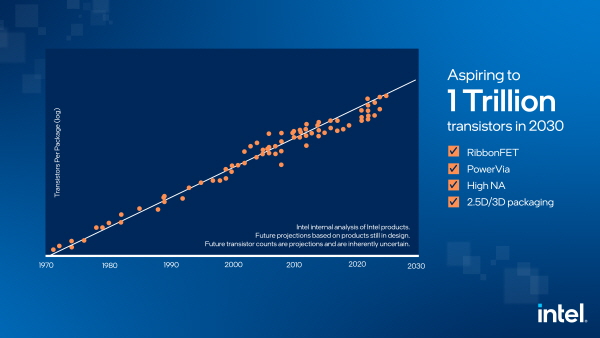
▲ Moore's Law number of transistors per device (Source: Intel)
3D packaging, new ultra-thin materials, and higher performance computing
Intel has continued innovation to sustain Moore's Law, such as setting a goal of 10 times the integration density in packaging technology and proposing the use of new ultra-thin materials three atoms thick for transistor integration.
Intel announced major research achievements to sustain Moore's Law, including packing one trillion transistors into a single package by 2030, at the International Electronics Device Manufacturers Meeting (IEDM) 2022 on the 5th.
Intel announced 3D packaging technology that will contribute to achieving 10x integration density, a new ultra-thin material three atoms thick for 2D transistors that surpass RibbonFETs, achievements in energy efficiency and memory for higher performance computing, and examples of improvements in quantum computing.
Gary Patton, Executive Vice President of Intel’s Component Research and Design Support, stated, “75 years after the invention of the transistor, the innovation driving Moore’s Law is what continues to address the world’s exponentially growing demand for computing,” adding, “At IEDM 2022, Intel presented forward-looking and specific research results necessary to break through current and future barriers, meet endless demand, and sustain Moore’s Law.” said.
Dr. Ann Kelleher, Intel’s General Manager of Technology Development and Senior Vice President, delivered a keynote speech at the IEDM General Assembly to commemorate the 75th anniversary of the invention of the transistor.
Dr. Keller presented a path for the semiconductor industry to expand the ecosystem around system-based strategies, address increasing computing demand, and innovate more effectively and sustainably at the speed of Moore's Law.
As the global surge in data consumption and advancements in artificial intelligence technology have resulted in the highest computing demand in history, Moore's Law is an essential element in meeting this demand.
Continuous innovation is the cornerstone of Moore's Law. For the past 20 years, the Intel Components Research Group has led innovations to continuously improve power, performance, and cost in personal computers, graphics processors, and data centers, including strained silicon, high-k metal gates, and FinFETs. Currently, the Intel Components Research Group is developing innovative packaging technologies such as RibbonFETs utilizing Gate-All-Around (GAA) transistors, PowerVia (backward power delivery technology), EMIB, and Foveros Direct.
Intel's component research group announced that at IEDM 2022 this year, to continue Moore's Law, it will achieve innovation in three areas: new 3D hybrid bonding packaging technology to seamlessly integrate chiplets, ultra-thin 2D materials to integrate more transistors on a single chip, and energy efficiency and memory for higher computing performance.

Comments
Related news
Intel Announces Next-Generation Thunderbolt Products
Intel has unveiled a next-generation Thunderbolt prototype aligned with the USB4 v2 specification, delivering the ultimate display experience for content creators and gamers.
2022.10.21by 배종인 기자
Intel Unveils Max Series for HPC and AI
Intel announced its Intel Max series product lineup for supercomputing (HPC) and AI workloads, featuring over 100 billion transistors in a 47-tile package with 128GB high-bandwidth memory, delivering performance improvements of up to 4.8x compared to competing products, and is garnering expectations that it will play a key role in solving difficult challenges in science and society.
2022.11.11by 배종인 기자
.jpg)
Intel Unveils Real-Time Deepfake Detection Technology
The urgent development of IT technology to prevent everyday threats caused by deepfake videos is needed. Real-time detection of deepfake videos is difficult to implement, and until now the process has involved uploading videos to detection applications for analysis and waiting several hours or more for results. It is expected that such inconveniences will be resolved.
2022.11.17by 명세환 기자

Intel Unveils Next-Generation 'Core Ultra Series 3' and vPro Platform for Enterprise PCs
Intel has officially unveiled the "Intel Core Ultra Series 3" for next-generation enterprise PCs and the latest vPro platform, addressing a wide range of demands from enterprise notebooks to high-performance workstations.
2026.03.26by 배종인 기자
ROHM Launches ESD Protection Diode Compatible with High-Speed Interfaces of 10Gbps or Higher
Semiconductor specialist ROHM has developed the 'RESDxVx series' of ESD (electrostatic discharge) protection diodes capable of responding to next-generation high-speed data communication environments exceeding 10Gbps, simultaneously enhancing both signal quality maintenance required in high-speed interfaces and IC protection performance.
2026.03.26by 배종인 기자











